
 Compono

1 min read
How to climb the ladder without losing yourself
 Compono
To climb the ladder effectively, you must align your natural work personality with the specific demands of higher-level roles rather than simply...

To climb the ladder effectively in the modern workplace, you must align your natural work personality with the specific demands of higher-level roles rather than simply working longer hours.
Success isn't about mimicking a generic leadership mould – it is about understanding how your unique traits, whether you are a Pioneer or an Auditor, can solve the specific problems your organisation faces at the next level. When you stop trying to fix your perceived 'flaws' and start leveraging your dominant work actions, the path upward becomes a natural progression rather than an exhausting uphill battle.
Key takeaways
- Climbing the ladder requires a shift from technical execution to strategic alignment with your natural work personality.
- Authentic career growth happens when you stop trying to 'fix' yourself and start doubling down on your innate strengths.
- Understanding how different personalities – like the Evaluator or the Helper – lead is the secret to sustainable promotion.
- Success at the next level depends on your ability to adapt your leadership style to the needs of your team and the situation.
We have all been told the same story about how to climb the ladder. You stay late, you say 'yes' to every project, and eventually, someone notices and hands you a promotion. But for many of us, that moment never comes, or if it does, it feels like a hollow victory. You might find yourself in a corner office feeling more misunderstood than ever, wondering why the things that made you successful in your old role are suddenly making you miserable in your new one.
The problem is that most career advice treats 'the ladder' like a single, vertical track that everyone should navigate the same way. It ignores the reality of your brain. If you are naturally a Helper who thrives on team harmony, being forced to climb a ladder that requires the blunt, results-driven focus of an Evaluator is going to lead to burnout. At Compono, we have spent over a decade researching how high-performing teams actually function, and the data shows that the most successful people aren't the ones who changed who they are – they are the ones who found a way to be more of who they already were.
If you have ever felt like you are 'too much' of something – too detailed, too quiet, or too idealistic – you aren't broken. You just haven't figured out how that specific trait is actually your greatest asset for moving up. Before you take the next step, it is worth looking at how your brain actually wants to work. You can take a quick personality read with Hey Compono to see which of the eight work personalities describes your default mode under pressure.
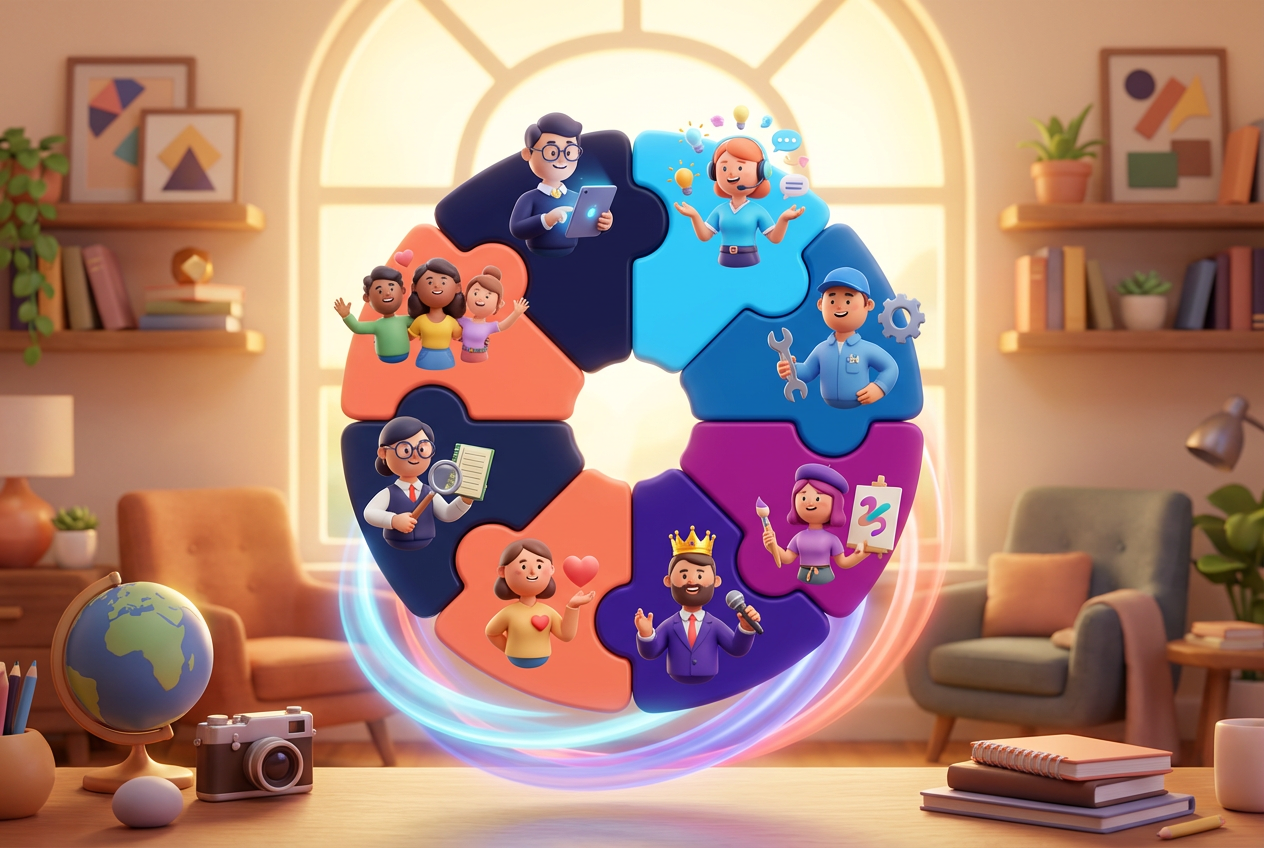
To climb the ladder without losing your mind, you need to recognise which of the eight key work activities you naturally gravitate towards. High-performing teams need a balance of all of them: Evaluating, Coordinating, Campaigning, Pioneering, Advising, Helping, and Doing. Most of us have one or two 'home' zones where we feel most energised. When you try to climb into a role that sits on the opposite side of the personality wheel, the friction can be immense.
Consider the 'Doer'. You might be incredibly reliable and practical, the person everyone goes to when they need a task finished accurately and on time. But as you climb the ladder, the expectation often shifts from 'doing' to 'campaigning' or 'strategising'. If you don't realise this shift is happening, you might find yourself micromanaging your old tasks because they feel safe, while neglecting the visionary work your new role actually requires. On the flip side, a 'Pioneer' might struggle to climb in a highly regulated, 'Auditor' heavy environment where their out-of-the-box ideas are seen as risks rather than assets.
Understanding these dynamics isn't about limiting yourself. It is about strategic awareness. When you know your blind spots – like a Campaigner overlooking details or an Evaluator being too blunt – you can build systems to manage them. Hey Compono helps professionals see these patterns clearly, allowing them to choose career moves that actually fit their internal wiring rather than just their resume.
As you move up, your leadership style becomes more important than your technical skills. But here is the catch: there is no 'best' leadership style. The most effective leaders are those who can move along the continuum from Directive to Democratic to Non-Directive leadership depending on what the situation needs. If there is a crisis, your team needs a Directive leader who can make quick, logical calls. If you are trying to innovate, they need a Non-Directive approach that gives them the autonomy to fail and learn.
Your work personality gives you a 'default' setting on this continuum. For instance, an Evaluator or a Coordinator will likely find Directive leadership easy – they love structure and clear goals. A Helper or a Campaigner will probably lean towards Democratic leadership, valuing team input and harmony. The challenge of the climb is learning how to 'flex' into the styles that don't come naturally to you. It is about being a 'Democratic' leader who can still make a 'Directive' call when the deadline is looming and the team is stuck in indecision.
This adaptability is what separates those who stall at middle management from those who reach the top. It is not about being a different person; it is about having a larger toolkit. If you are curious about how your specific type handles conflict or leadership pressure, you can check your Work Personality Summary Page to see your natural leanings and where you might need to stretch.

No one climbs the ladder alone, but most people network the wrong way. They look for people just like them – people who validate their ideas and share their frustrations. This is a mistake. To truly grow, you need to surround yourself with people who occupy the spaces on the personality wheel that you tend to avoid. If you are a big-picture Campaigner, you need an Auditor in your corner who will spot the flaws in your plan before your boss does. If you are a task-focussed Doer, you need a Pioneer who will push you to think about how your work fits into the five-year vision.
This is often where conflict happens. We tend to get annoyed by people who think differently than we do. A Coordinator might find a Pioneer scattered and unreliable, while the Pioneer finds the Coordinator rigid and boring. But in a high-performing team, that tension is where the magic happens. When you learn to value the 'annoying' traits of others as the missing pieces of your own success, your path upward clears significantly. You stop trying to be everything to everyone and start building a support system that allows you to stay in your zone of genius.
Key insights
- Career progression is a journey of self-awareness – knowing when to lead and when to listen based on your personality.
- The ladder isn't vertical for everyone; some of the most successful people find their 'climb' through lateral moves that better suit their strengths.
- Conflict at work is often just a clash of work personalities – learning to translate these differences is a superpower for any aspiring leader.
- True leadership is the ability to adapt your default style to meet the team where they are, not where you want them to be.
Climbing the ladder doesn't have to mean burning out or pretending to be someone you're not. It starts with a simple choice to understand the 'why' behind your behaviour and the 'how' of your team's dynamics. When you lead with authenticity and a deep understanding of your work personality, you don't just reach the top – you actually enjoy being there.
Ready to understand yourself better? Start with 10 minutes free – no credit card required. You can also learn more about personality-adaptive coaching and how it can help you navigate your next big career move with confidence.
You are ready when you have mastered your current technical tasks and find yourself naturally looking at the broader impact of your work. If you are starting to see how your role affects other departments or the company's long-term goals, it is a sign you are ready for a more strategic position.
Absolutely. While Campaigners often get more visibility, personalities like the Auditor or the Advisor are essential for high-level leadership. Introverted leaders often excel at Non-Directive leadership, empowering their teams to do their best work without micromanagement.
This is more common than you think. It doesn't always mean you need to quit. Often, you can 're-craft' your role by focusing more on the activities that align with your strengths or by partnering with someone who covers your gaps. Hey Compono can help you identify exactly where those misalignments are.
It depends on the ladder. In technical fields, specialising is key. However, as you move into senior leadership, being a 'specialist' in people – understanding how to motivate different personalities and manage team dynamics – becomes the most valuable skill you can have.
The first step is recognising that it isn't personal – it is a difference in work actions. If your boss is an Evaluator who wants data and you are a Pioneer who wants to talk about vision, try bringing data to support your vision. Meeting them in their 'home' zone builds trust and makes your climb much smoother.

1 min read
To climb the ladder effectively, you must align your natural work personality with the specific demands of higher-level roles rather than simply...

1 min read
To leverage strengths effectively, you must first identify your dominant work personality and then intentionally align your daily tasks with the...

1 min read
You get advice that actually works by filtering it through the lens of your specific work personality rather than following generic,...