
 Compono
1 min read
What does AI coaching look like for team leads
 Compono
What does AI coaching look like for team leads? It looks like having an experienced organisational psychologist in your pocket, ready to offer...
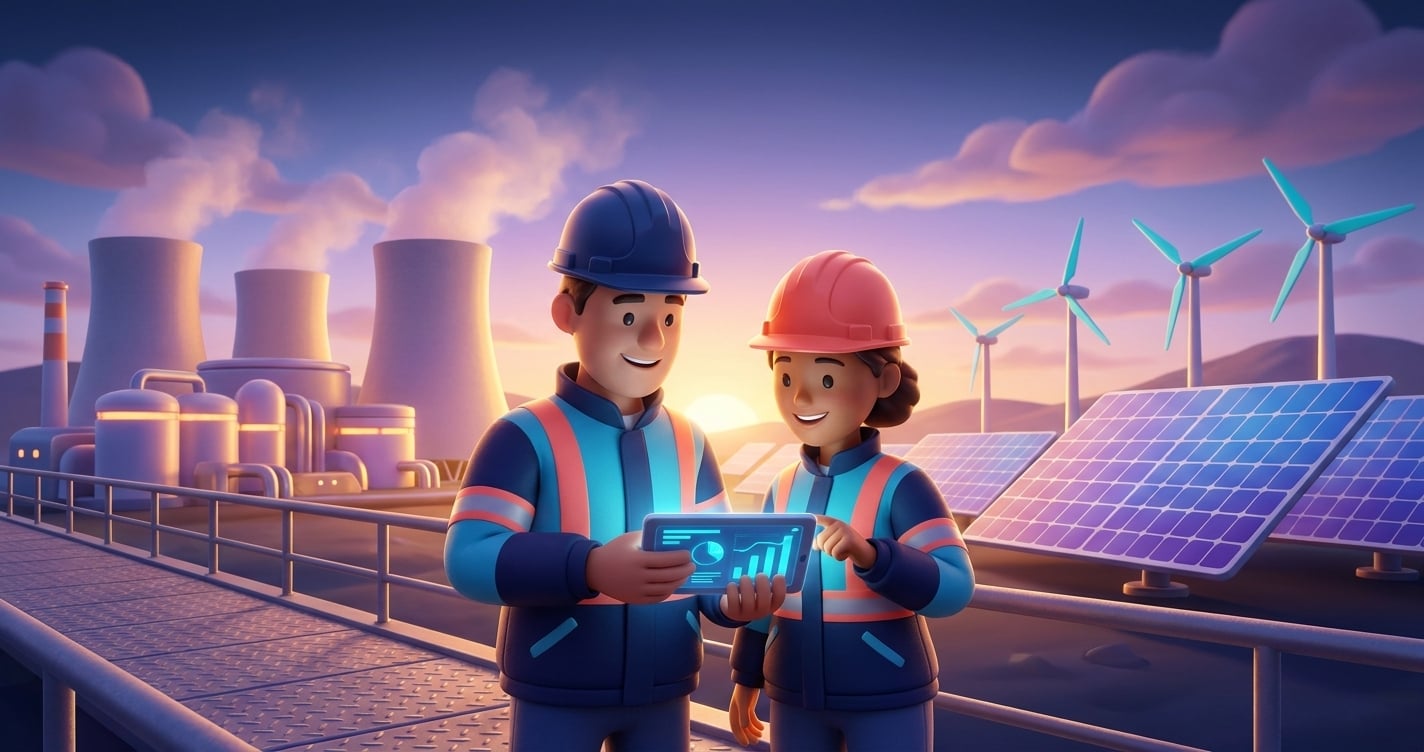
Measuring what does ai coaching roi look like in a energy business comes down to three clear outcomes: fewer operational incidents, faster onboarding for specialised roles, and higher retention of shift-based workers.
Key takeaways
- AI coaching delivers measurable returns by scaling leadership support to remote and shift-based workers who rarely receive traditional development.
- Safety metrics improve when field crews understand their natural communication styles and stress responses.
- Retention of highly specialised talent increases when employees receive on-demand, personality-adaptive guidance.
- Organisations working through the transition to renewables use AI coaching to help staff process complex operational changes.
You run an energy business. Your crews are spread across remote sites, working rotating shifts in high-pressure environments. The margin for error is zero. When mistakes happen on a rig, in a refinery, or on a wind farm, the consequences are severe.
In this environment, communication breakdowns are a massive operational risk. Yet traditional coaching and leadership development are usually reserved for executives sitting in corporate offices. The shift supervisors and site managers, the people making critical decisions at 2:00 AM, are left to figure out team dynamics on their own.
This is the gap AI coaching fills. By providing on-demand, personalised support to every employee, energy companies are seeing returns that go far beyond standard productivity metrics.
Most operational incidents in the energy sector have a human element. Fatigue plays a role, but so does interpersonal friction. When people are tired and under pressure, they revert to their default personality behaviours.
Consider a site manager who is a natural Doer. They want practical results immediately. They are managing an Auditor, someone who needs to check every detail and follow exact procedures before proceeding. Under pressure, the Doer gets impatient and pushes for action. The Auditor feels rushed, withdraws, and might miss a critical compliance check because they feel unable to speak up.
Traditional training programs try to fix this with annual workshops. That information is forgotten by the time the crew returns to the site. Hey Compono takes a different approach. It provides ongoing, personality-adaptive nudges that help individuals understand their own stress responses and how to communicate with their team in the moment.
When crews understand how they naturally react to pressure, they can adjust their behaviour before a miscommunication turns into a safety incident. Preventing just one major operational delay pays for the software entirely.

Energy is a 24-hour industry. Human resources and learning teams work standard business hours. If a night-shift supervisor is struggling with a difficult team member, they cannot wait until Monday morning to get advice.
AI coaching provides immediate, contextual guidance whenever the employee needs it. If a supervisor needs to have a difficult conversation about safety compliance, they can use personality-adaptive coaching to prepare. The system helps them frame the conversation based on the employee's specific work personality.
If they are speaking to a Campaigner, someone who focuses on big ideas and dislikes routine, the supervisor learns to frame the safety protocol not as a boring checklist, but as a crucial step in achieving the team's broader goals. This tailored approach reduces defensiveness and ensures the message actually lands.
Finding and training specialised talent in the energy sector is incredibly expensive. Replacing a qualified plant operator or field engineer costs a multiple of their salary in recruitment fees, lost productivity, and onboarding time.
People rarely leave their jobs because of the work itself. They leave because of poor management, unresolved conflict, or feeling misunderstood. Many shift supervisors are promoted because they were excellent on the tools, not because they have natural people management skills. They are thrown into leadership roles with minimal support.
When you give these new leaders access to AI coaching, you give them a safety net. They learn how to adapt their leadership style to different team members. A manager who naturally prefers Directive Leadership learns when to step back and use a Non-Directive approach with highly experienced staff.
At Compono, our research shows that when employees feel understood and managed according to their natural preferences, their engagement increases. They stay longer. In an industry where talent shortages are a constant threat, improving retention by just a few percentage points delivers massive financial returns.
The entire energy sector is undergoing a massive transition. Companies are integrating renewable sources, updating legacy infrastructure, and changing decades-old operational procedures. Change on this scale causes immense stress.
Different personalities handle change differently. The Evaluator will want to see all the data proving the new system works before they buy in. The Pioneer will be excited by the new technology but might ignore the practical steps required to implement it safely.
AI coaching helps organisations manage this transition at the individual level. It gives employees a private space to process their frustration with new processes. It helps them understand why they are reacting a certain way to the changes and provides practical steps to adapt.
When your workforce can process change quickly and safely, your operational transition stays on schedule. That is a measurable, bottom-line return on investment.
Key insights
Traditional coaching models are too slow and expensive to reach the field workers who actually determine an energy company's operational success.
ROI in this sector is heavily tied to safety and retention, both of which improve when teams communicate clearly under pressure.
Providing on-demand, personality-adaptive support helps shift workers manage conflict without waiting for HR intervention.
Understanding natural stress responses prevents minor miscommunications from escalating into costly operational delays.
Related reading: What does AI coaching look like for team leads · AI coaching subscription for business: how it works
Employee coaching, wellbeing support and team personality insights in one platform, built on organisational psychology.
Talk to usMost organisations start seeing behavioural changes within the first few weeks as employees become aware of their work personalities. Hard ROI metrics, like reduced turnover and fewer safety incidents, typically become measurable after three to six months of consistent use.
No. AI coaching supports managers by giving them the tools and insights they need to lead better. It acts as a private sounding board for supervisors to prepare for difficult conversations and understand their team's dynamics, making their human interactions more effective.
The platform is designed to be accessible on mobile devices, allowing field crews, rig workers, and plant operators to access guidance during their shifts, without needing to be tied to a corporate desktop computer.
Energy businesses should track retention rates in critical roles, the speed of onboarding new hires to full productivity, the frequency of interpersonal conflicts requiring HR intervention, and leading safety indicators related to communication.
Yes. Many safety issues stem from poor communication or people reverting to bad habits under stress. By helping employees understand their stress responses and teaching managers how to communicate protocols effectively to different personality types, compliance naturally improves.

1 min read
What does AI coaching look like for team leads? It looks like having an experienced organisational psychologist in your pocket, ready to offer...

1 min read
You can use AI coaching for leadership succession by mapping the natural work personalities of your potential leaders and providing scalable,...
1 min read
AI coaching software for L&D uses artificial intelligence to deliver personalised, personality-adaptive development at scale, giving every employee...