
1 min read
Why an AI coaching platform for team leads changes everything
An AI coaching platform for team leads provides on-demand, personality-specific guidance to help managers navigate difficult conversations and...
The best AI coaching platform for defence in ANZ must go beyond generic leadership advice and adapt to how individual service members naturally think, act, and make decisions under pressure.
Key takeaways
- Generic leadership models often break down in high-stress, unpredictable defence environments.
- Effective coaching adapts to an individual's natural work personality and stress responses.
- Capable platforms help leaders switch between directive and non-directive styles based on the situation.
- Scaling personalised coaching across a unit builds stronger, more resilient teams.
Defence personnel operate in an environment where clarity and execution are matters of safety. You have probably noticed that some team members respond instantly to direct orders, while others need to understand the broader context before they commit. When stress hits, these natural differences become glaringly obvious.
Leading a squad in a routine training exercise requires a completely different approach to managing a crisis response. Yet many leadership programmes treat everyone the same. They assume a single leadership style works for every scenario and every person.
The reality is that true adaptability requires more than just recognising the need to change. It begins with a deep understanding of how your personality influences your leadership style. Before you can effectively adjust your approach to suit the mission, you need a clear understanding of your natural tendencies.
Most traditional coaching models rely on a one-size-fits-all approach. They teach a set of best practices and expect leaders to apply them uniformly. This might work in a predictable office environment, but defence operations are rarely predictable.
When the pressure mounts, people revert to their default behaviours. A leader who naturally prefers strict control will double down on giving orders. A leader who naturally seeks consensus might hesitate when a rapid decision is required. Without self-awareness, these default reactions can compromise the mission.
Standard training tells leaders what they should do. It rarely addresses why they struggle to do it. If you have been told you are too rigid or too accommodating, generic advice to "be more flexible" is practically useless without understanding the mechanics of your own mind.

Our personalities influence how we interact with the world, including how we lead and work with others. We all have natural preferences for certain types of work and situations that get the best out of us.
Leadership can be viewed along a continuum. On one end is Directive Leadership, which involves high levels of control and structure. The leader makes key decisions and provides clear, specific instructions. This works well in situations that require order, efficiency, and quick decision-making – common scenarios in defence operations.
At the other end is Non-Directive Leadership, a hands-off approach where the leader grants the team autonomy. They trust highly skilled personnel to make their own decisions and manage tasks independently. In the middle sits Democratic Leadership, which balances leader guidance with team input.
If you are curious about how your unit naturally operates, Hey Compono maps these exact traits to help you understand your default leadership style.
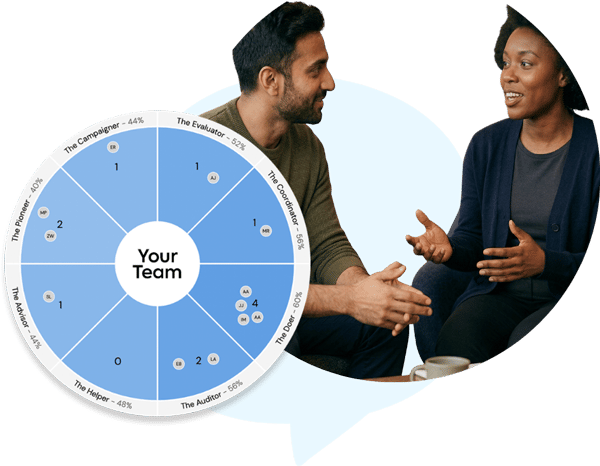
Based on personality, some individuals gravitate toward Directive Leadership due to their preference for structure and clarity. Personalities like The Coordinator or The Doer thrive here. They are practical, hands-on, and ensure tasks are completed with clear direction.
Other team members might be natural Pioneers or Auditors. The Pioneer values independence and innovation, encouraging the team to explore new possibilities. The Auditor relies on established processes and trusts the team to follow through with minimal oversight. These types naturally lean toward a Non-Directive style.
The challenge arises when a leader's natural style clashes with the needs of their team or the urgency of the situation. A Doer leading a team of Auditors might become frustrated by their need to check every detail. An Auditor leading a team of Doers might feel overwhelmed by their bias for immediate action.
A highly effective coaching platform understands these personality dynamics. It does not just offer generic advice. It provides specific, actionable guidance based on the individual's unique psychological makeup.
The best AI coaching platform for defence in ANZ will recognise that a directive leadership style works for a complex, urgent task where the team lacks experience. It will also recognise that a democratic style might be better for strategic planning sessions where diverse input is required.
This level of nuance is essential for building resilient units. When leaders understand their own blind spots, they can adapt their communication to reach every member of their team. They learn how to translate logical, risk-averse instructions into a vision that motivates the entire squad.
Teams using personality-adaptive coaching find these conversations become much easier to navigate. They spend less time dealing with miscommunication and more time focusing on the objective.
Conflict in defence teams is often a result of personality clashes rather than incompetence. When a fast-paced, future-focused Campaigner clashes with a logical, results-driven Evaluator, the tension can derail a project.
The Campaigner seeks future-oriented solutions and wants to brainstorm. The Evaluator focuses on logical, immediate conflict resolution and wants data. Without intervention, the Campaigner feels stifled, and the Evaluator feels frustrated by the lack of concrete action.
An intelligent coaching platform helps both individuals understand this dynamic. It advises the Campaigner to focus on data-driven examples to back up their ideas. It encourages the Evaluator to acknowledge the potential benefits of long-term planning. This turns a potential argument into a productive collaboration.
Effective leadership requires flexibility. There is no single approach that works for every situation. A directive approach might be necessary in a crisis, even if your natural tendency is more collaborative.
Leaders who prefer giving direct orders may need to embrace a more hands-off style when working with highly skilled specialist teams who thrive on autonomy. Flexibility allows you to harness your strengths while adapting to the demands of the task at hand.
At Compono, we have spent years fusing academic research into high-performing teams with personality theory. This research shows that the best leaders know how to shift their approach when necessary, moving seamlessly between styles as the situation evolves.
When an entire unit understands these principles, communication becomes sharper. Expectations are clearer. The team becomes more cohesive, adaptable, and ready to face unpredictable challenges with confidence.
Key insights
- Defence leadership requires the ability to switch between directive, democratic, and non-directive styles based on the urgency and complexity of the mission.
- Personality clashes are a primary source of friction in high-stakes environments, often mistaken for incompetence or insubordination.
- Understanding whether a team member is a Doer, an Auditor, or a Coordinator changes how a leader delivers instructions and feedback.
- Adaptive AI coaching provides real-time, personalised guidance that helps leaders overcome their natural blind spots before they compromise an operation.
Ready to understand your natural leadership style and how it impacts your unit?
Hey Compono helps teams give and receive feedback that actually moves the needle. Start free and see how it fits your workflow.
Personality determines your default reaction to stress and your natural communication style. In high-pressure defence environments, understanding these defaults helps leaders avoid communication breakdowns and adapt their approach to suit the mission.
Traditional training teaches uniform best practices that may not suit your natural temperament. AI coaching adapts to your specific work personality, offering personalised advice on how to handle conflicts, communicate effectively, and manage your specific blind spots.
Directive leadership involves high control and clear instructions, which is highly effective in urgent crisis situations. Non-directive leadership is a hands-off approach that gives autonomy to highly skilled teams, which works well for complex, innovative problem-solving.
Your personality gives you a default preference, but leadership styles can absolutely be adapted. The key is self-awareness. Once you know your natural tendencies, you can consciously choose to apply a different style when the situation demands it.
It helps team members realise that disagreements often stem from different ways of processing information, rather than personal attacks. By understanding these differences, teams can adjust their communication and resolve issues logically rather than emotionally.

Voice-first coaching that adapts to your personality. Get actionable steps you can take this week.
Start freeBuilt by Compono. Not therapy — practical behaviour change.
1 min read
An AI coaching platform for team leads provides on-demand, personality-specific guidance to help managers navigate difficult conversations and...
1 min read
The best AI coaching platform for NDIS providers in NSW is one that adapts to the unique work personalities of your support coordinators and care...
1 min read
Measuring what AI coaching ROI looks like in a defence business comes down to tracking specific metrics: faster decision-making cycles, reduced...