
 Compono
How to move forward when you are paralyzed by fear
 Compono
Paralysed by fear at work? Why your brain freezes under pressure, what it looks like for your personality, and practical steps to get moving again.

Getting stuck in fear happens when your brain prioritises survival over progress, triggering a biological freeze response that stalls decision-making and action.
This state of paralysis isn't a character flaw or a lack of ambition; it is a natural reaction to perceived threats in your environment, whether that is a looming deadline, a difficult conversation, or the risk of failure. To break the cycle, you must first recognise the physical signals of fear and then apply small, manageable shifts to recalibrate your nervous system and regain your professional momentum.
Key takeaways
- Fear is a survival mechanism that often misinterprets modern workplace stress as a physical threat.
- Being stuck in fear usually manifests as procrastination, over-analysis, or total withdrawal from team dynamics.
- Your specific work personality determines how you experience fear and which strategies will effectively get you moving again.
- Breaking the freeze response requires moving from abstract worries to concrete, tiny actions.
- Understanding your natural tendencies through tools like Hey Compono can help you predict and manage your fear triggers.
We have all been there. You are staring at a blinking cursor, or perhaps you have been 'researching' the same topic for three days without writing a single word. You might tell yourself you are just being thorough or that you are waiting for the right moment. But if you look closer, there is a tightness in your chest or a subtle sense of dread. You are stuck in fear, and the longer you stay there, the higher that invisible wall feels.
In the modern workplace, fear rarely looks like a predator in the wild. Instead, it looks like the fear of being 'found out', the fear of looking stupid in a meeting, or the fear that a single mistake will unravel your entire career. At Compono, we have spent years looking at how these emotional undercurrents dictate performance. We have found that when fear takes the wheel, your high-level thinking, the part of you that solves problems and innovates, effectively goes offline.
This paralysis is particularly exhausting because it is active. You aren't resting; you are spending an enormous amount of energy managing the anxiety of not doing the work. It is a cycle that feeds itself. The more you worry, the less you do, and the less you do, the more there is to worry about. Breaking out of this requires more than just 'trying harder'. It requires a fundamental shift in how you relate to your own brain's alarm system.
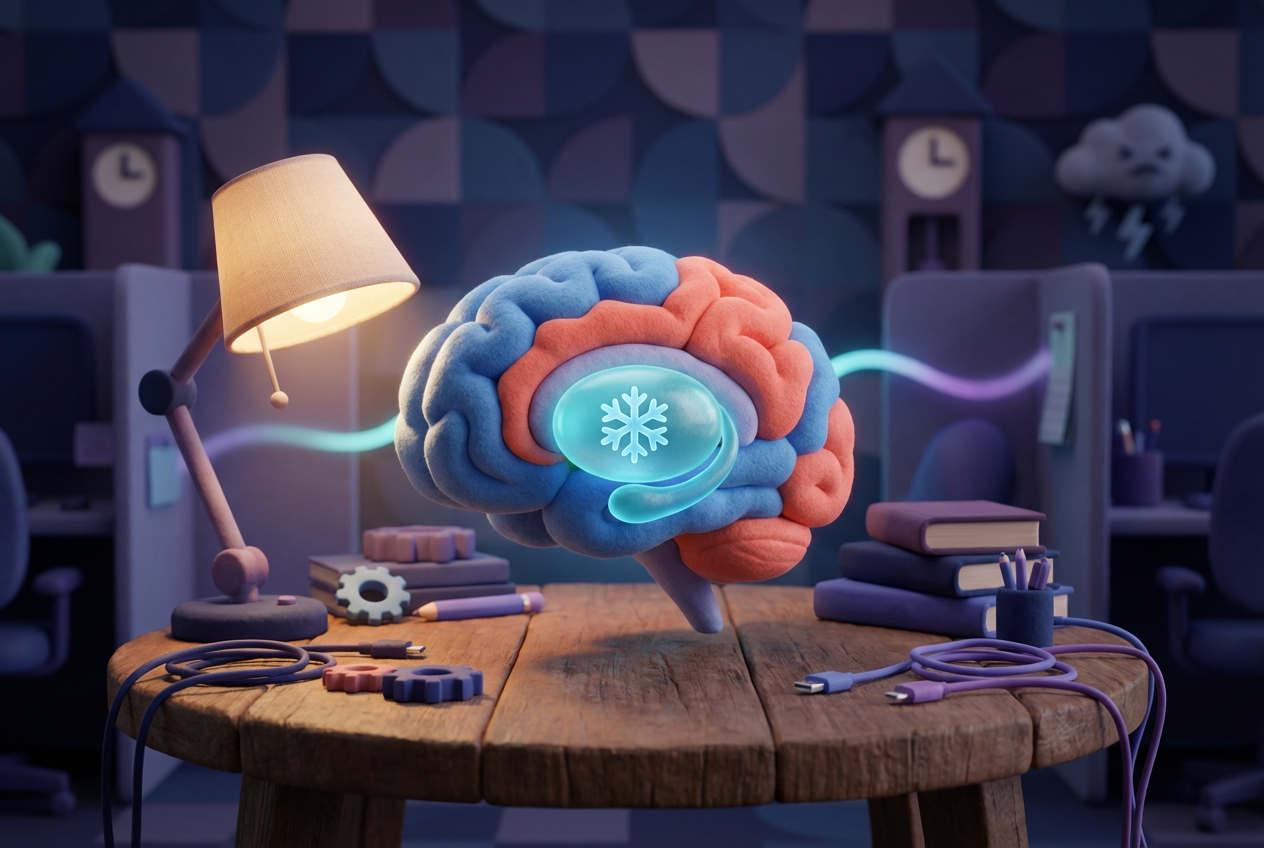
Your brain has a very simple priority: keep you alive. When you face a situation that feels risky, your amygdala, the brain's smoke detector, sounds the alarm. In a split second, your body is flooded with cortisol and adrenaline. This is great if you need to run away from a fire, but it is incredibly unhelpful when you need to lead a strategy session or give constructive feedback to a peer.
When the 'fight' or 'flight' options don't seem socially acceptable, many of us default to 'freeze'. This is the essence of being stuck in fear. You become hyper-vigilant, obsessing over every possible negative outcome. You might find yourself over-preparing to the point of exhaustion, or perhaps you simply shut down and avoid the task altogether. This isn't laziness; it is your nervous system trying to protect you from a perceived social 'death'.
The problem is that our brains haven't quite caught up to the 21st century. It can't tell the difference between a sabre-toothed tiger and a passive-aggressive email from your manager. Both trigger the same physiological response. Recognising this is the first step toward self-compassion. You aren't 'broken', your survival hardware is just running an outdated script in a modern office.
Not everyone experiences fear in the same way. Depending on your natural work personality, your version of being stuck might look completely different from your colleague's. For example, 'The Auditor' might get stuck in fear by obsessing over minute details, convinced that if they can just find one more data point, the risk will disappear. They don't see it as fear; they see it as being 'thorough', yet the project never moves forward.
On the other hand, 'The Helper' might feel stuck when they fear a decision will upset the team harmony. They might delay a necessary conversation for weeks, hoping the conflict will resolve itself. For them, fear is the dread of social friction. If you are curious about which of these patterns you default to when the pressure is on, Hey Compono can show you your primary work personality in about ten minutes.
Understanding these tendencies is vital. If you know that your 'Pioneer' brain tends to jump to a dozen new ideas to avoid the fear of failing at one, you can catch yourself in the act. You can stop the 'idea-hopping' and address the underlying worry. When you name the fear and link it to your personality, it loses its power over you. It becomes a data point rather than a permanent state of being.

The antidote to fear is rarely a grand gesture. It is almost always a tiny, almost insignificantly small action. When you are stuck in fear, the task ahead looks like a mountain. Your goal is to stop looking at the peak and start looking at your shoelaces. What is the smallest possible step you can take in the next five minutes that doesn't feel threatening?
If you are afraid of writing a major report, your first step isn't 'write the intro'. It is 'open a blank document and save it with a title'. That's it. By lowering the bar to the floor, you bypass the amygdala's alarm system. You are moving, and movement is the natural enemy of a freeze response. Once you have taken that tiny step, the next one feels slightly more possible.
We often wait to feel 'confident' before we act. But confidence is a result of action, not a prerequisite for it. You build confidence by proving to yourself, one tiny step at a time, that you can handle the discomfort. Many teams use personality-adaptive coaching to help individuals identify these micro-steps based on their unique strengths, ensuring the path forward feels authentic rather than forced.
While individual strategies are important, the environment you work in plays a massive role in how often you get stuck. A culture that punishes mistakes or rewards 'perfection' is a breeding ground for fear. In these environments, people stop taking risks, they stop speaking up, and innovation grinds to a halt. It is a quiet, expensive kind of failure that many organisations don't even realise they are paying for.
To thin the fear, leaders must model vulnerability. When a manager admits they are unsure or shares a story of a past failure, it gives the rest of the team 'psychological safety'. It signals that the workplace isn't a minefield where one wrong step ends your career. It becomes a laboratory where learning is the primary goal. This shift changes the fundamental question from "What if I fail?" to "What will we learn?"
When fear is out in the open, it can be managed. When it is hidden, it grows. By using objective frameworks to talk about how we work, and why we sometimes struggle, we take the shame out of the equation. You aren't a 'fearful person'; you are a professional managing a complex human experience. And with the right tools and a bit of self-awareness, you can always find a way to move again.
Key insights
- Fear is a physiological response that can be managed by understanding your nervous system's 'freeze' default.
- Work personalities like The Auditor or The Helper experience and manifest fear in distinct, predictable ways.
- Action is the primary way to break a freeze response, but those actions must be small enough to feel safe.
- Psychological safety in a team environment is essential for preventing long-term paralysis across an organisation.
- Self-awareness is the bridge between being controlled by fear and using it as a signal for growth.
Related reading: Paralysed by fear? Why your brain freezes and how to move · How to move forward when you are frozen by fear at work
Voice or text coaching that adapts to your personality. Start free.
Get started free
Your brain doesn't always distinguish between high-stakes threats and low-stakes discomfort. If a task triggers a fear of judgement or failure, even subconsciously, your body can default to a freeze response to avoid the perceived risk.
They are closely linked. Procrastination is often a symptom of fear. We avoid tasks not because we are lazy, but because we are trying to avoid the negative emotions (like anxiety or self-doubt) that the task stirs up.
The best approach is to provide psychological safety. Instead of focusing on the missed deadline, focus on the obstacle. Ask, "What part of this feels the most difficult right now?" and help them break that specific part into tiny, non-threatening steps.
Absolutely. A 'Campaigner' might hide fear behind a burst of new, unrelated activity, while a 'Doer' might become overly rigid. Recognising your specific 'fear signature' allows you to address it more effectively.
Yes. It is a universal human experience. Even the most successful leaders deal with the freeze response. The difference is that they have developed the self-awareness to recognise it and the strategies to move through it.

Paralysed by fear at work? Why your brain freezes under pressure, what it looks like for your personality, and practical steps to get moving again.

Feeling frozen by fear at work? Here's why your brain hits the brakes, and how personality-based strategies from Hey Compono help you regain momentum.

Stop letting the fear of the unknown stall your career. Learn why your brain craves certainty and how to build the resilience needed to thrive in...