
 Compono
1 min read
How customized coaching transforms your career growth
 Compono
Customized coaching is a tailored development approach that adapts to your specific work personality to help you navigate professional challenges and...

If you feel like you have no time to think, it is usually because your mental load has exceeded your cognitive capacity to process immediate tasks and long-term goals simultaneously.
This constant state of being 'on' isn't just a scheduling issue – it is a direct result of how your specific work personality interacts with the modern workplace's demands for instant responsiveness. When your days are a blur of back-to-back meetings and Slack notifications, your brain loses the ability to enter 'deep work' mode, leaving you feeling perpetually behind and mentally exhausted.
Key takeaways
- Mental congestion occurs when the volume of 'doing' outweighs the space for 'reflecting', leading to burnout.
- Your work personality significantly influences whether you thrive on fast-paced activity or require structured quiet time to process information.
- Reclaiming your time requires a shift from reactive habits to intentional boundary-setting based on how your brain actually functions.
- Small, consistent changes in how you organise your day can create the cognitive 'breathing room' needed for strategic thinking.
We have all been there. You sit down at 9:00 am with a clear plan, and by 9:15 am, that plan has been shredded by three 'urgent' emails and a 'quick' call that lasted forty minutes. By the time Friday rolls around, you realise you have spent forty hours reacting to other people's priorities and zero hours on your own. This isn't just annoying – it is a recipe for professional stagnation. When you have no time to think, you cannot innovate, you cannot spot risks, and you certainly cannot lead effectively.
At Compono, our research into high-performing teams shows that the most successful individuals aren't necessarily the ones doing the most; they are the ones who have mastered the art of mental recovery. Constant busyness is often a mask for a lack of clarity. We tell ourselves we are being productive because our hands are moving, but if our minds are just spinning in circles, we aren't actually going anywhere. It is like trying to drive a car with a foggy windscreen – you might be moving fast, but you are likely to hit a wall eventually.
The physical and emotional toll of this 'thought-poverty' is real. You might find yourself snapping at colleagues, struggling to make simple decisions, or feeling a sense of dread when you look at your calendar. This happens because your brain's prefrontal cortex – the part responsible for complex planning – is being bypassed in favour of the amygdala's fight-or-flight response. You are essentially living in a state of low-grade survival mode, which is exhausting for everyone involved.

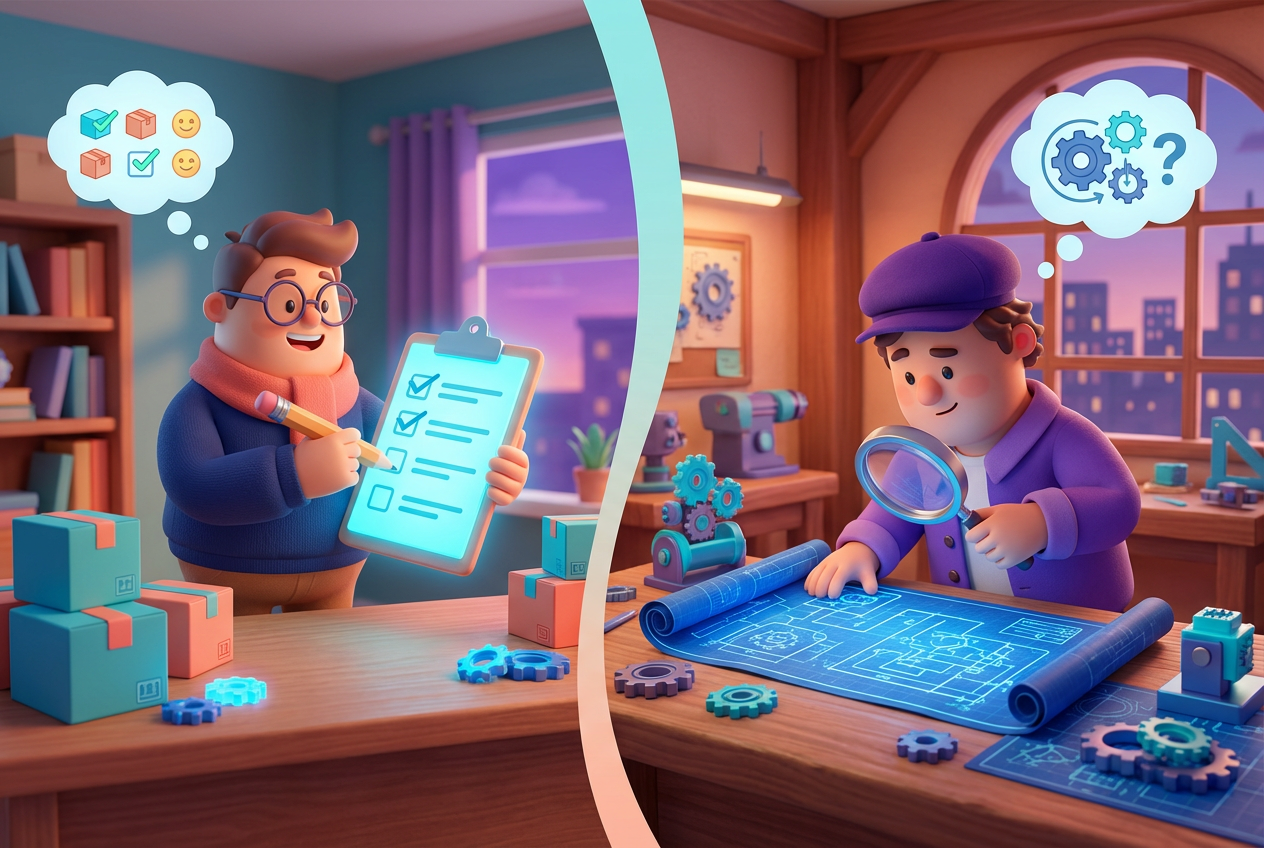
Not everyone experiences the 'no time to think' phenomenon in the same way. For example, a Doer might actually enjoy a high-volume task list, finding satisfaction in the physical act of ticking off items. However, even the most efficient Doer will eventually hit a ceiling if they don't pause to ensure those tasks are actually the right ones to be doing. Without that reflection time, they risk becoming a highly efficient engine running in the wrong direction.
On the other hand, someone like an Auditor needs significant time to process details and ensure accuracy. For them, a day with no time to think feels like a direct threat to their professional integrity. If they are rushed, they feel they are being set up to fail. Understanding these nuances is vital. If you are curious about which of these patterns fits you – and how it affects your stress levels – Hey Compono can show you in about 10 minutes.
Then there is the Pioneer, who needs mental space to explore creative solutions. If their calendar is filled with routine administrative tasks, they feel suffocated. The feeling of having no time to think for them is specifically a lack of time to dream and innovate. Recognising that your need for headspace is tied to your personality type allows you to stop shaming yourself for 'not being fast enough' and start designing a workday that actually supports your brain's natural rhythm.
To reclaim your time, you have to stop treating your calendar like a public park where anyone can set up a picnic. You need to treat it like a private laboratory. This starts with identifying your 'golden hours' – the time of day when your focus is at its sharpest. For some, this is the first two hours of the morning; for others, it is late afternoon. Once you know when you do your best thinking, you must protect that time with everything you have.
This might mean turning off notifications, closing your email tab, and physically moving to a different space. It also requires a shift in communication. We have been conditioned to believe that an instant response is a sign of a good employee. In reality, an instant response is often a shallow one. By training your colleagues to expect a considered response later rather than a rushed one now, you create the space you need to actually do your job well.
Some teams use personality-adaptive coaching to have these conversations without it getting weird. When everyone understands that the Auditor needs quiet time to review the data, or that the Campaigner needs a sounding board to refine their vision, the friction of 'busyness' starts to melt away. It becomes less about 'why aren't you answering me?' and more about 'how can I support your focus?'
You might feel that taking 15 minutes to sit and do nothing is a waste of time when your to-do list is a mile long. But that strategic pause is often where the most important work happens. It is during these moments of 'boredom' that your brain enters the default mode network, which is where creative problem-solving and self-reflection live. If you never stop, you never give your brain the chance to connect the dots.
Try implementing a 'thinking audit' at the end of each day. Ask yourself two questions: What was the most important thing I did today? And what would I have done differently if I had ten more minutes to think? Often, the answer to the second question reveals a shortcut or a better approach that you missed because you were moving too fast. Over time, these insights accumulate, helping you work smarter, not harder.
At Compono, we have spent over a decade researching how high-performing teams manage their energy. We have found that the most resilient professionals are those who prioritise 'recovery' as much as 'performance'. They understand that a brain that has no time to think is a brain that is losing its edge. By intentionally slowing down, you are actually giving yourself the fuel to speed up when it matters most.
Key insights
- The feeling of having no time to think is a signal that your cognitive load is poorly managed, not that you are incapable of the work.
- Individual work personalities require different types of mental space – some need quiet for detail, others need freedom for ideation.
- Strategic pauses and protected 'golden hours' are not luxuries; they are essential tools for professional performance and mental health.
- Effective time management is less about calendars and more about understanding the natural rhythms of your own work personality.
Reclaiming your headspace doesn't happen overnight, but it does start with a single decision to prioritise your mental clarity. If you are tired of the constant noise and want to understand how your brain is wired to handle pressure, we can help. At Compono, we believe that self-awareness is the foundation of every great career.
This is often due to 'residual mental load'. Even if you don't have many meetings, the anticipation of potential interruptions or the weight of an unfinished task list can occupy your mental bandwidth. Your work personality might also be naturally inclined to over-analyse, meaning you are 'thinking' even when you aren't 'working', which leads to mental fatigue.
Frame the request around outcomes rather than activities. Instead of saying 'I need more time to think', try 'I want to ensure this project is strategically sound, so I am blocking out two hours for deep-dive analysis to identify potential risks'. This shows that your 'thinking time' is directly tied to the quality of your output and the success of the team.
Start small. Choose one 30-minute block each day where you turn off all notifications and focus on a single, complex task. This helps retrain your brain to handle deep focus again. Once you are comfortable with 30 minutes, gradually increase the duration. Consistency is more important than intensity when building new focus habits.
Absolutely. Personalities like the Auditor or the Advisor often require more solitary time to process information and reach conclusions. Conversely, a Campaigner might find they 'think' best while talking through ideas with others. Understanding your specific type through Hey Compono can help you identify exactly what kind of 'thinking time' works for you.
Technology is a double-edged sword. While it provides the tools for work, it also provides the distractions. Use tools that automate routine tasks to free up cognitive space, but be disciplined about muting communication apps during your focus blocks. The goal is to make technology serve your focus, not dictate your schedule.
1 min read
Customized coaching is a tailored development approach that adapts to your specific work personality to help you navigate professional challenges and...

1 min read
A coaching demo is a practical walkthrough of a coaching platform or methodology designed to show you how personalised guidance can solve specific...

1 min read
The helper meaning in a professional context describes a work personality type defined by deep empathy, a drive to support others and a natural...