 Mathan Allington
To answer "how to answer why should we hire you", you must stop summarising your resume and start proving exactly how your specific skills solve the hiring manager's immediate problems.
Last reviewed November 2026
Key takeaways
- Interviewers ask this question to assess how well you understand the daily realities and challenges of the role.
- The most effective answers follow a strict structure of acknowledging the need, offering proof of your capability, and estimating your impact.
- Your response should focus heavily on evidence of problem-solving and teamwork, as these are top priorities for modern employers.
- Remote and hybrid roles require you to adjust your answer to highlight autonomous work and strong written communication.
- Turning the end of your answer into a follow-up question shifts the changing from a one-sided interrogation into a collaborative conversation.
It is the moment in the job interview that makes most candidates freeze. The hiring manager leans back, looks at you, and asks why they should hire you over everyone else in the waiting room. It feels like a trap. It feels like you are being asked to brag or, worse, to guess what the other candidates lack.
Many professionals stumble here. They either list adjectives like "hardworking" and "dedicated", or they launch into a massive recap of their entire career history. Both approaches miss the point. This question is not actually about you. It is about the employer, their team, and the specific problem that led them to open this job requisition in the first place.
Once you understand that the interviewer is just trying to manage their own risk, you can stop feeling defensive. A great answer simply connects the dots between what you do naturally and what the business needs urgently.
Why interviewers ask why they should hire you
Hiring a new employee is an expensive and risky bet. When a manager asks this question, they are checking two things. First, they want to know if you actually understand what the job involves beyond the bullet points in the job description. Second, they are looking for reassurance that you have the specific skills to handle those challenges.
According to research from Indeed, the strongest interview responses connect a candidate’s skills to the company’s challenges and support claims with evidence of measurable results. If you can articulate the company's problem better than they can, they will automatically trust that you have the solution.
Your goal is to show self-awareness. You need to demonstrate that you know your own strengths, you know how to apply them, and you know how to work with others to get things done.
The three-part winning answer formula
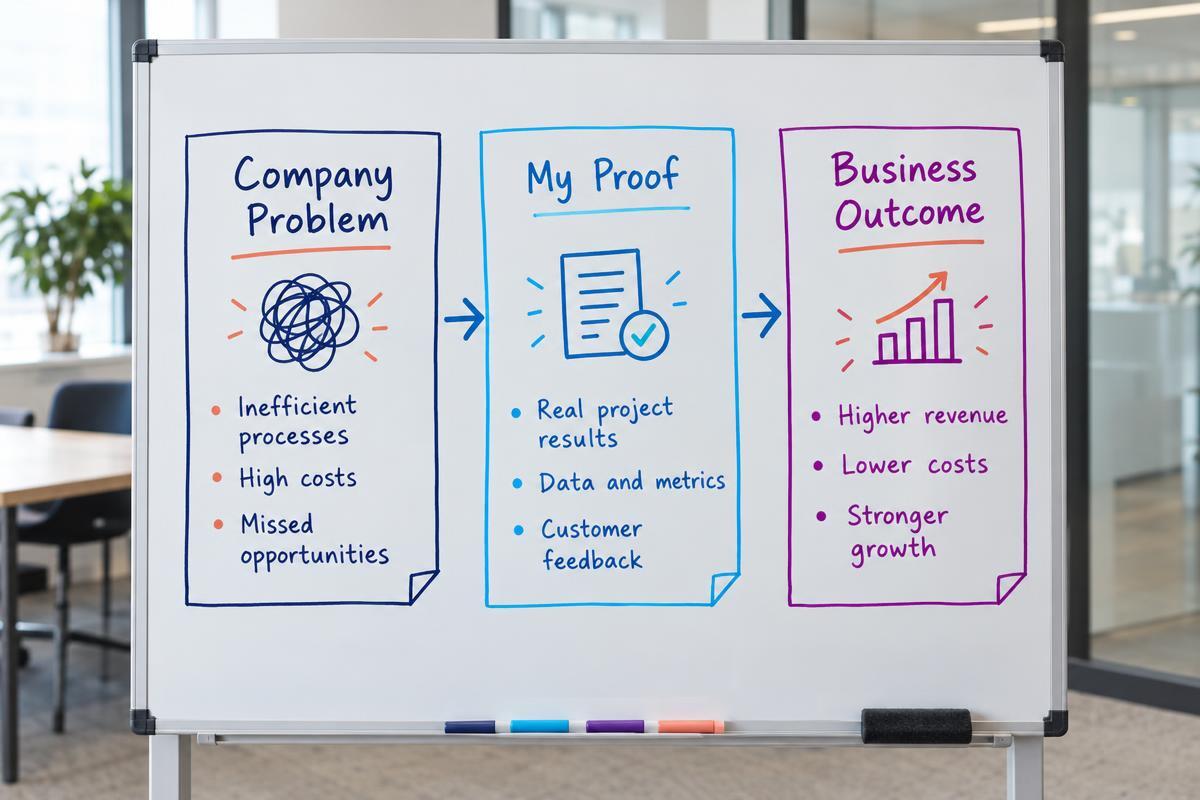
Do not wing your answer. The most confident candidates use a simple, three-part framework to structure their response. We call this the Need, Proof, Impact framework.
Identify the need
Start your answer by reflecting the core challenge of the role back to the interviewer. This proves you have been listening during the interview. For example, you might say that based on your conversation today, the team really needs someone who can untangle their legacy database while keeping the daily reporting running.
Provide the proof
Next, offer one specific example from your past that proves you can do this exact thing. This is where you rely on data and facts. Mention the size of the project, the timeframe, or the specific tools you used. A recent report by the National Association of Colleges and Employers found that nearly 90% of employers seek evidence of problem-solving ability, while nearly 80% prioritise teamwork skills in candidates. Make sure your proof includes both.
Explain the impact
Finish by predicting what you will achieve in this new role. Keep it grounded. Explain that because you have solved this problem before, you can help the team reduce their reporting time by half within your first three months. This takes the guesswork out of the hiring decision.
Tailoring answers by career stage and industry
Your answer must adapt to your current career context. A senior executive should not answer this question the same way a recent graduate would. The context matters.
Pivoting careers or lacking qualifications
If you are changing industries, you might feel like you have no right to answer this question confidently. You might be missing some technical requirements. However, modern hiring is shifting. Data from the 2025 Recruiter Nation Report indicates that 91% of organisations evaluate candidates primarily on skills rather than degrees or job titles.
When you lack a specific qualification, lean on your transferable skills. Explain that your background in a completely different industry gives you a unique perspective on their problems. Frame your non-traditional path as an asset rather than a liability. If you are preparing for competency-based interviews, focus heavily on how quickly you learn new systems.
Using your Work Personality
The best answers are authentic to who you are. This is where understanding your Work Personality gives you a massive advantage. If you are a Doer, your answer should focus on your bias for action and your ability to execute under pressure. If you are an Evaluator, you should highlight your analytical thinking and how you save teams from making expensive mistakes.
When you align your natural working style with the job requirements, you stop sounding like you are reciting a script. You sound like a professional who knows exactly what they bring to the table. If you want to refine this delivery, Hey Compono can help you map your personality traits to standard interview questions.
Nuances of answering for remote and hybrid job roles
The rules change slightly when you are applying for a remote or hybrid position. The hiring manager is still asking why they should hire you, but underlying that question is a fear about visibility. They want to know if they can trust you to work without supervision.
In this scenario, your answer must explicitly mention your ability to manage your own time and communicate clearly. The Unstop Talent Report 2025 reveals that recruiters rank communication and interpersonal skills as the top priority at 72%, followed by problem-solving at 59%. In a remote team, poor communication destroys productivity.
When you are preparing for video interviews, your delivery matters as much as your words. Look directly into the camera lens when delivering your final impact statement. This creates the illusion of direct eye contact, which builds trust far faster than staring at the interviewer's video feed on your screen.
Conducting a pre-interview interactive self-assessment
You cannot formulate a strong answer in the moment if you have not done the thinking beforehand. Before your interview, grab a blank piece of paper and draw three columns. This simple self-assessment is the fastest way to find your unique selling points.
In the first column, write down the three biggest problems this company is currently facing. Base this on your industry research and the job description. In the second column, list three specific moments in your career where you solved identical or highly similar problems. In the third column, write down the business outcome of your work using hard numbers.
When you sit in the interview chair, you now have a menu of targeted stories to choose from. You are no longer scrambling for ideas. You are simply matching the right story to the right question.
Mistakes to avoid when explaining your value
Even with a good structure, certain phrases will instantly damage your credibility. Knowing what not to say is just as valuable as knowing what to say.
| The Mistake | Why It Fails | The Better Approach |
|---|---|---|
| Making it entirely about you | Saying "I really want this job to advance my career" ignores the employer's needs. | Focus entirely on what you can deliver for the team in the first six months. |
| Claiming to be a perfectionist | It is a cliché that shows a lack of self-awareness and an inability to delegate. | Name a real, manageable weakness and explain the system you use to mitigate it. |
| Using generic culture fit terms | Saying "I am a great team player" offers zero proof and sounds like everyone else. | Give an example of a time you helped a struggling coworker meet a shared deadline. |
| Putting down other candidates | Saying "I bet the other applicants don't have my drive" makes you look arrogant. | Keep the focus strictly on your own track record and measurable results. |
If you have struggled with these mistakes in the past, taking time to practise your answers in a low-stakes environment is the only way to break the habit. You have to hear yourself say the words out loud to know if they sound natural.
How to turn your answer into an engaging follow-up question
The most sophisticated way to answer this question is to use a role-reversal technique. After you deliver your Need, Proof, and Impact statements, do not just stop talking and wait for the next question. Hand the conversation back to the interviewer.
You can do this by asking a targeted question that builds on the answer you just gave. For example: "I have explained how I would approach the database migration based on my previous projects. Given your current team structure, what would be the biggest internal hurdle I would need to clear in my first thirty days?"
This technique is highly effective when preparing for behavioural interviews because it forces the interviewer to start visualising you in the role. They stop evaluating you as a candidate and start talking to you like a colleague. It turns an interrogation into a collaborative problem-solving session.
Answering "why should we hire you" does not have to be painful. When you stop worrying about being right and start focusing on being useful, the entire interview changing changes. You shift from a person asking for a job into a professional offering a solution.
How Hey Compono can help with your interview practice
If you want to test your answers before sitting in front of a real hiring manager, you need a safe place to fail and improve. Hey Compono provides realistic interview simulations that adapt to your work personality and the specific roles you are targeting.
Related reading
Frequently asked questions
What if I do not have a unique skill to talk about?
You do not need a rare skill to stand out. Most hiring managers just want reliable professionals who communicate well and follow through. Focus on your reliability, your ability to learn quickly, and your track record of working well with difficult stakeholders. Consistency is often more valuable than a unique technical skill.
How long should my answer be?
Keep your answer between 60 and 90 seconds. Anything longer usually means you are rambling and losing the interviewer's attention. Deliver your three-part framework clearly, state your impact, and then ask a follow-up question to pass the conversation back to them.
Can I use the exact same answer for different companies?
No. While your proof (the story of your past success) might stay the same, you must change the need and the impact for every single interview. You have to tailor your answer to the specific problems the company is facing, otherwise you will sound generic.
What if the interviewer asks this question right at the start of the interview?
If they ask it early, you will not have gathered enough information to perfectly target their immediate needs. In this case, rely on the research you did before the interview. State what you understand their main challenges to be based on the job posting, offer your proof, and then ask them if your assessment of their challenges is accurate.
How do I answer this if I am applying for an internal promotion?
When applying internally, your biggest advantage is your institutional knowledge. Focus your answer on the fact that you already understand the company culture, the internal systems, and the current bottlenecks. Your proof should highlight how your existing internal network will allow you to deliver results much faster than an external hire.