
 Compono

1 min read
The Helper meaning: understanding this work personality
 Compono
The true helper meaning in the workplace describes a personality type that is naturally empathetic, supportive, and driven to create harmony within...

A Campaigner in the workplace is a visionary, people-oriented professional who excels at inspiring others and driving innovation through enthusiastic persuasion.
These individuals, often seen as the magnetic force within a team, thrive on big-picture thinking and building deep relationships to achieve shared goals. While their energy is infectious, understanding their specific work preferences is the key to turning that spark into sustainable success without the burnout or idea-overload that often follows.
Key takeaways
- Campaigners are naturally persuasive and energetic, making them excellent at roles involving negotiation, selling, and promotion.
- Their visionary nature means they often prioritise future possibilities and big-picture strategy over routine, structured tasks.
- To be at their best, Campaigners need a dynamic environment that offers variety, creative freedom, and opportunities for networking.
- Collaborating effectively with a Campaigner requires setting clear, measurable goals to ground their enthusiasm in practical execution.
- Under stress, they can become scattered or overwhelmed, making it vital to help them narrow their focus to one key initiative at a time.
You’ve probably met them – the person who walks into a room and instantly changes the temperature. They’re the ones pitching the 'impossible' project with such genuine belief that you find yourself nodding along before you’ve even seen a budget. In our research at Compono, we’ve spent over a decade looking at how these natural tendencies shape team performance. We call this specific profile the Campaigner, and they are the vibrant, magnetic personas that light up modern work environments.
But being the 'ideas person' isn't always easy. If you are a Campaigner, you’ve likely been told you’re 'too much' at some point – too loud, too idealistic, or too focused on the next big thing while the current one is still half-finished. You might feel misunderstood when your colleagues ask for 'just the facts' while you’re trying to sell them a dream. The struggle is real: how do you keep that creative fire burning without exhausting yourself or leaving your team in a state of perpetual chaos?
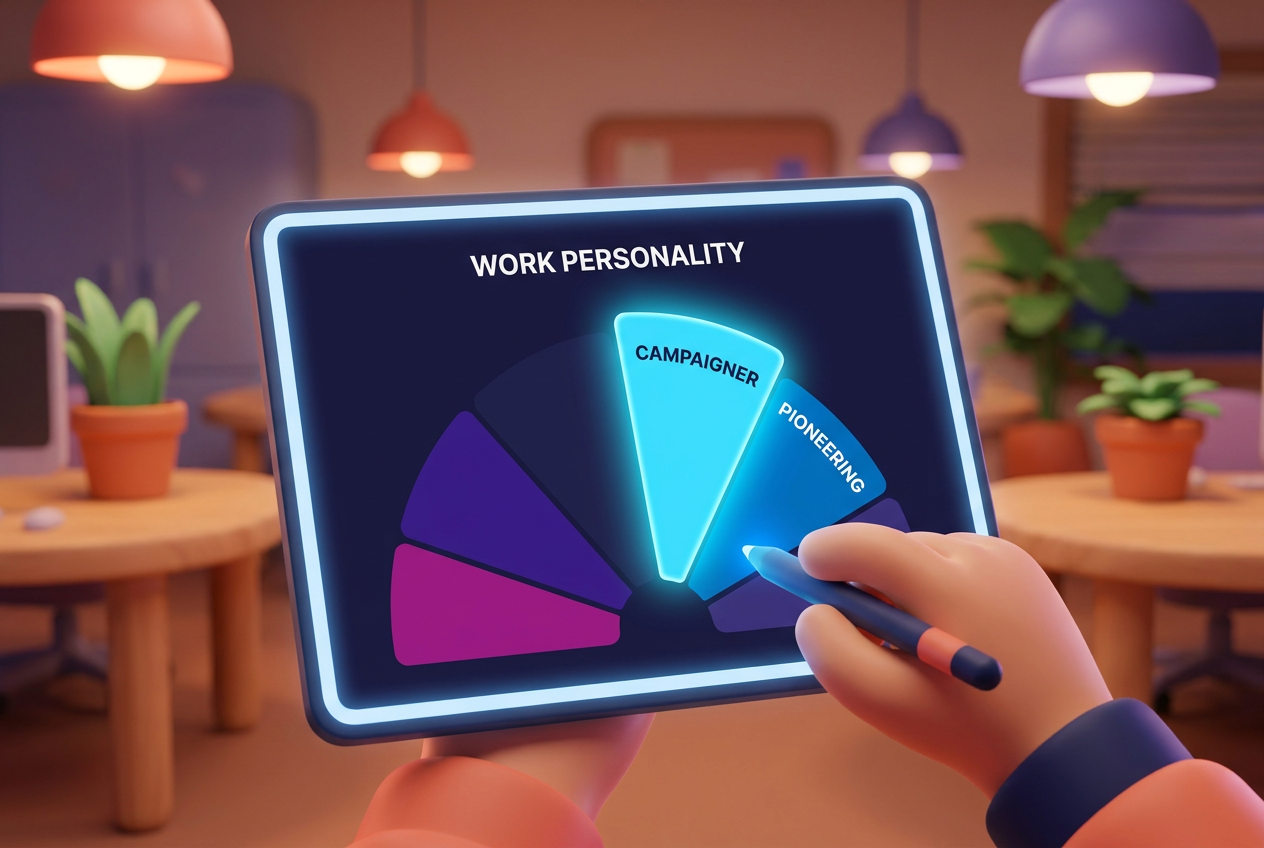
At their core, Campaigners are negotiators and promoters. They don't just complete tasks; they champion them. This personality type is mapped against work activities that are crucial for high-performing teams, specifically those involving campaigning and pioneering. They have an instinctive ability to draw in an audience, using imagination to look beyond the mundane and see what could be, rather than just what is.
This enthusiasm isn't just for show. It’s a strategic asset. In a workplace that often feels bogged down by 'the way we’ve always done it', the Campaigner is the one asking 'what if we did it differently?' They thrive in lively, stimulating environments where variety is the norm. If you’re curious which personality type you default to under stress, Hey Compono can show you in about 10 minutes, helping you understand if this visionary drive is your primary engine.
However, this same energy can lead to potential blind spots. Because they are so focused on the horizon, Campaigners can sometimes overlook the pebbles at their feet. They might prioritise popularity over practicality or find themselves overcommitting to projects because they genuinely believe they can do it all. Recognising these patterns is the first step toward balance. It’s not about fixing yourself – because you aren't broken – it's about organising your work to suit your brain.
When a Campaigner steps into a leadership role, they naturally gravitate toward Democratic Leadership. This isn't a top-down, 'do as I say' approach. Instead, it’s about collaboration, shared decision-making, and valuing every contribution. They lead by inspiring a shared vision, making everyone on the team feel like they are part of something bigger than a weekly KPI report.
This style is incredibly effective in creative industries or during periods of major change. Because the Campaigner is future-focused, they can rally a team behind a new strategy with ease. They excel at building networks and ensuring that the team feels connected and motivated. They don't just manage people; they build movements within their organisations.
The challenge arises when the situation requires a different gear. For example, in a crisis where quick, directive decisions are needed, a Campaigner might find it hard to stop the collaborative discussion and just give an order. Or, in a highly regulated environment, they might feel stifled by the rigid control required. Learning to flex your style – moving between directive, democratic, and non-directive approaches – is what separates a good leader from a great one. Hey Compono helps leaders identify these natural tendencies so they can adapt to what the team needs in the moment.
If you’re working alongside a Campaigner, you know that the 'idea-a-minute' pace can be both exhilarating and exhausting. To get the best out of them – and to keep your own sanity – it’s important to set clear, measurable goals. This doesn't mean stifling their creativity; it means giving that creativity a container to live in. When their energy is focused on a specific outcome, they are unstoppable.
One of the best things you can do for a Campaigner is to provide a platform for their expression. They need to feel seen and heard. If you confine them to repetitive, routine tasks with no room for input, you’ll see their light fade fast. Instead, encourage them to delegate the detail-oriented 'finishing' tasks to someone like a Doer or an Auditor, while they focus on the high-level persuasion and networking that comes naturally to them.
Feedback is also vital, but it must be constructive. Campaigners are people-oriented and value harmony, so a blunt critique of their 'unrealistic' idea can feel like a personal rejection. Instead, use structured feedback that guides their enthusiasm. Ask, 'How can we turn this vision into a project timeline?' or 'What are the first three steps to make this happen?' This keeps the conversation focused on execution without killing the dream.
Conflict in teams often happens because of a clash in work personalities. A Campaigner might see an Auditor as 'boring' or 'stuck in the mud', while the Auditor sees the Campaigner as 'flaky' or 'unrealistic'. These aren't character flaws; they are just different ways of processing information. When you understand this, conflict stops being a battle and starts being a puzzle to solve.
In a conflict scenario, a Campaigner will usually seek a solution that includes everyone's perspective. They want to move toward a positive future rather than dwelling on the mistakes of the past. This is a strength, but it can also lead to unaddressed issues if they avoid the 'hard' conversations to maintain harmony. They might use verbal persuasion to steer others toward a resolution, but they must be careful not to overshadow quieter voices in the process.
For a team to thrive, the Campaigner needs to be paired with types that ground them. For instance, when a Campaigner works with an Evaluator, the leader should help the Campaigner break their big ideas into logical components. This ensures the vision is backed by data and a realistic plan. By acknowledging these differences, teams can move from friction to synergy. There’s actually a way to figure out which of these patterns fits you – Hey Compono provides a quick personality read to see how you show up in these moments.
Where does a Campaigner truly shine? They are built for roles that require influence and forward-thinking. Think Marketing Specialists, Public Relations Managers, or Brand Strategists. Any role that allows them to 'sell the dream' and implement change is a natural fit. They also excel in business development and sales, where the 'thrill of the chase' keeps them engaged.
Because they are driven by future possibilities, they often struggle in traditional 9–5 roles that are purely administrative or routine. They need the freedom to innovate. If they are stuck in a role that is too rigid, they might look like they are underperforming, when in reality, they are just in the wrong garden. When a Campaigner finds a career path that aligns with their need for variety and social interaction, they don't just work – they thrive.
Ultimately, having a Campaigner in the workplace is about more than just having someone who is 'good with people'. It’s about having a visionary who can see the path ahead when everyone else is looking at their feet. By providing them with the right structure, the right partners, and the right leadership framework, you can turn their enthusiastic energy into the engine that drives your team toward its most ambitious goals.
Key insights
- The Campaigner is a vital personality type for high-performing teams, specifically driving the 'campaigning' and 'pioneering' work activities.
- They lead best through a democratic style that values collaboration and shared vision, though they must learn to flex into directive styles when necessary.
- To avoid burnout and idea-overload, Campaigners should be encouraged to delegate detail-heavy tasks and focus on high-level strategy and networking.
- Conflict resolution with a Campaigner is most effective when it focuses on future outcomes and breaks big ideas into actionable, logical steps.
- Career satisfaction for this type comes from roles that offer variety, influence, and the freedom to explore innovative solutions.
Where to from here? Understanding your work personality is the first step toward a more fulfilling career and a more cohesive team environment.
A Campaigner is a professional characterised by enthusiasm, visionary thinking, and strong people skills. They excel at inspiring others, building networks, and championing new ideas, often acting as the magnetic force that drives team motivation and innovation.
Managing a Campaigner involves providing them with a platform for creativity while setting clear, measurable goals to focus their energy. It is helpful to encourage them to delegate detail-oriented tasks and use structured feedback to ground their big-picture ideas in practical reality.
Campaigners thrive in careers that involve influence, creativity, and variety. Common paths include marketing, public relations, journalism, brand strategy, sales management, and business development, where they can use their persuasive skills to drive change.
Under high pressure, a Campaigner may become scattered or overwhelmed by too many ideas. They might struggle to focus on immediate tasks or lose track of priorities. Helping them narrow their focus to one actionable step at a time is the best way to support them during these periods.
Campaigners are naturally focused on the future and big-picture possibilities. Routine or repetitive tasks often feel restrictive and lack the variety they need to stay motivated. They prefer dynamic environments where they can explore new avenues rather than following a strict, unchanging process.

1 min read
The true helper meaning in the workplace describes a personality type that is naturally empathetic, supportive, and driven to create harmony within...

1 min read
Personality insights are the objective data points that reveal why you work the way you do and how your natural tendencies impact your team’s...

1 min read
Being an Advisor at work means you naturally act as the diplomatic glue that holds teams together, using empathy, flexibility, and open-mindedness to...