 Mathan Allington
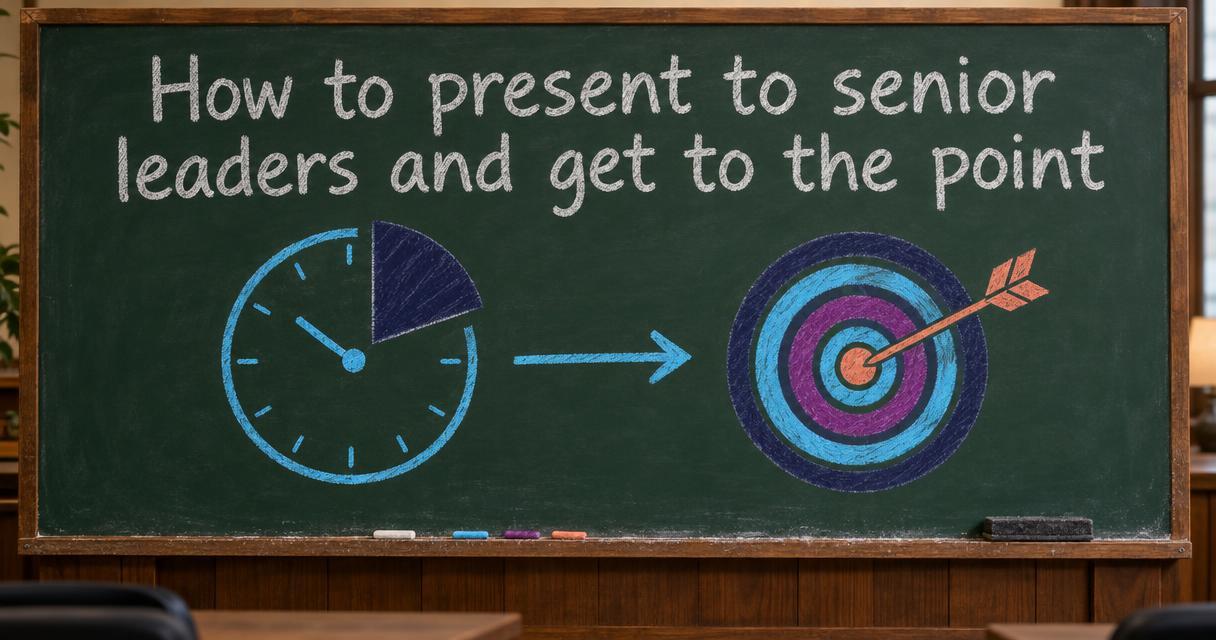
To present to senior leaders effectively, you must open with the final decision they need to make rather than the journey you took to get there. It is a stressful shift in communication style, especially when you have spent weeks preparing a dense slide deck only for an executive to cut your allocated time down to five minutes. Learning how to present to senior leaders means learning how to master brevity, handle intense pushback, and keep a room full of busy people focused on the short answer.
Last reviewed November 2026
Key takeaways
- Lead with the short answer upfront because executives care about decisions rather than context.
- Prepare a five-minute contingency version of your presentation in case your time slot is suddenly cut short.
- Design your slides for rapid scanning because dense text causes cognitive overload and derails the meeting.
- Handle interruptions by treating them as buying signals rather than personal attacks on your work.
- Send a clear read-ahead document to answer the obvious questions before you even step into the room.
The problem with traditional presentations
Most professionals learn to build a presentation like a story. They start with the background, outline the methodology, present the data, and finally reveal the conclusion. This approach proves you did the work. It also guarantees you will lose an executive audience within the first three minutes.
Senior leaders operate in a constant state of context switching. They move from a board meeting about revenue to a crisis management call and then straight into your presentation. They do not have the cognitive bandwidth to sit through your discovery journey. Ineffective workplace communication costs U.S. businesses an estimated $1.2 trillion annually, according to a 2024 report by Grammarly. When you force executives to hunt for your main point, you waste expensive time and damage your credibility.
The stakes for getting this right are high. Research published by PortoTheme reveals that 61 percent of executives say at least half of their meetings fail to produce decisions. You have to design your time in the room to force an outcome.
Lead with the short answer upfront
The single most important rule for an executive audience is to give them the answer first. Military and government communicators call this the BLUF method, which stands for Bottom Line Up Front. You state your recommendation, the cost, and the required action on the very first slide.
"The best ideas don't always win", as noted by Antoinette Roze on The Leadership Project. She argues that presenters must identify the audience's problem, the one idea leaders need to understand, and the exact next action required. If they agree with your bottom line immediately, you might not even need to present the rest of your deck. You can use the remaining time to discuss implementation or budget.
When you learn how to get to the point when you speak at work, you demonstrate respect for their schedule. If leaders want to know how you arrived at your conclusion, they will ask. Your job is to have the supporting data ready, not to force them to sit through it.
Control the narrative with pre-meeting read-aheads
Executives read much faster than you can speak. If you put a wall of text on a screen, they will read the text, ignore your voice, and find a typo to argue about. A survey from Decktopus, cited by PortoTheme, shows that more than 70 percent of audiences prefer slides containing less than 25 percent text.
The solution is to separate your reading material from your presenting material. Send a comprehensive read-ahead document two days before the meeting. This document should contain all your charts, methodologies, and detailed financial models. When you pitch a business case to the executive team, the read-ahead does the heavy lifting.
In the actual room, your slides should be visual anchors. Use a single powerful metric or a clear graphic on each slide. The presentation is the conversation you have about the document, not a live reading of the document itself.
Handle pushback without losing your composure
An executive presentation rarely goes according to a rehearsed script. A leader will interrupt you on slide two to ask a highly specific question about slide eight. When this happens, do not ask them to hold their questions until the end. An interruption is a signal that they are engaged and thinking critically about your proposal.
Your reaction in these moments matters more than the content of your slides. Research by Sylvia Ann Hewlett, cited by EVP Leadership, found that senior executives weight gravitas at 67 percent, communication at 28 percent, and appearance at just 5 percent when defining executive presence. Gravitas is your ability to remain calm and authoritative under pressure.
Tailor your responses to the personalities in the room. A leader with a Doer personality will want rapid execution facts, while an analytical leader will want to test your risk assumptions. If you struggle to hold your ground during aggressive questioning, Hey Compono can help you rehearse these high-stakes scenarios out loud before the meeting.
Prepare a five-minute contingency plan
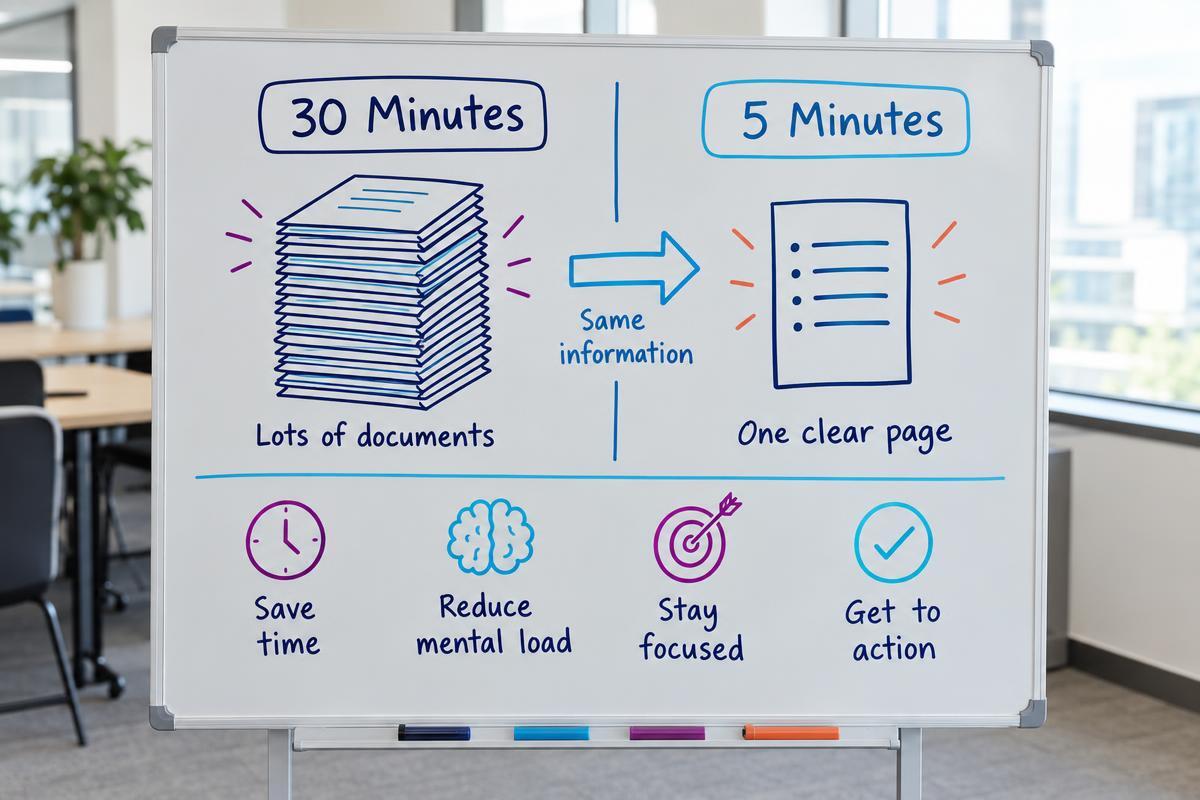
You will eventually face a situation where you are scheduled for 30 minutes, but the CEO walks in late and announces they only have five minutes before a hard stop. You cannot just talk six times faster. You must pivot immediately to a condensed version of your pitch.
Always prepare an executive one-pager. This is a single physical or digital document that contains the problem, the proposed solution, the budget required, and the expected return on investment. If your time is cut short, drop the slide deck entirely. Hand out the one-pager and state exactly what you need from them.
This level of adaptability builds immense trust. It shows leadership that you value their time and can operate efficiently under constraints. Practising your pivot with Hey Compono builds the muscle memory you need to remain calm when the schedule falls apart.
Secure the outcome and document the decision
A successful presentation is worthless if people leave the room with different understandings of what was agreed upon. Virtual and hybrid meetings make this even harder because you cannot always read the room's body language. You must actively clarify the outcome before the meeting ends.
Reserve the final three minutes for a definitive close. Summarise the decision that was just made, name the person responsible for funding it, and outline the immediate next steps. Driving effective decision making for modern teams requires someone to take ownership of the consensus.
Follow up within one hour with a short, bulleted email. Reiterate the decision, list any open questions that require further research, and thank them for their time. This creates a paper trail and ensures accountability across the leadership team.
How Hey Compono can help with executive presentations
Getting a leadership team to agree on a path forward requires practice and preparation. The AI coaching platform gives you a private space to rehearse your pitch, handle difficult questions, and refine your communication style before you step into the boardroom.
Related reading
Frequently asked questions
How do you start a presentation to senior executives?
Start by stating the exact decision you need them to make. Outline the core problem, your recommended solution, and the cost upfront. Skip the introductory context and dive straight into the business impact.
What should I do if a leader interrupts my pitch?
Stop talking and listen to their question. Do not ask them to wait until the end of the presentation. Answer the question directly, even if it forces you to skip ahead to a later slide, and then smoothly guide the conversation back to your main point.
How many slides should an executive presentation have?
Keep your presentation as short as possible. Aim for one visual anchor per main idea rather than a specific number of slides. Place all your detailed data, charts, and background methodology in an appendix that leaders can review on their own time.
What is a read-ahead document?
A read-ahead is a detailed summary sent out a few days before your meeting. It contains the heavy context, financial models, and data that executives need to review so they can use the actual meeting time for debate and decision-making.
How do I handle a meeting time getting cut in half?
Abandon your standard slide deck immediately. Switch to your executive summary or a one-page document. State the problem, your recommendation, and the resources you need, then open the floor to their questions.