
 Compono
What HR can and cannot see in AI coaching
 Mathan Allington
Exactly what HR can and cannot see when you use workplace AI coaching. Learn how your privacy is protected and what aggregate data your company...

Salary negotiation practice AI works by simulating real-time conversations with a hiring manager, allowing you to test your arguments, refine your delivery, and build confidence before the actual meeting.
Key takeaways
- Using AI to rehearse salary discussions helps you anticipate pushback and formulate calm, professional responses under pressure.
- AI tools are excellent for generating scripts, but you must adapt the language to fit your natural communication style so you do not sound rehearsed or robotic.
- Never rely on AI for your market research – always bring verified industry data into your prompts to prevent the bot from hallucinating salary bands.
- Negotiating is about more than base pay, and AI can help you practice asking for additional paid time off, flexible hours, or signing bonuses.
Asking for more money is universally uncomfortable. Your heart rate spikes, your palms sweat, and all the logical points you prepared suddenly vanish from your mind. You sit in front of a mirror practising your pitch, but the mirror does not talk back. It does not interrupt you, tell you the budget is tight, or ask why you think you deserve the top of the band.
This is exactly why professionals are turning to technology to prepare. A salary negotiation practice AI gives you a low-stakes environment to stumble, try again, and figure out what works before you get into the room. It acts as a sparring partner that can throw every common objection your way.
But there is a massive difference between reading an AI-generated script and actually delivering it while looking another human in the eye. If you want to secure the best possible offer, you need to know how to use these tools effectively – and where you need to rely on your own human instincts.
When you practice with a friend or partner, they usually go easy on you. They want you to succeed, so they accept your arguments without much resistance. An AI simulator does not care about your feelings. You can instruct it to be difficult, stubborn, or dismissive, forcing you to maintain your composure.
The results of this preparation are hard to ignore. Recent data shows 78% of professionals said they feel more confident in salary negotiations when they use AI to prepare. That confidence comes from repetition. When you have already answered a difficult question ten times against a bot, the eleventh time against a real hiring manager feels routine.
Using a simulator also helps you strip the emotion out of your pitch. Many people approach salary talks defensively, feeling they need to justify their worth. AI helps you reframe your arguments around market value and business impact, keeping the conversation objective and professional.

While preparation is helpful, relying too heavily on technology can backfire. The temptation to let the bot do all the heavy lifting is strong. In fact, 47% of U.S. adults said they would let AI negotiate their pay, and one in three have already asked AI for advice on raises or bonuses.
But Valerie Chapman, founder of Ruth AI, points out a significant risk: “People are handing the most consequential money conversation of their lives to a tool most have never questioned.”
When you copy and paste an AI script, you risk sounding like a corporate textbook. Hiring managers negotiate regularly. They can tell when someone is reciting a generic, highly sterilised speech. If your delivery feels unnatural, you lose the human connection that often tips the scales in a close negotiation.
This is where self-awareness becomes your biggest asset. At Hey Compono, we know that different work personalities handle conflict and high-stakes conversations in vastly different ways. An AI tool will usually generate a highly logical, direct script. How you deliver that script depends entirely on your natural style.
If you are naturally a "Helper" – someone who values team harmony and avoids conflict – delivering a blunt, AI-generated ultimatum will feel terrible. Your body language will betray your discomfort, and the hiring manager will sense your hesitation. Instead, you need to adapt the AI's points into collaborative language. Frame the negotiation as a mutual problem to solve together.
Conversely, if you are an "Evaluator" or a "Doer", you might take the AI's direct script and deliver it too aggressively. Your challenge isn't finding the courage to ask; it is remembering to soften the edges. You might need to actively practice adding warmth to the AI's logical arguments so you do not come across as adversarial.
If you're curious what personality type you default to under stress, Hey Compono can show you in about 10 minutes. Knowing your baseline helps you translate robotic advice into authentic human communication.
One of the biggest mistakes people make with salary negotiation practice AI is asking the bot what they should be paid. Generative AI tools are notorious for hallucinating numbers or pulling outdated salary bands from years ago.
Employers are catching on to this trend. Recent surveys reveal that 70% of employers said they noticed an increase in employees citing data from AI tools such as ChatGPT during salary negotiations. Even worse, 63% of employers said they saw more employees requesting salaries based on unreliable or unverified data this year.
If you walk into a negotiation and cite a salary band that does not exist in reality, you immediately lose credibility. You must do your own market research using verified industry reports, networking, and established salary databases. Once you have the real numbers, feed them into your AI prompt to practice defending them.
To get the most out of your practice sessions, you need to set the scene accurately. Do not just ask the bot to "help me negotiate." Give it a specific persona, context, and constraints.
Try using a prompt like this: "You are the hiring manager for a Senior Marketing Manager role. I have just been offered the position at $110,000, but my market research shows the band is $120,000 to $135,000. I am going to ask for $125,000. I want you to push back, tell me the budget is strictly capped, and ask me to justify the higher number. Do not make it easy for me."
By forcing the AI to take a hard line, you get to practice sitting in the discomfort of a "no." You can test different pivots and see which arguments feel most natural rolling off your tongue.
When setting up your salary negotiation practice AI, make sure you program it to ask the most common and difficult questions hiring managers use to test your boundaries. Practising these out loud is critical.
Have the bot ask: "What are your salary expectations?" This often comes up early in the interview process, and fumbling it can anchor your offer too low. Practice deflecting the question or confidently stating your researched range.
Also prepare for: "We can't meet that number, but we can offer X. Will you accept?" This is the classic squeeze. Use the simulator to practice pausing, acknowledging the offer, and pivoting to other forms of compensation if the base pay truly will not move.
A successful negotiation rarely begins and ends with the base salary. If a company is genuinely restricted by internal pay bands, you need to know what else you value before you sit down at the table. AI simulators are excellent for practising these secondary requests.
Interestingly, 17% of professionals said AI helped them secure more PTO or work flexibility during salary negotiations. You can use your practice sessions to transition smoothly from a stalled salary talk into a conversation about signing bonuses, remote work days, or accelerated performance reviews.
Tell your AI simulator: "If you refuse my salary request, I am going to ask for an extra week of annual leave. I want you to act hesitant so I can practice justifying the request based on my past performance."
The goal of rehearsing with a bot is not to memorise a script word for word. The goal is to build muscle memory. When you have practiced navigating pushback a dozen times, your nervous system stays calm when the real hiring manager says no.
Take the structure the AI gives you, combine it with verified market data, and filter it through your own personality. Personality-adaptive coaching principles remind us that authenticity builds trust. If you speak like yourself, advocate for your worth clearly, and remain professional, you put yourself in the strongest possible position to get what you deserve.
Key insights
- AI simulators provide a safe, low-stakes environment to practice handling difficult objections and salary pushback.
- The best negotiation outcomes happen when you blend AI-generated structure with your natural, authentic communication style.
- Employers are increasingly wary of candidates citing unverified AI data, making independent market research non-negotiable.
- Practising how to pivot to secondary benefits like flexibility or PTO can save a negotiation when base salary budgets are capped.
Understanding your natural communication style is the secret to taking an AI script and making it sound authentic in the real world. When you know how you default under pressure, you can adjust your approach to negotiate with genuine confidence.
Related reading
Using AI to practice and prepare for a salary negotiation is highly effective for building confidence and testing arguments. However, you should never read an AI script verbatim to a hiring manager, as it often sounds unnatural and rehearsed.
No. Generative AI tools frequently hallucinate salary data or rely on outdated information. Always conduct your own research using verified industry reports and bring those real numbers into your AI practice sessions.
Give the AI specific instructions about the role, the offer, and the budget constraints. Tell it to act stubborn, ask difficult questions, and push back on your requests so you can practice handling resistance.
Never say you got your numbers from AI. You should be able to confidently state that your expectations are based on independent market research, industry benchmarks, and the specific value you bring to the role.
Your personality dictates how you handle conflict and pressure. Some people naturally avoid conflict and need to practice holding their ground, while others are naturally blunt and need to practice softening their delivery to maintain a collaborative tone.
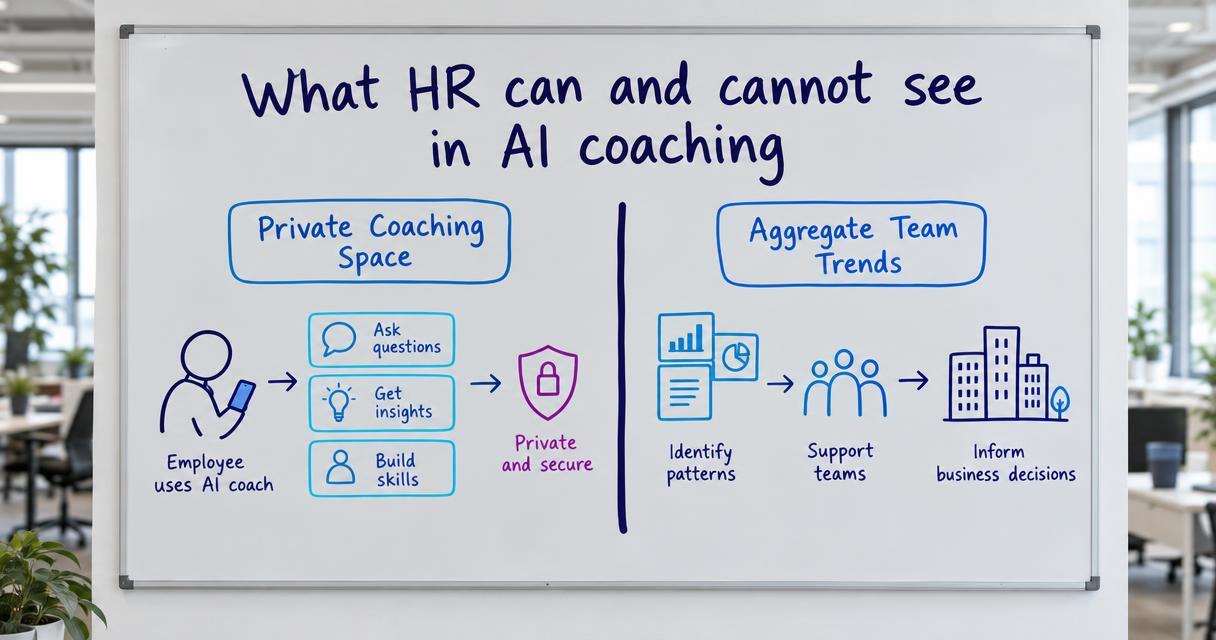
Exactly what HR can and cannot see when you use workplace AI coaching. Learn how your privacy is protected and what aggregate data your company...

Career advice without the corporate script. How coaching that adapts to how you work beats another framework you will never use again.

How white label candidate coaching helps you scale personalised support, improve placement rates and add a new revenue stream.
 Compono