
 Compono

1 min read
Why your work performance feels like it is getting worse
 Compono
If your work performance feels like it is getting worse, the cause is often a clash between your natural work personality and your current...

A therapist can help you work through emotional exhaustion and mental health challenges. Sometimes, though, the root of the distress is a mismatch between your natural personality and what your current job actually asks of you. Telling those two apart is the first real step forward.
Last reviewed July 2026.
Key takeaways
- Therapy is essential for managing clinical mental health issues and deep-seated emotional patterns.
- Career dissatisfaction often comes from doing work that drains your natural energy day after day.
- Understanding your work personality can reveal whether you are in the wrong role or just need better coping strategies.
- High-performing teams need a balance of eight work actions, including Helping and Advising.
You wake up on a Tuesday and the day feels like a lead blanket. You have been told you are too sensitive, too intense, or not resilient enough for the pressure of modern work. It is a lonely place to be, feeling like you are failing at a game where everyone else seems to know the rules.
We often jump to the conclusion that we are broken and need fixing. We look for a therapist to help us toughen up or manage the anxiety that spikes every time an email pings. Before you book that session, it is worth asking a harder question: is the problem inside your head, or is it the environment you are forcing your head into every day? At Compono we have spent more than a decade researching the intersection of human behaviour and workplace performance, and a lot of what we label burnout or workplace anxiety is actually a personality clash with a job description. Spend forty hours a week working against your natural grain and your mental health eventually pays for it.
There is no shame in seeking professional support. A therapist gives you a safe, objective space to untangle your thinking and process the things we all carry to some degree. If you are experiencing persistent low mood, panic attacks, or an inability to function, a mental health professional is your first port of call.
Many professionals, though, find themselves in the therapist's chair talking in circles about a boss they dislike or a project that feels meaningless. In those cases the therapy might be treating the symptoms of a deeper misalignment. You are not necessarily anxious because of a chemical imbalance. You might be anxious because your Helper personality is being forced to work like a cold, results-driven Evaluator.
Look at where your energy goes. If you finish a day feeling like a hollowed-out shell, it might not be the workload, it might be the type of work. A Helper thrives on empathy and supporting others. Stuck in a role built around constant aggressive competition, no amount of talk therapy will make that role feel comfortable.
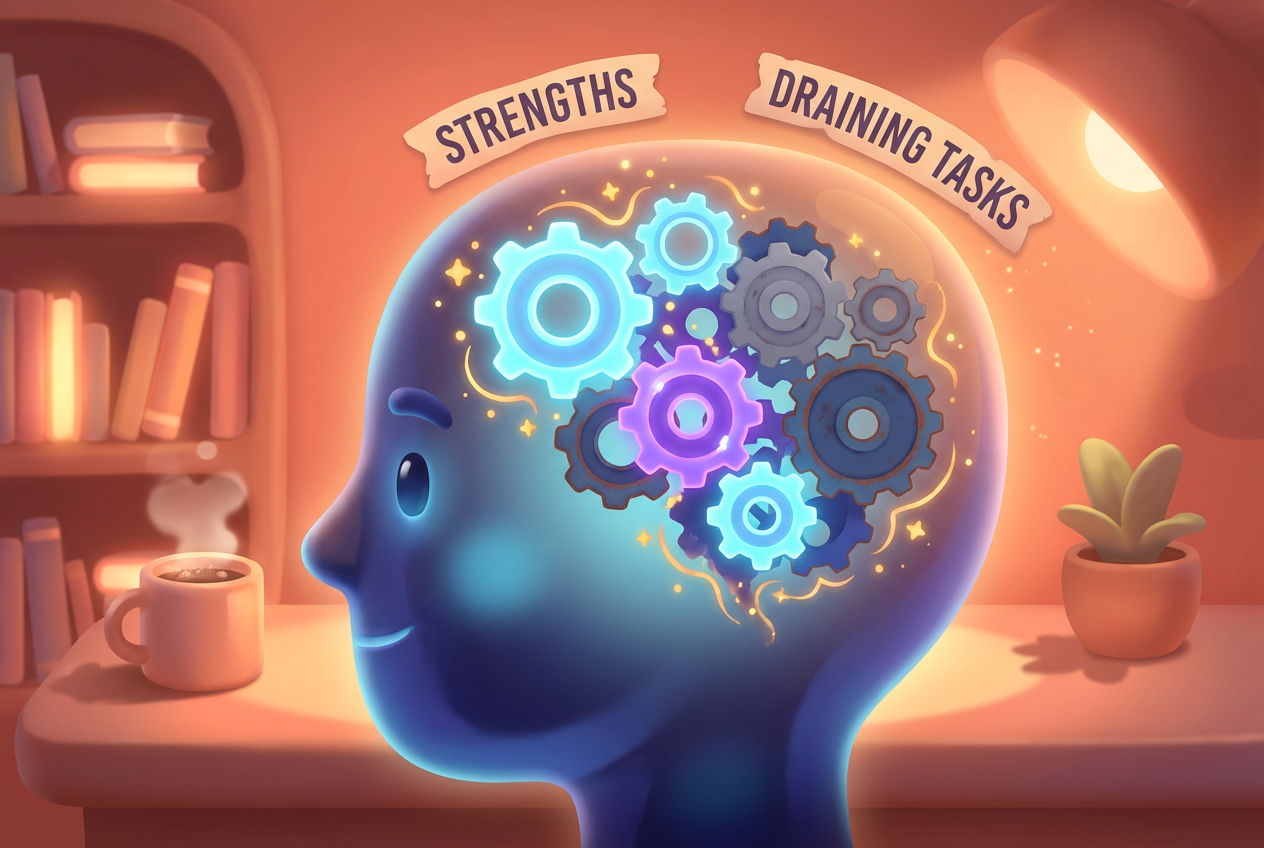
We all have a dominant work personality that shapes which activities give us energy and which ones take it away. Understand that and the reason behind your stress gets much clearer. You stop blaming yourself for being lazy or unproductive and start seeing that you are trying to swim upstream.
High-performing teams draw on eight work actions: Evaluating, Coordinating, Campaigning, Pioneering, Advising, Helping, Auditing, and Doing. Most of us are naturally strong at two or three. If your job keeps you in your blind spots most of the time, you will eventually feel like you need a therapist just to survive the week. There is a way to see which of these patterns fits you, so take a quick personality read and see what comes up. This is not about pigeonholing yourself, it is about the self-awareness to know why some tasks feel like pulling teeth while others feel like second nature.
Many people who seek out a therapist have spent years being told they are too much. Too detailed. Too emotional. Too focused on the big picture. In the wrong job those traits get treated as faults. In the right job they are the whole point. Someone told they are too obsessive about details is a liability in a fast-moving sales role and an absolute hero as an Auditor.
Validation is powerful. When you realise your intensity is a Pioneer spirit looking for an outlet, the shame starts to lift. You are not broken, you are misapplied. This is where the work of Hey Compono becomes a practical companion to therapy. Therapy helps you understand your past, and understanding your work personality helps you design your future. We see it often with the Advisor type, who is empathetic and open-minded but can get crushed in rigid, directive environments. They might think they have an anxiety disorder, then move into a collaborative, coaching-based role and watch the anxiety fade. They did not need to change who they were, they needed to change where they were.

Self-awareness is the bedrock of any meaningful change. Whether you find it through a therapist or through a personality read, the goal is the same, to live a life that feels authentic. If you are constantly masking your true self to fit a corporate mould, the friction eventually causes fire, and burnout is just the smoke.
If you are curious which personality type you default to under stress, Hey Compono can show you in about ten minutes. That insight lets you have better conversations with your manager, your partner, and even your therapist. Instead of saying "I'm stressed," you can say "I'm being asked to spend too much time Coordinating when my strength is Campaigning." That kind of specificity turns a vague dread into a solvable problem, and it moves you from feeling like work happens to you towards actively shaping your path to match how you are wired.
Related reading: How to know when you need guidance in your career · How to know my strengths and why it matters for your career
Career change coaching that starts with your personality, not a template. Start free.
Get started freeA therapist can help you identify the values and emotional patterns that influence your choices, though they are not career counsellors. They help you clear the mental clutter so you can decide based on who you really are, rather than who you think you should be.
Burnout usually feels like a total depletion of empathy and energy across all areas of life. If you are still passionate about your hobbies and relationships but dread every specific task at work, it is more likely a role mismatch than clinical burnout.
At Compono we define work personality as your dominant natural preference for certain work activities. It is grounded in decades of organisational psychology and helps explain why you gravitate towards some tasks and avoid others.
This depends on your workplace culture and your comfort level. You are not legally required to disclose it in most places. Talking about your work personality and how you work best is often a safer and more productive way to ask for the support you need.
The Hey Compono assessment is quick and intuitive, usually about ten minutes. It gives you immediate insight into your major characteristics and likely blind spots.

1 min read
If your work performance feels like it is getting worse, the cause is often a clash between your natural work personality and your current...

1 min read
A work persona is the version of yourself you bring to the job: the behaviours, communication habits, decision-making style and energy you adopt to...

1 min read
Unfulfilling work usually happens when there is a fundamental mismatch between your natural work personality and the specific activities you perform...