 Mathan Allington
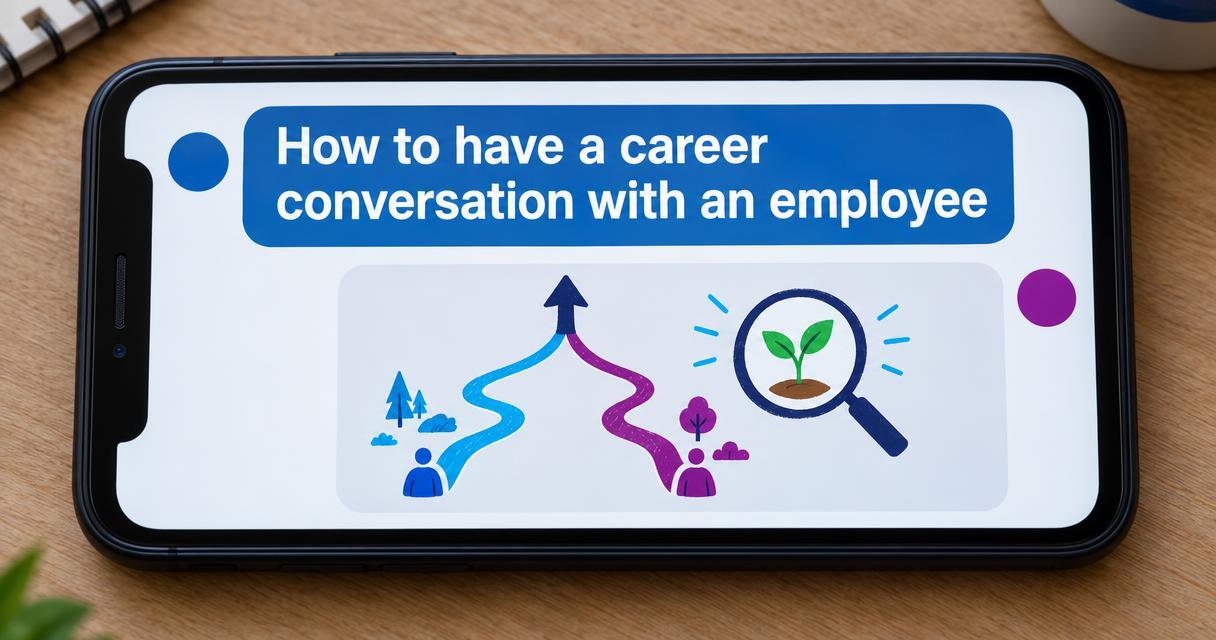
To know how to have a career conversation with an employee, you need to separate it completely from their annual performance review and focus entirely on their future goals rather than their past mistakes.
Last reviewed November 2026
Key takeaways
- Career conversations must happen separately from performance reviews to keep the focus on growth instead of evaluation.
- Managers should send preparation questions a week in advance so both parties arrive ready to talk about the future.
- Effective conversations rely on open-ended questions that uncover what an employee actually enjoys doing every day.
- Not every career move is a promotion upwards; lateral moves and reskilling are powerful ways to keep staff engaged.
- You must document a shared digital action plan with specific timelines to ensure the conversation turns into real progress.
Most managers know they should be talking to their team about career growth. The problem is that these chats often get pushed back, forgotten, or squeezed into the last five minutes of a stressful project update. When you neglect career discussions, people start looking for a door. A recent Gallup survey found that 45% of employees who voluntarily left their jobs said no manager or leader had proactively discussed their future during their final three months.
People want to know they have a future at your company. When they do not see a path forward, they assume one does not exist. A 2025 McKinsey report found that only about one-third of employees receive consistent support from their managers for career development. If you want to keep your best people, you have to talk to them about where they are going.
The good news is that you do not need all the answers. You just need a solid framework to guide the discussion. Hey Compono is built on the reality that regular, honest conversations are the foundation of a strong team. Here is exactly how to structure and run those conversations.
The difference between a performance review and a career conversation
You cannot combine a performance review with a career conversation. If you try, the performance review will eat the career conversation alive.
Performance reviews look backwards. They are about measuring past output, correcting mistakes, and deciding on compensation. When money and grading are on the table, employees naturally get defensive. They want to prove they did a good job.
Career conversations look forwards. They are about aspirations, skill gaps, and what the employee wants to do next year or in five years. You need the employee to be vulnerable about what they do not know yet. If they are busy defending their past performance, they will never be honest about their future fears.
Schedule career conversations at a completely different time of year to performance reviews. A good rhythm is to hold them twice a year, sitting squarely in the middle of your usual review cycles.
Phase 1: Pre-meeting preparation and setting expectations
A career conversation will fail if you both turn up with a blank piece of paper. The most critical work happens before you even book the meeting room.
Give your employee at least a week of notice. Tell them exactly what the meeting is about and what you need them to think about beforehand. This is where good one on one meeting preparation makes a massive difference. You want them to reflect on their own goals rather than waiting for you to hand them a career path.
Send a brief questionnaire to get them thinking. Keep the questions simple:
- What parts of your current role do you enjoy the most?
- What projects drain your energy?
- What is one new skill you want to learn in the next six months?
- Where do you see your career heading in the next few years?
As the manager, you also need to prepare. Look at the company roadmap and think about where new opportunities might pop up. You should also consider their natural working style. The Work Personality framework is highly useful here because a highly analytical employee will want a completely different career path to someone who thrives on taking big creative risks.
Phase 2: During the meeting
When you sit down, your job is to listen more than you speak. You are playing the role of a coach rather than an instructor.
Start by setting a safe tone. Let them know this is an open space to talk about what they want, even if that eventually means moving on to another company. When you remove the pressure of pretending they will stay in their current seat forever, people open up.
Use open-ended questions to guide the chat. If they say they want to be a manager, do not just nod and write it down. Dig deeper. Ask them what it is about management that appeals to them. Often, people say they want to be managers just because they think it is the only way to get a pay rise. They might actually hate managing people and would be much happier as a highly paid technical specialist.
Plug-and-play conversation scripts
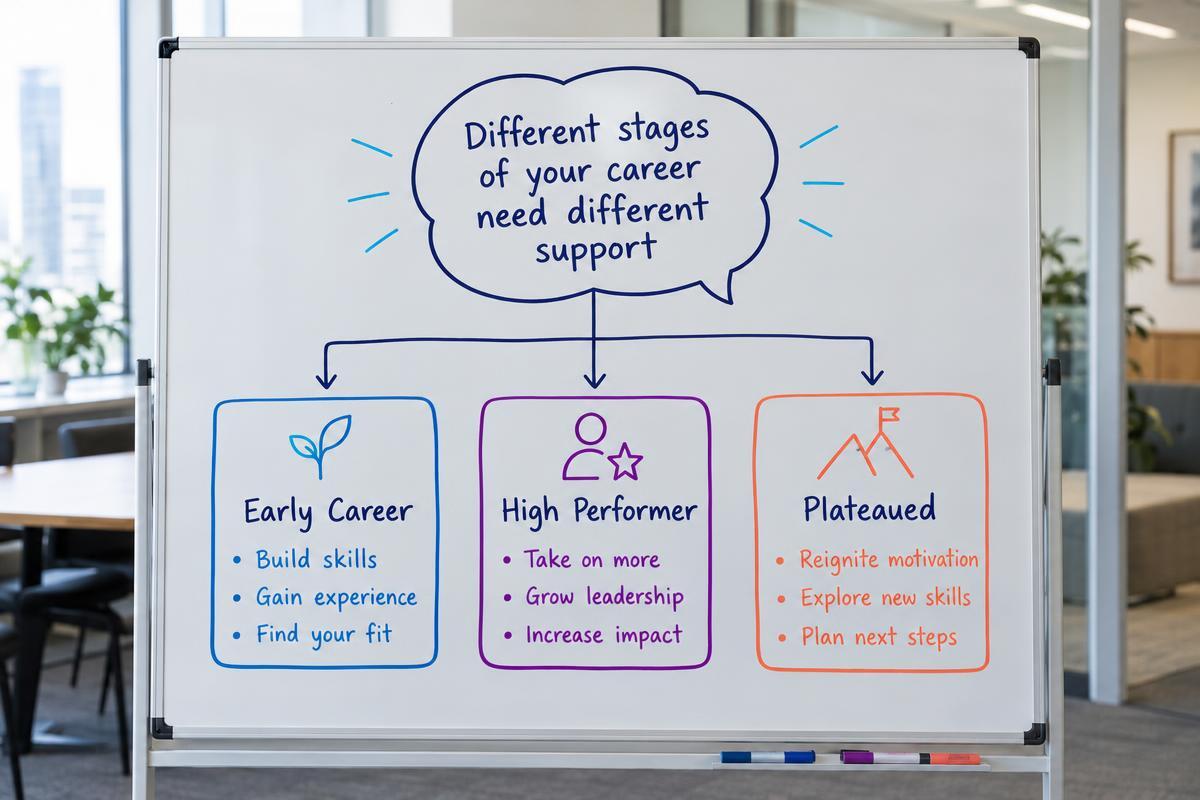
Different employees need different approaches. Here is how to frame the conversation based on where they are right now.
For the early-career employee figuring things out:
"I know you are still getting a feel for the industry, which is perfectly fine. Today is just about figuring out what you enjoy doing. Let's look at the projects you worked on last quarter. Which one made you lose track of time because you were so engaged?"
For the high-performer ready for more:
"You are absolutely crushing your current targets. The business is growing, and we have some interesting problems to solve over the next year. If you could write your own job description for the next phase of our growth, what would be on it?"
For the disengaged or plateaued employee:
"I want to make sure your role is actually serving you. Recently, it has felt like you might be a bit drained by the current workload. If we could take one task off your plate and replace it with something you want to learn, what would those two things be?"
Handling difficult career conversation scenarios
Not every career conversation is a smooth chat about promotions and new titles. Sometimes you have to manage friction and disappointment. If things get tense, you might need to practice a difficult conversation with an employee before you have the real thing. Here is how to handle the most common roadblocks.
Managing unrealistic expectations
Sometimes an employee wants a promotion to a senior role, but they simply do not have the skills yet. Your job is to bring them back to reality without crushing their motivation.
Do not just say no. Break down the gap between where they are and where they want to be. Say something like, "I love that you are aiming for the senior director role. To get there, the business needs someone who can run complex cross-department projects. Right now, you are great at team-level execution. Let's make your goal for the next six months leading a project with the finance team so you can build that specific skill."
When there is no budget for training or promotions
You will often have career conversations when the company is in a hiring freeze or cutting budgets. You cannot promise a promotion, but you can still offer growth. A recent ADP study found that employees who said their employer invested in their skills were nearly six times more likely to recommend the company to others.
Growth does not always cost money. Look for stretch assignments, shadowing opportunities with senior leaders, or internal team transfer conversations that allow them to learn a completely new part of the business. Lateral moves are excellent for building institutional knowledge and keeping smart people engaged when upward mobility is temporarily blocked.
Adapting for remote and hybrid teams
Remote career conversations require more structure. You cannot rely on reading body language across a desk. Turn your camera on, minimise all your other windows, and give them your complete focus. Remote workers often feel invisible, so explicitly mapping out their career trajectory is vital to keeping them connected to the company mission.
Phase 3: Building the development plan and following up
A great conversation is useless if nothing happens afterwards. You have to write things down and hold each other accountable.
A 2025 LinkedIn report revealed that only 15% of employees said their manager helped them build a career plan in the previous six months. That is a massive failure of follow-through.
Create a shared digital action plan. This does not need to be a complex piece of software. A simple shared document works perfectly as long as you both have access to it and check it regularly.
| Timeline | Manager action | Employee action |
|---|---|---|
| Within 24 hours | Send a summary email of what was discussed. | Review the summary and add any missed details. |
| Within 1 week | Approve the specific goals in the shared document. | Draft three concrete milestones for the next quarter. |
| Every 4 weeks | Check in on progress during a regular one-on-one. | Report on what is working and what is blocked. |
| Every 6 months | Schedule the next formal career conversation. | Reflect on the previous six months of growth. |
When you put dates against actions, progress happens. If they wanted to learn a new skill, their milestone for the first month might simply be researching three online courses. Your milestone might be introducing them to the head of a different department for a mentoring coffee.
It is normal to feel nervous about guiding someone else's career. That is why an AI coaching platform for teams can take the pressure off by giving managers the exact frameworks and practice they need to have these chats confidently. The Hey Compono app lets managers rehearse difficult scenarios before they happen, ensuring they walk into the real meeting ready to listen.
A 2025 ADP report found that only 24% of employees feel confident they have the skills needed to move up in their organisation. Your job as a manager is to help them build that confidence. By dedicating real time to their future, setting clear goals, and following up relentlessly, you transform from a boss into a career sponsor. That is how you build a team that actually wants to stick around.
How Hey Compono can help with manager coaching
Guiding a team member's career is tough when you have your own workload to manage. Hey Compono gives new and existing leaders the practice they need to handle development chats, difficult feedback, and team friction without the guesswork.
Related reading
Frequently asked questions
How often should a manager have a career conversation with an employee?
You should aim for two dedicated career conversations a year. These should be entirely separate from annual or quarterly performance reviews. However, you can and should touch on career progress briefly during your regular weekly or fortnightly one-on-one meetings to ensure the agreed goals remain on track.
What if an employee does not know what they want to do next?
This is incredibly common, especially for early-career professionals. Take the pressure off finding a ultimate destination. Instead, focus the conversation on the immediate future. Ask them what tasks they enjoy doing right now, what they want to learn in the next three months, and what sort of work they want to avoid. You can build a growth plan around following their energy rather than forcing them to pick a specific job title.
How do you handle a career conversation when there are no promotion opportunities?
Be honest about the current business market upfront so you do not build false hope. Then, pivot the conversation to lateral growth and skill development. Discuss opportunities for them to lead cross-functional projects, shadow senior leaders, or learn a completely new discipline that makes them more valuable for when the budget eventually opens up.
Should HR be involved in employee career conversations?
Usually, no. A career conversation is a trusting dialogue between a manager and their direct report. Bringing HR into the room can make it feel like a formal performance intervention or a disciplinary meeting. HR provides the frameworks and training for managers to have these chats, but the manager must lead the actual conversation.
What is the best way to track progress after the conversation?
Create a shared digital document that both you and the employee can edit. Break their big career goals down into small, actionable milestones with specific deadlines attached to each quarter. Open this document briefly at the end of your regular one-on-one meetings to check on progress and remove any blockers they are facing.