
 Mathan Allington
How to prepare a candidate for a second interview: a guide
 Mathan Allington
To prepare a candidate for a second interview. Discover recruiter frameworks for panel dynamics, competency coaching and presentation practice.
You read through your interview notes, the points make right sense in your head, and then you try to say them out loud and completely freeze.
Last reviewed November 2026
Key takeaways
- Thinking about an answer uses a different part of the brain than speaking it under pressure.
- Recording your first cold attempt shows you exactly where your story structure falls apart.
- Repeating an answer out loud three to five times helps you find your natural phrasing without sounding robotic.
- Using a structured self-audit helps you fix pacing, breathing, and filler words before the real interview.
There is a massive gap between knowing what you want to say and actually saying it. When you read a prepared answer silently, your brain fills in the blanks. You skip over awkward transitions. You ignore how long the story actually takes to tell.
Then the interview starts, the adrenaline hits, and that right mental script turns into a rambling mess. Practising out loud bridges that gap. It forces you to deal with the physical mechanics of speaking. It feels incredibly awkward to talk to an empty room or a laptop camera. Pushing through that awkwardness is how you build the muscle memory required to sound confident when a hiring manager is staring back at you.
The cognitive load of a job interview is heavy. You are trying to read the room, remember your work history, and project confidence all at once. According to a 2020 JDP survey of 2,018 people, 70% of Americans practise interview responses out loud. The same research shows 62% prepare anecdotes in advance. This suggests that spoken practice works best when you already have your core stories mapped out.
When you only practise silently, you are memorising a written script. Written language is formal and dense. Spoken language is looser and requires breathing room. If you try to recite a written document, recruiters spot the performance immediately. Interview responses should be rehearsed without memorising exact wording because hiring managers easily identify answers that sound overly rehearsed.
You need to prepare for an interview without a script. The goal is to know the milestones of your story so well that you can explain them naturally, even if the exact words change every time.
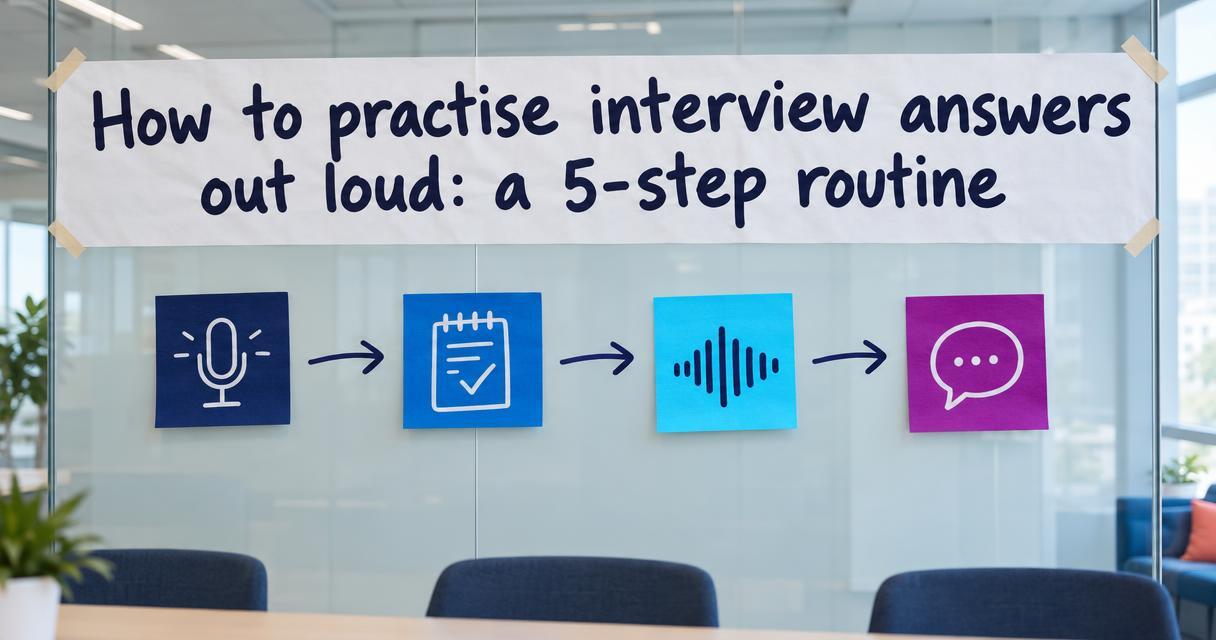
Talking to yourself in the mirror is a classic piece of advice, but it lacks structure. You need a systematic way to improve. A practical target is three to five aloud run-throughs per core interview story. This allows your phrasing to vary naturally while the core structure stays intact.
First, record a cold answer using a voice memo app. Pick a common question and answer it out loud without looking at your notes.
Second, play it back. This is painful but necessary. Listen for where you rambled or lost the main point entirely.
Third, refine one specific thing. Do not try to fix everything at once. Focus on trimming a long introduction or clarifying the business result.
Fourth, repeat the process. Professor Michael Chad Hoeppner recommends "loud drafting": answering an open-ended question aloud repeatedly until the response sounds natural. Keep your answers under 90 seconds to hold the listener's attention.
Fifth, introduce a wildcard. Have a friend ask a random follow-up question to break your script and force you to think on your feet.
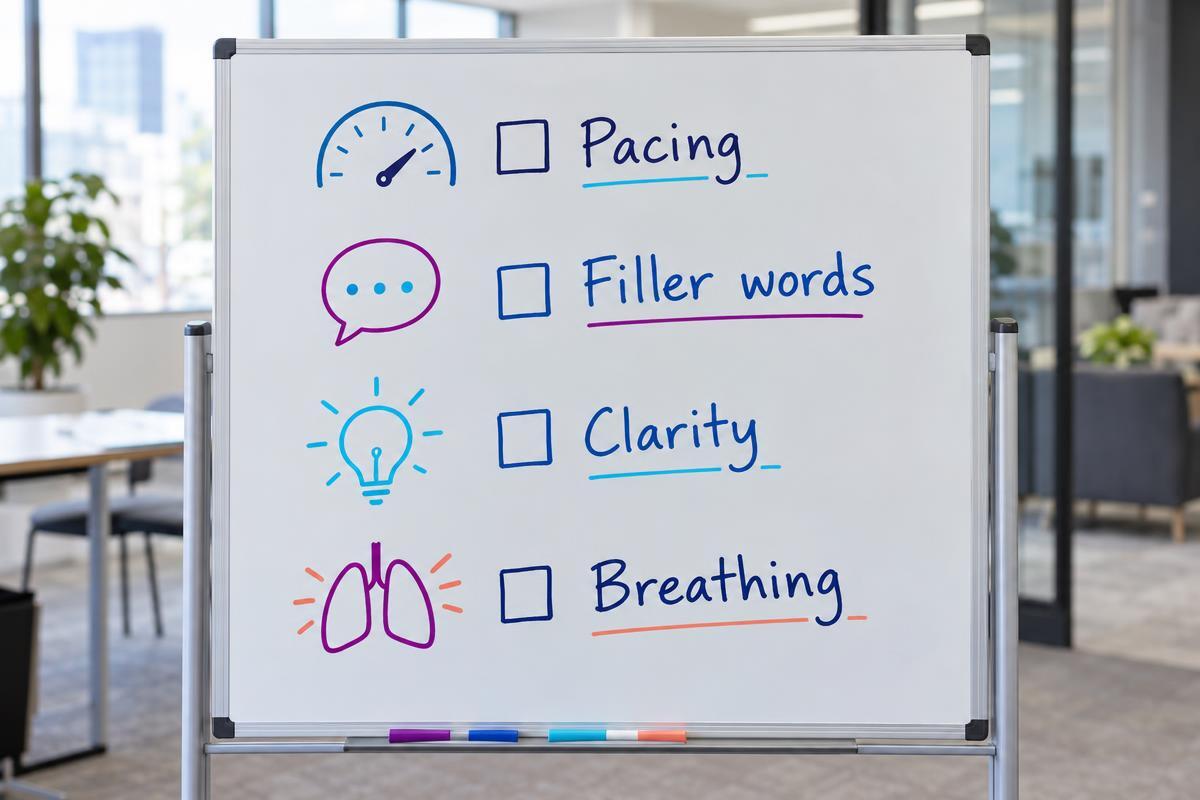
Recording your practice is useless if you do not know what needs fixing. Create a mental rubric to audit your playbacks. If you want a more formal framework, you can score interview answers using an interview rubric to track your progress.
Check your pacing first. People speak much faster when they are nervous. If your voice sounds tight and rushed, you are probably holding your breath. Try taking a deliberate breath before you start speaking and pausing briefly between your main points.
Count your filler words. A few ums and ahs are entirely human and acceptable. If you use them to bridge every single sentence, they become distracting. The fix is learning to tolerate silence. When you lose your train of thought, just stop talking for a second.
Evaluate your clarity. Did you actually answer the prompt, or did you get lost in background details? If a stranger listened to the recording, they should be able to identify the main takeaway immediately.
The STAR method is the standard way to structure behavioural answers. Candidates often sound like robots when they move through these steps out loud. They announce the transitions rigidly, ticking boxes instead of having a conversation.
To fix this, use your out-loud practice to soften the edges of the framework. Instead of saying "The situation was", try starting with the context naturally. A phrase like "Last year, our team was facing a massive backlog" sets the scene without sounding like a textbook.
Different people struggle with different parts of a behavioural story. The Evaluator work personality might naturally lean into heavy data and context. This turns a short story into a five-minute lecture. The Campaigner might skip the task entirely and jump straight to the exciting result. Practising aloud helps you hear these natural imbalances and correct them before you face a panel.
An interview is rarely a straightforward interrogation. It is a conversation that moves in unpredictable directions. A 2024 Eztrackr analysis found that 38% of presentation-interview rounds included an unexpected pivot or extended Q&A.
You cannot prepare for every pivot by speaking to a wall. You need to practise thinking on your feet. While it helps to practise interview questions with AI to get used to the format, you also need to simulate panel changing in your own physical space. Look at different spots in the room as you speak, imagining you are addressing different stakeholders.
If you are doing a mock interview, ask your partner to interrupt you mid-story with a challenging question. This builds the mental resilience you need to stay calm when a hiring manager derails your prepared narrative. Real practice focuses on the actual gap in your delivery, not just reciting a generic script.
Talking to a wall is tough, and recording yourself takes discipline. Hey Compono gives you a better way to prepare. You can run through real high-stakes conversations with an AI that listens, adapts, and gives feedback in plain language before it counts.
Related reading
Aim for three to five run-throughs per core story. The first attempt will usually be messy as you figure out the pacing. By the fourth or fifth attempt, you will find a natural rhythm without accidentally memorising a rigid script.
Recording yourself is much more effective. A mirror distracts you with your own facial expressions in real time. Listening back to an audio recording forces you to confront your pacing, filler words, and clarity exactly as an interviewer will hear them.
The best way to eliminate filler words is to get comfortable with silence. We use words like "um" and "like" because we feel pressure to fill dead air while we think. Take a deliberate breath and simply pause when you need a moment to gather your thoughts.
Do not panic and do not try to rewind to find your exact place in a script. Take a short pause, state the main point you are trying to make, and move forward. Interviewers care about your ability to communicate clearly, not your ability to recite a story perfectly.
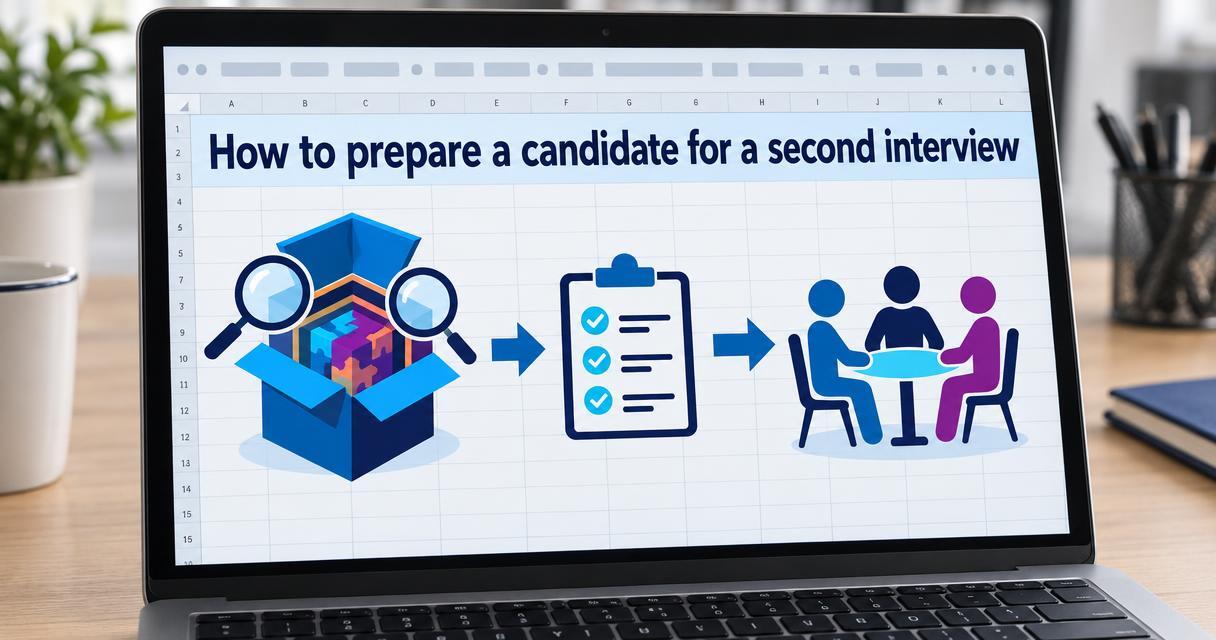
To prepare a candidate for a second interview. Discover recruiter frameworks for panel dynamics, competency coaching and presentation practice.

How to practise the STAR method so your interview answers stay structured, stop rambling, and show what you actually did.

A way to prepare that does not rely on memorised answers: know your strengths, handle the hard questions, and work out if the culture suits you.
 Compono