
 Compono
How an ai leadership coach transforms team performance
 Compono
What an AI leadership coach actually does day to day, how it reads the way your people work, and where it helps you most as a manager.

For People and Culture managers, AI coaching looks like a scalable way to give every employee personalised, real-time feedback and development guidance, moving beyond generic training programmes to address individual needs.
Key takeaways
- AI coaching provides personalised, adaptive development for every employee at scale, something previously impossible for P&C teams to manage manually.
- It automates the administrative burden of learning and development, freeing up managers to focus on high-impact strategic work and complex people issues.
- Modern AI coaching focuses on understanding individual work personalities to deliver guidance that resonates, rather than applying a one-size-fits-all approach.
- The platform offers objective, data-driven insights into team dynamics, communication styles, and potential conflict areas without human bias.
- By aggregating anonymised data, AI coaching helps P&C leaders identify team-wide skills gaps and cultural trends proactively.
Let’s be honest. Your plate is full. You’re expected to be a strategist, a mediator, a recruiter, an administrator, and a culture champion, all at once. You’re trying to support every single person in the organisation, but you’re only one person.
The old learning and development playbook isn’t working anymore. One-off workshops get forgotten, and generic online modules gather digital dust. Your people need and deserve individual support, but scaling that kind of high-touch coaching feels impossible.
So when you hear “AI coaching”, it’s easy to be sceptical. It sounds cold, robotic, and like another piece of tech that promises the world but creates more work. But what if it wasn’t about replacing the human element, but about finally having the tools to scale it?
The biggest fear around AI in any people-focused role is that it will strip the humanity out of the work. But good AI coaching does the opposite. It handles the repetitive, low-touch tasks so you can focus your energy on the complex, high-touch work that truly matters.
Think about the time spent organising training, sending reminder emails, or trying to deliver basic feedback to every single manager. An AI coach can handle that. It can provide instant, 24/7 support with common challenges, suggest relevant resources, and give people a safe space to work through problems on their own time.
This frees you up to deal with the serious stuff, mediating a genuine team conflict, designing a new career progression framework, or coaching a senior leader through a difficult transition. It turns you from a reactive firefighter into a proactive strategist.
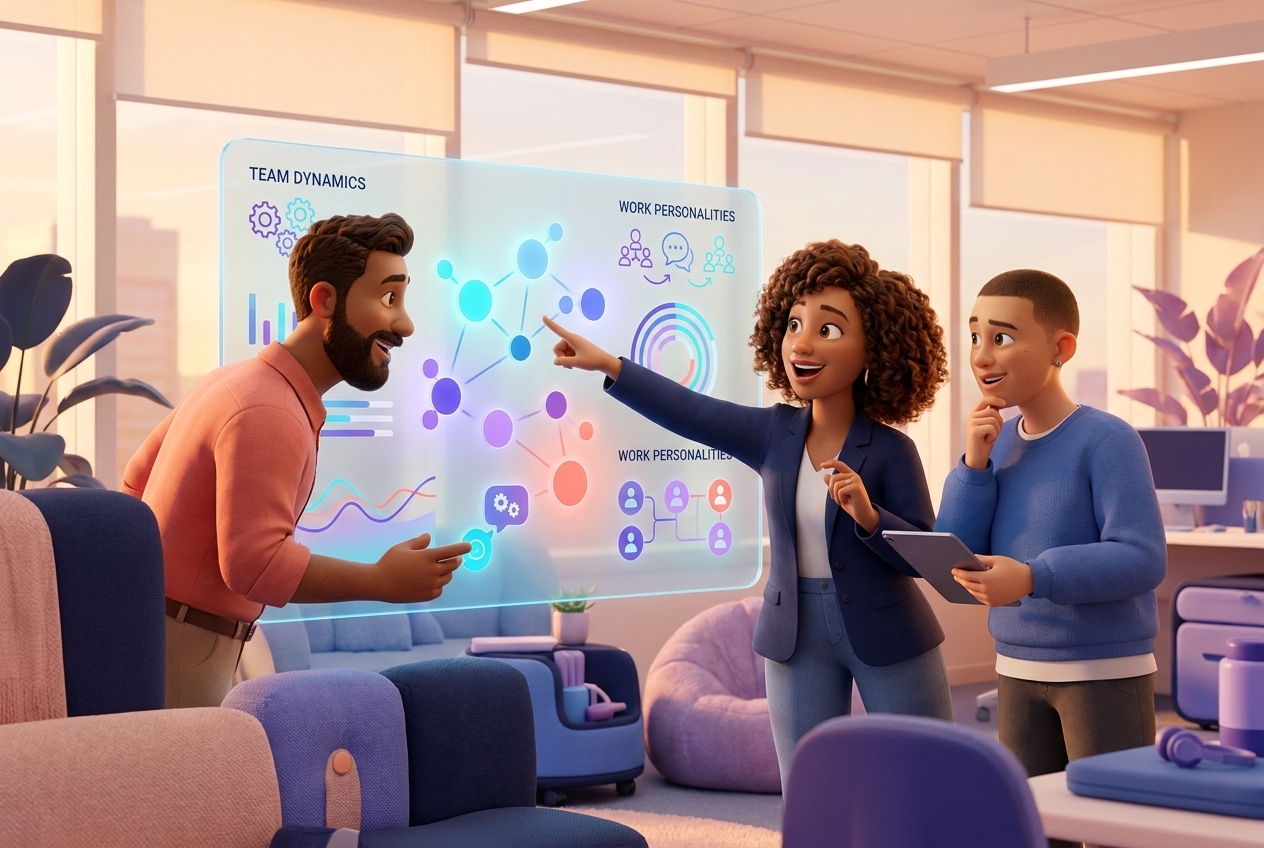
Most corporate training fails because it’s generic. It treats everyone the same, assuming a single webinar will somehow resonate with a quiet, detail-oriented Auditor and an enthusiastic, big-picture Campaigner. It never works.
Effective AI coaching is built on the idea that different people need different kinds of support. At Compono, we’ve built our tools on the back of decades of organisational psychology research into what makes people tick at work. True personalisation starts with understanding someone’s core work personality.
An AI coach can identify if an employee is a natural Doer who needs clear, practical steps, or a Pioneer who needs space to explore creative ideas. The guidance then adapts. The feedback, the communication tips, the goal-setting advice, it’s all framed in a way that actually makes sense to that individual. Some teams use personality-adaptive coaching to have these conversations without it getting weird.
For too long, P&C decisions have relied on annual engagement surveys and anecdotal evidence. You might have a gut feeling that communication is breaking down or that managers are struggling with performance reviews, but you lack the concrete data to prove it and inform your strategy.
AI coaching platforms provide a real-time, aggregated view of your organisation’s health. You’re not spying on individuals. You’re seeing anonymised, high-level trends. For example, you might discover that 60% of your new managers are struggling to delegate effectively, or that conflict frequently arises between two specific work personality types.
These are insights you can act on. Instead of commissioning another generic leadership programme, you can design a targeted workshop on delegation for new managers. You can provide specific resources on how different personalities can collaborate better. It allows you to be precise and effective with your time and budget.
Giving and receiving feedback is one of the hardest parts of work. Managers often avoid it because they’re afraid of saying the wrong thing and demotivating their team. Employees can become defensive because the feedback feels like a personal attack.
An AI coach acts as a neutral, objective third party. It can deliver insights based on behaviour and data, not emotion or bias. It helps an employee build self-awareness first, giving them the language to understand their own tendencies. For instance, an Evaluator might see data showing their communication is perceived as blunt, helping them understand their impact without a manager having to say “you’re too harsh.”
This equips both the manager and the employee with a shared, objective framework. The conversation shifts from “you always do this” to “it looks like your Coordinator tendencies are clashing with the team’s need for flexibility.” It depersonalises the conflict and focuses on practical solutions, which is the entire point.
Key insights
For People and Culture managers, AI coaching is a tool for amplification, not replacement. It scales the human-centric work you’re already doing by providing personalised support to every employee. It moves beyond generic solutions by adapting to individual work personalities, making guidance more relevant. The platform provides objective, real-time data that informs proactive people strategy, and it helps facilitate difficult conversations by offering a neutral, data-driven starting point for feedback.
Understanding how AI coaching can support your people strategy is the first step. The next is seeing how these principles apply in the real world to build healthier, more self-aware teams.
Related reading: Best AI coaching app in 2026: an honest guide · AI coaching cost per seat: what to expect in 2026
First-time manager coaching that fits how you think, whenever you need it. Start free.
Get started freeNot at all. While it can support performance, its main function is proactive development. It helps with communication, collaboration, conflict resolution, and self-awareness, the foundational skills that prevent performance issues from starting in the first place.
Trust is built on utility and privacy. When employees see that the AI provides genuinely useful, non-judgmental advice that helps them manage their work life better, they engage with it. It’s also seen as a psychologically safe space to ask questions they might not feel comfortable asking their manager.
Reputable platforms like Hey Compono are built with privacy at their core. Individual user data is confidential. P&C managers only ever see aggregated, anonymised data and high-level trends to protect individual privacy while still providing strategic insights.
An AI coach doesn't absorb culture in the same way a human does. Instead, it reflects and reinforces the culture you want to build. By providing consistent language and frameworks for feedback and collaboration, it helps embed your desired cultural behaviours at scale.
A chatbot gives pre-programmed answers to common questions. An AI coach uses a sophisticated model, often including personality psychology, to provide adaptive, contextual, and personalised guidance. It’s not just retrieving information; it’s helping an individual develop new skills and awareness over time.

What an AI leadership coach actually does day to day, how it reads the way your people work, and where it helps you most as a manager.

Coaching available every day reaches further than a workshop. Here is what people and culture managers get from AI coaching, and where it fits.

How to measure AI coaching ROI against human coaching: what to track on safety, onboarding speed and retention when your people work shifts.