
 Compono
1 min read
How to create sustainable change in your career and life
 Compono
Sustainable change starts with aligning your new behaviours with your natural work personality rather than fighting against your default settings.

Willpower fails because you are relying on it for things it was never good at: grinding through work that fights your natural style, in an environment full of small temptations, at the tired end of a long day, with no plan for when the tank runs low. Weak willpower is usually a design problem, and design problems can be fixed.
Last reviewed August 2026.
We have all been sold the same story: success is a matter of wanting it enough. The hustle posts, the motivational quotes, the 5am club, the vague suspicion that if you just had more discipline you would be more productive and generally more sorted. It is a comforting story for the people it flatters and a miserable one for everyone else, because it makes every lapse a verdict on your character.
The people who look like they have iron willpower are usually doing something else. They have arranged their work so it runs with the grain of how they think, and they have arranged their day so they rarely have to say no to anything. They are experiencing less friction than you, which from the outside looks a lot like grit. That is a very different thing, and it is learnable.
A quick word on the science, because it is worth being honest. The idea that willpower is a limited tank that drains through the day (you may have heard it called ego depletion) has been argued over by researchers for years, and the evidence is messier than the pop-psychology version suggests. What is not in dispute is the everyday experience: after hours of forcing yourself through work you find draining, your evening decisions get worse. Treat the "battery" idea as a useful metaphor rather than a law of physics and it will serve you well.

The reason one person can spend six hours in a spreadsheet while another wants to climb the walls after twenty minutes usually comes down to work personality. An Auditor lives for detail and precision. Staying focused on a complex data set costs them very little, because it is close to their natural setting.
A Campaigner runs on variety, people and big-picture ideas. Sit a Campaigner in silence checking line items for a week and by Wednesday they will be wrecked. The work was not physically hard. Resisting their own pull towards connection and novelty for eight hours a day is what wore them out. The Auditor and the Campaigner can have identical discipline and wildly different results, depending on what you ask them to do.
The same holds across Compono's eight work personalities. Coordinators find it easy to stick to a plan because structure is where they feel calm. Pioneers can struggle with routine and then show enormous staying power on a creative problem they care about. Doers push through tasks that would stall a Pioneer, and stall on the open-ended thinking a Pioneer finds effortless. When we talk about willpower we are really talking about self-regulation, and how much of it a task demands depends on who is doing it. If you want to know your own starting point, the free four-question work personality assessment takes about two minutes.
If there is a bowl of lollies on your desk, you spend willpower every time you look at it and decide not to. By the fiftieth time your brain is tired and you reach for the sugar. That is decision fatigue in its most literal form, and the same thing happens with your notifications, your messy desk, the tab you keep opening and the phone that lives face-up next to your keyboard.
People who seem highly disciplined are mostly good at environment design. They remove the temptation before they ever have to resist it. Slack closed for an hour and the phone in another room. A workspace chosen to fit the task, whether that is a hum of activity or total silence. The aim is to make the right choice the easy choice, so willpower becomes the backup instead of the main event.
What counts as a good environment is personal. Some people need a busy room to feel motivated. Some need absolute quiet to keep any thread of focus at all. A Helper may work better with people nearby, and an Evaluator may need the door shut. Try both for a week each and notice which one leaves you with something in the tank at 5pm.
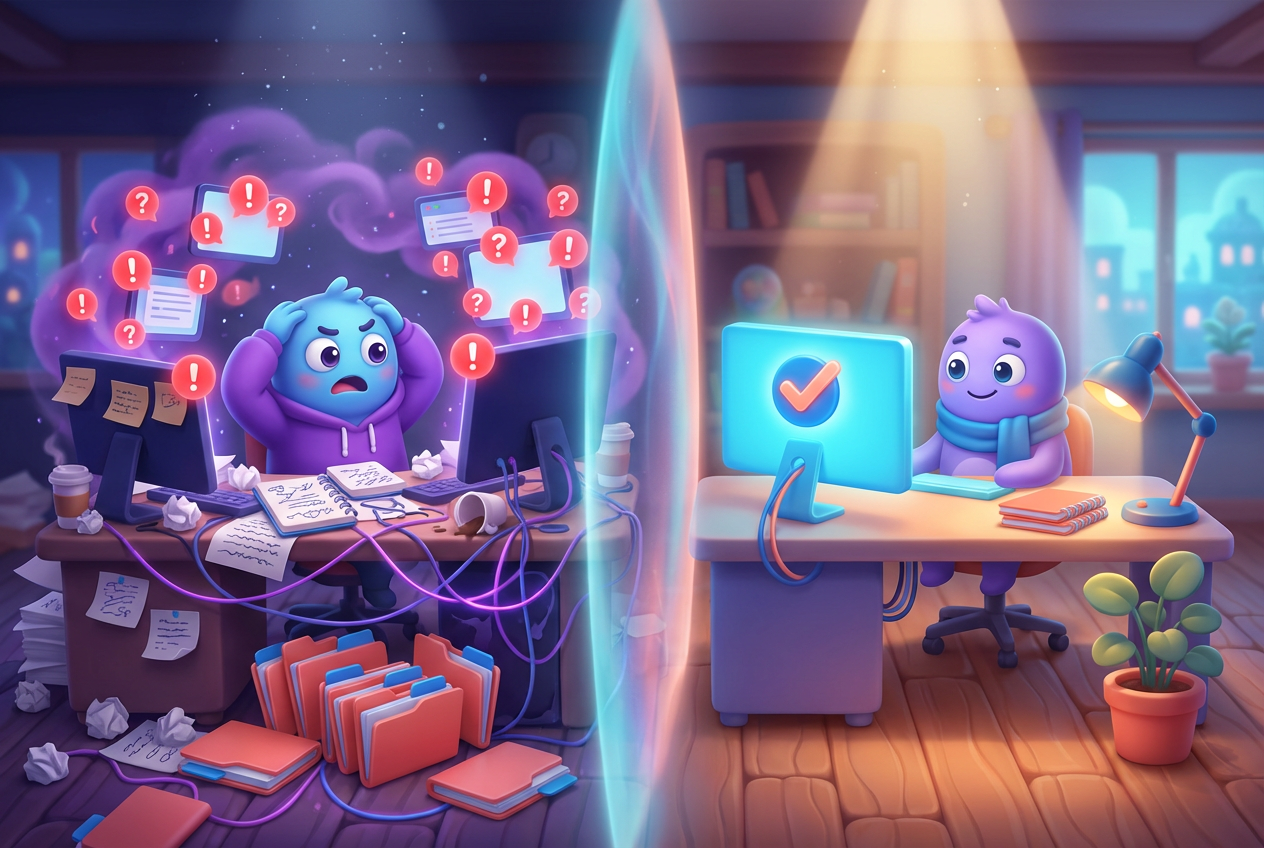
Think of your self-control as a phone battery. Full in the morning (if you slept), draining through the day, some activities costing you one per cent and some costing you twenty. Having "more willpower" then comes down to two moves: charging the battery and reducing the drain. You charge it with sleep, food, movement and work that suits your personality. You reduce the drain by automating decisions and by not spending your best hours on your least important tasks.
If you know you are sharpest in the morning, do not spend that hour on your inbox. Save the hard, resistant work for when you have the most to give it. Batch the small decisions, wear roughly the same thing, eat the same breakfast, start at the same time. It sounds joyless written down, but the point is to keep your decision-making energy for the things that actually deserve it.
The trickiest skill is spotting when you are already depleted. The signs are familiar: you snap at a colleague, you make an impulsive call, you open the fridge for no reason, you re-read the same paragraph four times. Pushing through at that point rarely works. The disciplined move is a fifteen-minute walk or a quick chat with a mate, which will do more for the next hour than staring blankly at the screen would.
If it would help to talk it through, that is what Hey Compono is for. It is an AI coach you speak to by voice or text, and because it adapts to your work personality, a Campaigner asking "why can't I focus" gets different coaching from an Auditor asking the same thing. It is coaching, so it will not diagnose you or replace treatment. It will help you work out where your energy is actually going and what to change first. You can start free.
Related reading: Why you can't make decisions and how to fix it · How to follow through and finish what you start
Voice or text coaching that adapts to your personality. Start free.
Get started freeYes, though not the way most people try. You do not build it by suffering through more of what drains you. You improve your results by managing your energy and designing your day so it needs less willpower in the first place.
Because you spend it all at work. If your job asks you to regulate your behaviour and hold focus for eight hours, especially on tasks that fight your personality, you arrive home with very little left. Aligning your work with how you naturally operate reduces that drain.
A lot. Some types, like the Coordinator, find it easy to stick to a plan because they enjoy structure. Others, like the Pioneer, struggle with routine but show huge staying power on a creative problem they care about. Discipline is task-specific, and personality decides which tasks cost you most.
Laziness is not wanting to do the work. Depletion is wanting to and finding your brain will not engage. If you keep opening the file and closing it again, that is depletion, and the answer is energy management and better task fit rather than self-criticism.
Yes. It is an AI coach that knows your work personality, so it can help you see which activities energise you and which ones drain you, and then plan your day around that. It is coaching rather than treatment, and it does not diagnose anything.

1 min read
Sustainable change starts with aligning your new behaviours with your natural work personality rather than fighting against your default settings.

1 min read
Self discipline is the ability to align your actions with your long–term goals rather than your immediate impulses, and it starts with understanding...

1 min read
Commitment feels hard when there is a mismatch between your natural work personality and the tasks on your plate. It is rarely a character flaw or a...