
 Mathan Allington

How To Practice A Difficult Conversation With An Employee
 Compono
Learn how to practice a difficult conversation with an employee. Get practical steps to prepare, manage your anxiety, and deliver clear feedback.
You know something needs to change at work, but the thought of bringing it up to your boss makes your stomach drop.
Last reviewed November 2026
Key takeaways
- Assess psychological safety before speaking up to ensure your manager is open to feedback.
- Shift the focus from a personal grievance to a shared business problem you can solve together.
- Use specific, observable evidence rather than emotional labels when describing the issue.
- Come prepared with a proposed solution or a clear next step to keep the conversation constructive.
- Send a brief, neutral follow-up email to document the agreed actions and ensure clarity.
Most of us bite our tongues because we do not want to be labelled a complainer. We worry that speaking up will backfire, damage our professional reputation, or make daily interactions incredibly awkward. Research from the LeadChange Group found that 85% of employees in one interview study said they had felt unable to raise an important issue with their boss, most commonly because they feared being viewed negatively or damaging the relationship.
It is a valid fear. Sitting on a problem rarely makes it disappear. Instead, the frustration builds into career anxiety and resentment.
When you learn how to raise a concern with your manager without sounding negative, you stop suffering in silence. The secret is shifting your approach from venting about a personal frustration to solving a shared business problem. When you frame your concerns around the work, you give your manager a clear, unemotional path to help you fix things.
Before you schedule a meeting, you need to assess the environment. Not every manager handles feedback well, and speaking up requires a baseline of trust. A practical preparation framework is to identify the issue, explain how it affects work, define the desired change, gather examples, and choose a private, unrushed time to talk, as recommended by NABS.
You can audit the psychological safety of your working relationship by looking at your manager's recent behaviour. Ask yourself a few basic questions before you proceed.
If your manager regularly shoots the messenger or shuts down alternative ideas, you might need to adjust your approach or involve human resources. If you are dealing with a boss who simply ignores problems, you might be trying to deal with a manager who doesn't manage. In these cases, your preparation needs to rely heavily on documented facts.
Understanding work personalities also helps here. At Hey Compono, we see that an Evaluator manager prefers strict logic and data. If you bring them a concern wrapped in strong emotion, they might dismiss it as a personality clash. Tailor your preparation to what your manager values most, whether that is team harmony, bottom-line results, or strict process compliance.
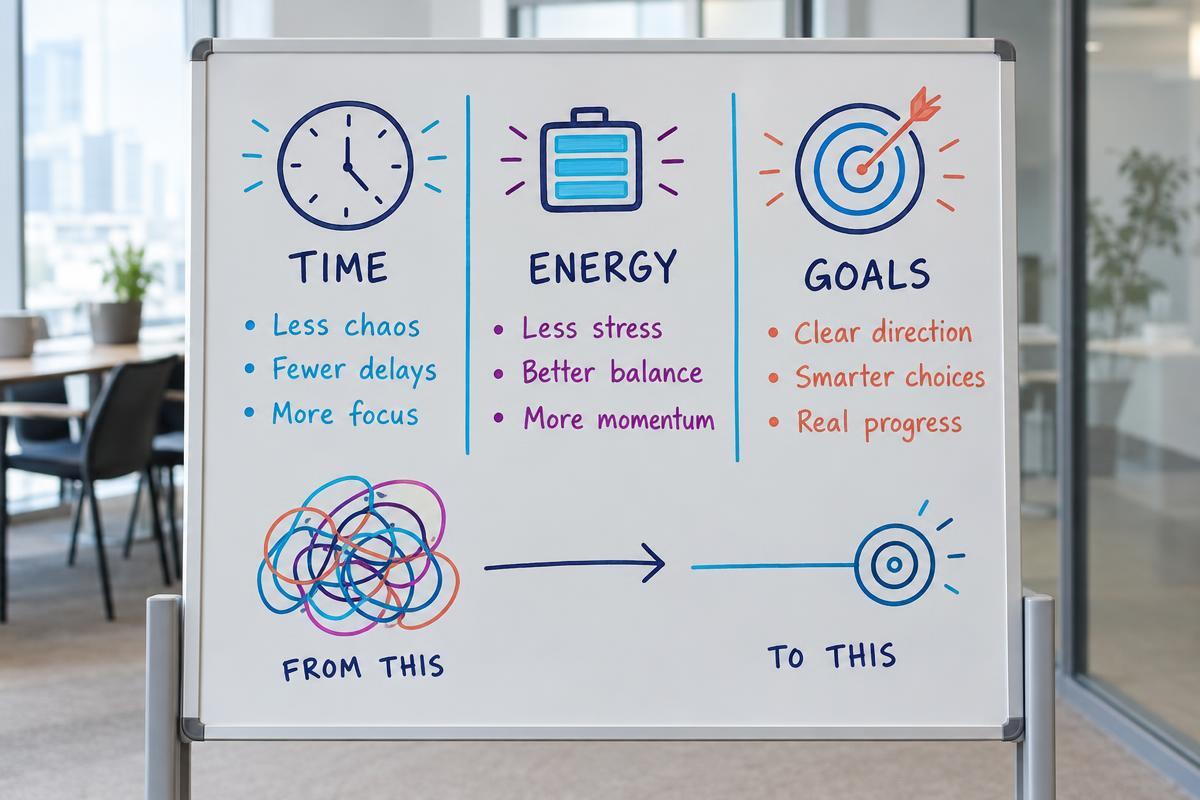
The biggest mistake people make when raising a concern is framing it as a personal attack on the manager's leadership. When someone feels attacked, they become defensive. You can bypass this reaction by positioning the issue as an external obstacle that the two of you must tackle together as a team.
Framing a concern around a shared goal shifts the conversation from criticism and blame toward collaboration and joint ownership, according to Housely. Instead of saying your manager's communication style is disorganised, you point out that the current project handover process is causing delays.
This framework requires you to link your concern directly to something your manager cares about. If your manager is under pressure to hit a quarterly target, show them how your concern is putting that target at risk. When you make the problem about the work rather than the person, the conversation becomes a strategy session rather than a confrontation.
A constructive concern should describe the observable issue, explain its impact, and end with a specific request rather than venting or hinting, according to EchoPitch. You can use this structure to handle almost any difficult topic. Here are exact scripts you can adapt for your own situation.
When you are drowning in work, it is tempting to walk into an office and declare that you are completely overwhelmed. This often sounds like you are rejecting work or failing to manage your time. Instead, frame the conversation around prioritisation and resource allocation.
"I want to make sure I am focusing my energy on our most critical targets this month. Looking at my current project list, I have four major deliverables due by Friday. I want to maintain the quality of the work, so I need your help to prioritise which two should take precedence, and which two we can push to next week."
This script works because it shows you are committed to quality. It forces the manager to make a resourcing decision rather than simply telling you to work harder.
Telling your boss they are a micromanager will almost certainly trigger a defensive response. Most micromanagers behave this way because they are anxious about outcomes. You need to address their anxiety by offering visibility and structure.
"I have noticed we are spending a lot of time reviewing the daily progress on this account. I want to make sure you have the confidence you need without it taking up so much of your schedule. Could we agree on a weekly Friday update email where I give you a full summary of the metrics, rather than doing daily check-ins?"
This approach gives them exactly what they want (visibility) while giving you what you want (autonomy to do the work). If you want to refine how you deliver this, Hey Compono lets you practise the delivery with an AI coach before you step into the real meeting.
When you suspect you are being passed over for projects or feeling unappreciated at work, leading with an accusation of bias rarely works. You need to focus on future opportunities and clear requirements.
"I noticed I was not included in the recent pitch team for the new client. I am highly motivated to take on that level of client-facing work. Could we outline the specific skills or milestones I need to hit so I can be the first choice for the next major pitch?"
This script removes the accusation entirely. It politely puts the manager on notice that you are watching the assignments, and it forces them to provide objective criteria for future decisions.
The words you choose dictate the tone of the meeting. Using "I" statements, such as "I've noticed", "I felt uncomfortable", and "It would help me if", can make concerns less confrontational, according to NABS. Avoid adjectives that sound like personal judgments. Stick to facts.
| What you want to say (Venting) | What you should say (Business case) |
|---|---|
| "You never give me enough time to finish these reports properly." | "When the report requirements arrive on Thursday afternoon, I do not have enough hours to run the full data analysis by Friday morning." |
| "This new software is terrible and nobody knows how to use it." | "I have noticed the team is spending an extra two hours a day manually fixing errors in the new software. We might need additional training." |
| "You always interrupt me when I am trying to explain my ideas in meetings." | "I've noticed we often move to the next agenda item before I can finish my updates. It would help me if we could allocate five dedicated minutes for my section." |
| "I am doing the work of three people and I am completely exhausted." | "My current workload includes the responsibilities from the vacant roles. I need to review our priorities so the most critical tasks do not suffer." |
Notice how the constructive column relies on numbers, days of the week, and specific behaviours. Facts are neutral. Adjectives are debatable.
Even with right preparation, your manager might react defensively. When this happens, do not argue back immediately. Manage your own tone and body language. Keep your voice steady and avoid crossing your arms. If they push back hard, use a bridging phrase to acknowledge their perspective without abandoning your concern.
You might say something like, "I hear what you are saying about the budget constraints, and I agree we need to be efficient. My concern is that the current process is actually costing us billable hours." If you struggle with these moments in real time, you can always read up on how to give hard feedback to learn more about holding your ground.
Once the meeting ends, you must document what was discussed. If you do not write it down, the agreement does not exist. The trick is sending a follow-up email that sounds helpful rather than litigious. Keep it brief, polite, and focused on the future.
A good follow-up email looks like this: "Hi [Name], thanks for the productive chat today. I just wanted to quickly summarise our agreed next steps so we are on the same page. I will focus on projects A and B this week, and we will review the timeline for project C next Tuesday. Let me know if I missed anything." This creates a paper trail in a friendly, professional way.
Speaking up to authority figures is hard, especially when your career progress is on the line. Getting comfortable with these discussions takes time, but you do not have to figure it out by trial and error on your real boss.
Related reading
Your concern is worth raising if the issue is actively preventing you from doing your job well, impacting your health, or hurting the business. If it is a minor annoyance that only happens occasionally, it might be better to let it go. If it is a recurring pattern that affects your output or wellbeing, you need to schedule a conversation.
If your manager reacts with anger, remain calm and keep your voice level. Acknowledge their reaction by saying you can see this is a frustrating topic, and offer to pause the conversation. You can say, "I can see this is not a good time to discuss this. Let's pick this up tomorrow when we have more time to look at the details."
In most situations, you should try to resolve the issue directly with your manager first. Going over their head to HR can permanently damage trust. However, if your concern involves harassment, discrimination, illegal activities, or a severe breach of company policy, you should go directly to human resources.
Change rarely happens overnight. Give your manager two to three weeks to start the changes you discussed, unless the issue is an immediate safety concern. If nothing changes after a month, you can use your follow-up email to politely reopen the conversation and check on the progress of the agreed steps.
It is almost always better to raise sensitive concerns in a live conversation, either face-to-face or on a video call. Written text lacks tone and body language, making it very easy for a manager to misread your intentions as aggressive or negative. Have the conversation live, and use writing only for the follow-up summary.

Learn how to practice a difficult conversation with an employee. Get practical steps to prepare, manage your anxiety, and deliver clear feedback.

How to give a coworker hard feedback without wrecking the relationship, with practical steps for the conversation itself.
To push back on a deadline with your manager using data, risk trade-offs, and proven scripts. Take control of your workload today.
 Mathan Allington