
 Mathan Allington

How to handle a career plateau and find your next move
 Compono
A career plateau is growth stalling, not failing. How to tell a structural plateau from a personal one, and how to work out your next move from there.

To write a business case for your promotion, you need to structure your achievements like a venture capital pitch: outline your commercial impact, prove you are already operating at the next level, present three to five major metrics, and detail a transition plan that mitigates the risk of your move.
Last reviewed November 2026
Key takeaways
- Treat your promotion request as an internal investment pitch that proves a clear return on investment.
- Connect every achievement to a measurable business outcome like revenue generated or hours saved.
- Present a risk mitigation strategy that explains how your current tasks will be backfilled.
- Gather stakeholder endorsements before you submit your formal written document.
You have been doing the work of a senior employee for six months. Your manager nods enthusiastically during your one-on-one meetings. You take on extra projects, mentor junior staff, and consistently deliver above your pay grade. Yet, when performance review season arrives, nothing changes. The goalposts move again, and you are told you need to put together a formal case to justify a title change.
Staring at a blank document trying to summarise years of hard work feels overwhelming. It is easy to fall into the trap of listing every minor task you have completed since your hire date. Unfortunately, a task list will not get you promoted. Decision makers do not want to see a log of your daily activities; they want to see a compelling argument for why paying you more money is a smart financial move for the business.
Writing an effective business case requires a complete mindset shift. You have to stop thinking like an employee trying to prove they work hard, and start thinking like a consultant pitching an investment opportunity. This guide breaks down exactly how to structure your arguments, calculate your return on investment, and build a written case that leadership cannot ignore.
A business case is a strategic document that proves you are a sound financial investment for the company. Promotions are scarce resources, and executives guard them carefully. According to a 2026 report by Ravio, the average promotion rate across tracked companies was just 4.0 percent over the previous 12 months, which equals roughly one in 25 employees (Clave Prep). To stand out in that environment, you need a different strategy.
Your manager might advocate for you, but they are rarely the final decision maker. They have to take your request to a compensation committee, a department head, or the human resources team. Your written case is the tool your manager uses to fight for you when you are not in the room. If your document is weak, their argument will be weak.
The core purpose of this document is to remove friction from the decision making process. By laying out the commercial facts clearly, you make it easy for leadership to say yes. You achieve this by focusing heavily on business impact rather than personal effort.
Employees focus on time spent and effort exerted. Investors focus on yield, efficiency, and scale. When building your case, you must adopt an ROI-first lens. The company is essentially buying your skills. If they promote you, they are increasing their investment in you. You need to prove that their increased investment will yield a higher return.
To do this, you must step back and look at your department's overarching goals. Is your company currently focused on aggressive revenue growth, or are they focused on cost cutting and efficiency? Your business case must align directly with whatever the executives care about right now. If the company is focused on cutting costs, highlighting how you saved the business ten thousand dollars is infinitely more powerful than explaining how many hours you worked.
You can use Hey Compono to help you clarify your professional goals before you begin writing. When you understand your own career trajectory clearly, it becomes much easier to articulate your value to others.
Most professionals start by listing their daily tasks. That is a mistake. A business case must connect your daily tasks to the broader company strategy. Leadership does not promote potential; they promote proven capability.
Research shows that promotion evidence is strongest when it demonstrates that the employee is already performing at the scope and decision-making level expected in the target role (Winning Presentations). You must prove you are already doing the job you want.
Start by downloading the official job description for the role you want. If your company does not have a formal progression framework, look up job descriptions for that title on public job boards. Highlight the core competencies, leadership requirements, and decision-making responsibilities.
Next, audit your last 12 months of work. Match your specific projects to the requirements of the senior role. A documented example of higher-level performance can include leading a cross-functional workstream, covering for a senior colleague, or representing the function at executive level (Winning Presentations). Write down every instance where your actions matched the senior job description.
No candidate is right. You will likely find gaps between your current experience and the target role. A strong business case acknowledges these gaps and explains exactly how you have proactively closed them. Did you take a leadership course? Did you ask to shadow a senior director? Documenting your self-awareness and initiative is a powerful way to demonstrate maturity.
While this written document is important, you also need to spend time preparing for a promotion conversation so you can present your findings confidently when the time comes to meet your manager.
Executives are busy. They will not read a ten-page essay about your career history. Keep your document concise and highly structured. A promotion case should typically focus on three to five major numbers rather than an exhaustive list of accomplishments (Winning Presentations).
Begin your document with an executive summary. This should be a single paragraph that clearly states the role you are applying for, the primary reason you are ready, and the overarching commercial impact you have delivered over the past year. Think of this as your elevator pitch.
Below your summary, create a section dedicated entirely to measurable business outcomes. Use bullet points to highlight your three biggest wins. Make sure these wins are tied directly to revenue, efficiency, or strategic company goals.
When detailing your wins, you must use a structured format to ensure clarity. Vague statements like "managed the marketing budget" or "improved team communication" hold no weight. Instead, you need a formula that forces you to be specific.
A useful achievement formula is: "Achieved [outcome] by doing [action], resulting in [business impact]" (Plademy). For example, write "Achieved a 15 percent reduction in software costs by auditing unused licences, resulting in an annual saving of twenty thousand dollars." This removes all ambiguity and proves your exact worth.
Not every role generates direct revenue. If you work in human resources, operations, design, or administration, your impact might feel much harder to quantify. You have to learn how to translate your soft skills and daily operations into hard financial metrics.
If you have been unofficially mentoring junior staff, do not just say you "helped the team". Measure the impact of that help. Did your mentoring reduce the onboarding time for new hires from four weeks to two weeks? That is a massive cost saving for the business, because those new hires became productive faster.
Effective impact statements identify what the employee did, the scope of the work, the measurable result, and stakeholders who can verify it (Hermes IDE). If you improved team morale and stopped someone from quitting, you saved the company thousands of dollars in recruitment fees. Claim that value.
Use a simple table structure in your planning phase to map out exactly how your non-revenue skills impact the short answer.
| Soft skill category | How to measure the business impact |
|---|---|
| Team leadership and mentoring | Calculate the reduction in staff turnover or time saved during onboarding new hires. |
| Process improvement | Track the number of hours saved per week and multiply by the average hourly wage. |
| Client relationship building | Measure the increase in client retention rates or the speed of resolving support tickets. |
| Cross-functional collaboration | Document the reduction in project delays or the successful launch of joint initiatives. |
One of the main reasons managers delay promotions is the fear of losing your output in your current role. If you are their best performer, promoting you creates a massive headache for them. They have to find someone else to do your current job.
You need to present a risk mitigation section in your business case. This proves that you are thinking like a leader. You must detail exactly how your current tasks will be backfilled, automated, or delegated to junior staff. If you need help structuring this phase, reading about how to build a transition plan will give you the exact steps to outline a smooth handover.
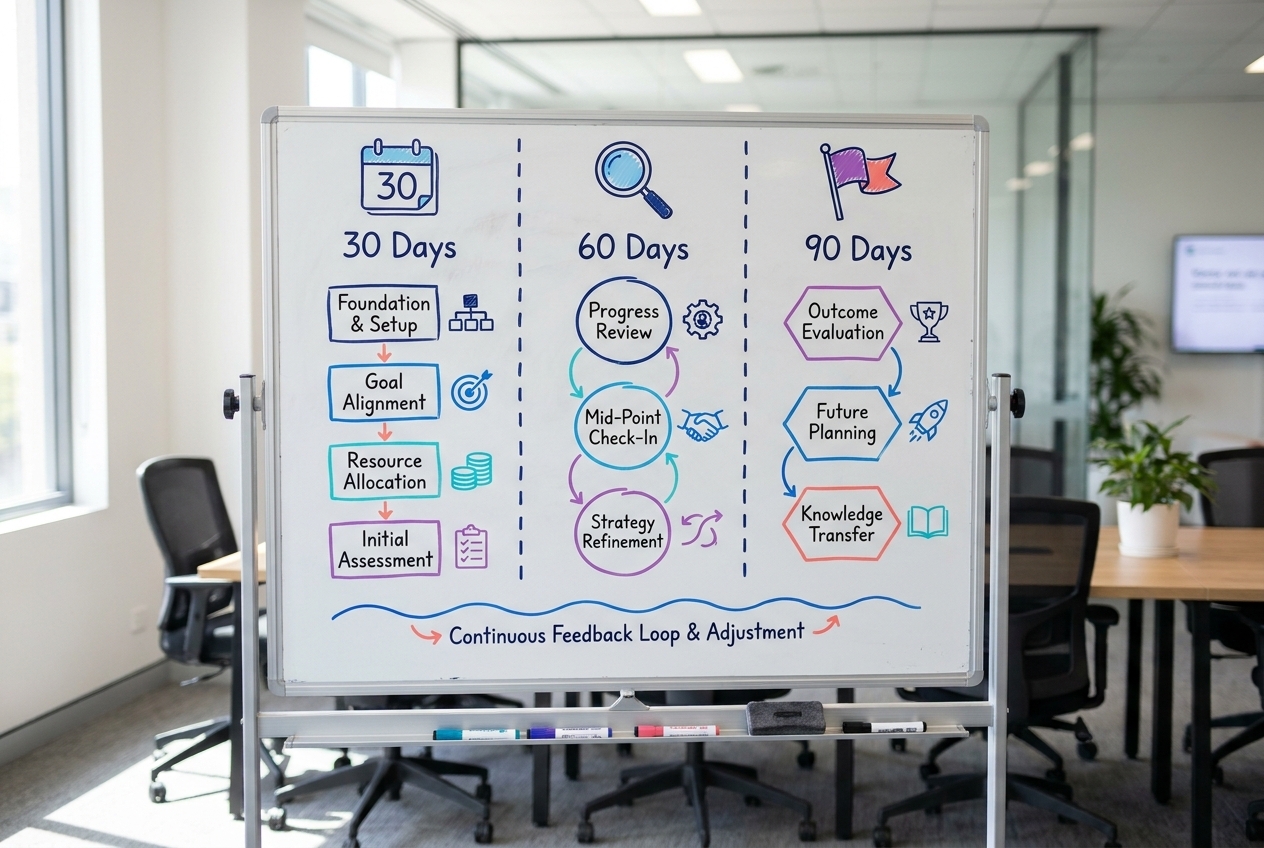
Include a detailed 30–60–90 day plan for your proposed new role. This shows that you are ready to hit the ground running. In the first 30 days, explain how you will hand over your old responsibilities and audit the new market. In the 60-day section, detail the quick wins you plan to achieve. In the 90-day section, outline your long-term strategic projects.
By providing this roadmap, you shift the conversation away from "is this person ready?" to "how quickly can we start this plan?". You are doing the hard work of visualising the future for your manager.
You cannot be the only person advocating for your promotion. A business case built entirely on your own opinions is inherently biased. You need external validation from respected figures within the business to lend weight to your claims.
Identify two or three senior leaders who have benefited from your work recently. Approach them privately and explain that you are building a case for your next career step. Ask if they would be willing to provide a short, written endorsement of a specific project you delivered for them.
Include these brief quotes or endorsements in a dedicated section of your business case. When the compensation committee reads your document, seeing praise from a department head or a senior director makes it incredibly difficult for them to deny your impact.
Your business case will only succeed if the person reading it actually absorbs the information. Different leaders process information differently, and tailoring your document to their natural preferences gives you a significant advantage.
If your manager naturally defaults to The Evaluator work personality, they will want to see hard data, deep risk analysis, and logical progression. They need numbers to feel safe making a decision. Keep the document highly analytical.
Conversely, if your manager is highly relational and focused on team harmony, you should highlight your mentorship, cultural impact, and stakeholder feedback. Framing your pitch around the specific way your manager thinks is an important skill. If you need help refining your own approach to these conversations, using an AI career and life coach can give you personalised feedback on your communication style.
Sometimes you build the right case, present it flawlessly, and the answer is still no. Often, this has nothing to do with your performance and everything to do with corporate budgets. A promotion freeze does not mean you stop building your case: it means you shift your timeline and negotiate differently.
If the company legitimately cannot afford a salary increase, you can still ask for the title change to reflect the work you are already doing. A new title sets you up for higher future earnings, whether internally or externally. When it is time to discuss these financial details, practising salary negotiation with AI can help you refine your arguments before you face your manager.
You can also negotiate for non-monetary benefits. Ask for additional paid leave, a flexible working arrangement, or a dedicated professional development budget. Treat the promotion as a total compensation package rather than just a base salary increase.
If you are dealing with active resistance from a manager who refuses to champion your cause, you have a different problem entirely. You might have to build a case that extends beyond their desk, using your stakeholder endorsements heavily. Learning the specific steps for handling an unsupportive boss will help you build your case independently and protect your career trajectory.
Depending on your company culture, you might need to decide between a presentation slide deck or a written memo document. Look at how decisions are typically made in your business. If executives love reading detailed strategy papers, use a memo format. If they prefer quick, visual summaries in board meetings, build a five-slide pitch deck.
Regardless of the format, the content remains the same. Lead with commercial impact, prove you are working at the next level, mitigate the risks of transition, and back everything up with hard data. When you treat your career like a business, leadership will treat you like a leader.
Building a reliable business case is only half the battle. You also need the confidence to deliver your pitch out loud, handle unexpected objections, and negotiate your worth without second-guessing yourself. The Hey Compono app gives you access to adaptive voice coaching, allowing you to run through your pitch and get immediate feedback on your tone and clarity.
Related reading
A written business case should ideally be one to two pages long. If you are using a slide deck, aim for five to seven slides. The goal is to be concise and focus heavily on measurable business impact rather than listing every minor task you complete.
You should present your case three to four months before the official performance review cycle begins. Budgets are usually locked in well before the actual review meetings take place, so waiting until the end of the year means the money has likely already been allocated.
If you cannot access exact revenue figures, focus on percentages and time saved. You can state that you reduced processing time by 20 percent, or that you increased client engagement rates by a specific margin. Time saved can always be converted into an estimated financial saving.
Issuing an ultimatum is highly risky and often damages trust permanently. Instead of threatening to leave, focus entirely on the value you bring and the market rate for your skills. Let your documented impact speak for itself without resorting to aggressive ultimatums.
While traditional advice suggests waiting at least a year, you can ask for a promotion earlier if the scope of your role has changed dramatically. If you took on the responsibilities of a senior team member who left, or if you delivered a massive strategic project ahead of schedule, you have a valid reason to build a case.

A career plateau is growth stalling, not failing. How to tell a structural plateau from a personal one, and how to work out your next move from there.

Get an exact asking for a pay rise script for Australia in 2026. Learn how to time your request, present your value, and handle difficult...

What AI coaching software for HR does, why personality-adaptive coaching beats a chatbot, what to check on privacy and reporting, and how Hey Compono...