 Mathan Allington
You can learn how to handle a manager who changes priorities constantly by forcing clear trade-offs and asking them which current project should pause to make room for their latest urgent request.
Last reviewed November 2026
Key takeaways
- You can manage constant priority shifts by asking your boss to choose which existing task drops off your list.
- Documenting every request in a shared priority log makes your actual workload visible and undeniable.
- Protect your performance review by recording partial wins when projects are abandoned mid-cycle.
- Recognise the difference between a genuine business pivot and a manager who simply struggles to plan ahead.
Why you need to learn how to handle a manager who changes priorities constantly
Nothing drains your energy faster than a manager who constantly changes direction. You get halfway through a major project, and suddenly the goalposts move. The work you just spent two weeks on gets shelved, replaced by a new urgent priority that will probably change again by Friday.
This creates a massive psychological cost. It leads to lost momentum, burnout, and a complete erosion of trust. You stop giving your best effort because you assume the work will be scrapped anyway. You are not imagining this problem. According to Gallup research, only 49% of employees strongly agreed they knew what was expected of them at work in the first half of 2026. When expectations constantly shift, that clarity disappears entirely.
Your manager might not even realise they are causing chaos. Manager engagement fell from 30% to 27% globally in 2025 (Gallup). They are often overwhelmed themselves, absorbing pressure from above and passing it down the line without filtering it first. This is why you have to step up and manage the flow of work yourself.
Identify the root cause of the changing priorities
Before you push back, you need to understand why the priorities keep shifting. There is a big difference between a legitimate business pivot and toxic managerial disorganisation.
Sometimes the market changes, a client demands something different, or the company strategy shifts. That is normal agility. But often, a manager simply has a new idea in the shower and treats it like an immediate directive. This is known as an idea bomb. You need to clarify if they are just thinking out loud or if they genuinely want you to drop your tools and pivot.
Your manager's work style plays a huge role here. A visionary leader might constantly spitball ideas without expecting you to act on all of them. On the other hand, the Doer personality type on a team will find this incredibly frustrating because they just want to execute the plan and tick boxes. If you can spot the pattern, you can stop being reactive at work and start handling the chaos strategically.
Use the trade-off protocol to manage expectations
When a manager drops a new priority on your desk, your instinct might be to just say yes and silently drown. Or you might want to say a flat no, which makes you look uncooperative. The solution is to force a trade-off.
Make the manager responsible for the capacity limits. When they assign a new task, you accept the work but ask them to decide what drops off your plate.
| The scenario | What you say to force a trade-off |
|---|---|
| A sudden new project | "I can absolutely start on this new initiative today. To make room for it, should I pause the Q3 report or delay the client rollout?" |
| An urgent favour | "I have three hours booked to finish the marketing brief. If I do this instead, the brief will be delayed until tomorrow. Is that the right call?" |
| A complete strategy pivot | "I understand we are changing direction. Let's look at my current task list and agree on what gets permanently shelved so I can focus on this." |
This approach is the foundation of managing up effectively. You remain helpful and agile, but you protect your workload. Gallup data reveals only 33% of managers are rated positively for clear communication, exposing a 25-point perception gap with how leaders view themselves. You have to fill that communication gap by forcing clarity.
Document priorities to make your capacity visible
Managers who constantly shift priorities usually have no idea how much work you actually have on your plate. If they cannot see your workload, they assume you have spare capacity to burn.
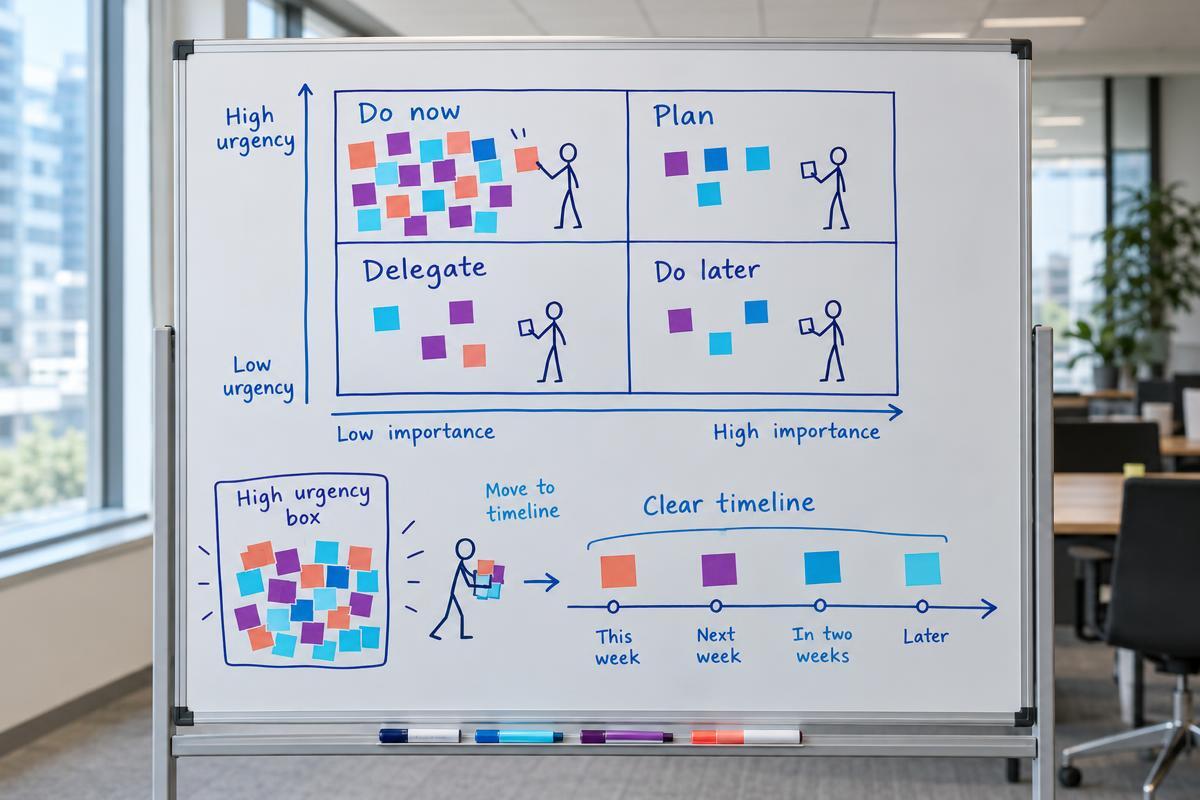
Create a shared priority log or a simple visual dashboard. Every time your manager gives you a new task, add it to the board and ask them where it ranks against the other items. Gallup recommends that managers explicitly reprioritise work as demands change. If they fail to do this, your shared document does the heavy lifting for them.
A visual board makes the trade-offs undeniable. When the manager sees a column full of paused projects, they start to realise the cost of their changing mind. This objective approach takes the emotion out of setting priorities at work and grounds the conversation in hard facts rather than frustration.
Protect your performance review when goals move
One of the hidden dangers of a chaotic manager is that you reach the end of the performance cycle with very little completed work to show for it. Your original goals were abandoned months ago, and you spent the year pivoting between half-finished projects that never saw the light of day.
You need to document your accomplishments when the goalposts move. Keep an impact log that tracks the velocity of your work, not just the final output. If you spent four weeks building a foundation for a project that was eventually cancelled, record that effort. Note what you delivered up to the point of cancellation.
The Hey Compono app helps you practise having these exact performance conversations so you do not get penalised for your manager's disorganisation. You can learn to articulate your adaptability as a strength rather than letting it look like a lack of follow-through.
Decide when to walk away from the chaos
Sometimes, upward management and boundary setting are not enough. You have to identify when strategic agility crosses the line into chronic incompetence.
If you have started trade-off conversations, maintained a visible priority log, and continually asked for clarity, but the chaos continues, the environment might be fundamentally broken. A manager who cannot stick to a plan causes endless stress for their team. If the situation starts damaging your mental health or stalling your professional growth, it might be time to look into career change coaching to plan your exit.
You cannot fix a manager who refuses to change their behaviour. As Hey Compono often reminds professionals, you can only control your response, protect your boundaries, and decide what you are willing to tolerate in your career.
How Hey Compono can help with shifting priorities
If you are constantly dealing with a chaotic manager and want to rebuild your confidence, you can prepare for these difficult conversations with personality-adaptive AI coaching.
Related reading
Frequently asked questions
How do you politely say no to a manager?
You rarely have to say a flat no. Instead, you offer a trade-off. Tell them you can take on the new task, but ask them which of your current priorities they want you to pause or delay to make room for it.
Why do managers constantly change priorities?
Managers often change priorities because they are reacting to pressure from above, struggling with their own workload, or failing to differentiate between casual ideas and actual directives. Sometimes, it is a legitimate business pivot in response to market changes.
How does work personality affect shifting priorities?
Some work personalities thrive on new ideas and constant change, while others prefer structure and clear expectations. Understanding these differences helps you communicate better. For example, highly organised people find sudden changes extremely frustrating, while visionary types might see them as exciting opportunities.
How do I protect my performance review when goals change?
Keep a personal impact log throughout the year. Document the work you put into projects before they were cancelled or paused. Highlight your adaptability and record the milestones you hit, ensuring you have evidence of your effort even if the final goalposts moved.
What is the trade-off protocol?
The trade-off protocol is a communication technique where you accept a new task on the condition that an existing task is paused or deprioritised. It forces the person assigning the work to take responsibility for your capacity limits.