 Mathan Allington
The first time you sit across the desk from a workmate to discuss their performance, the changing permanently shifts. Learning how to manage a former peer requires you to learn a completely new job while actively rewriting established relationships.
Last reviewed November 2026
Key takeaways
- Acknowledge the awkwardness directly in your first one on one meeting to clear the air.
- Establish clear boundaries around social events and late night communication early on.
- Tie feedback to team goals rather than personal preferences to maintain objectivity.
- Address passive aggressive pushback from passed over colleagues quickly and professionally.
The reality of internal promotion
Internal promotions are common, but they rarely come with a manual. When you transition from peer to leader, you are expected to know how to delegate, manage performance, and handle conflicts overnight. Yet, the reality is that most organisations fail to provide a safety net for this shift. Although 75% of organisations prioritise internal promotion, only 20% of HR leaders report having successors ready for critical roles, according to the DDI Global Leadership Forecast 2025. This means you are likely stepping into your new role without much formal preparation.
A 2025 survey cited by the MATC Group found that 59.3% of first-time managers identified adjusting to people management and demonstrating authority as a major challenge. The hardest part is often the sudden drop in psychological safety. Trust in immediate managers fell from 46% in 2022 to 29% in 2024, as noted in the DDI Global Leadership Forecast 2025.
At Hey Compono, we frequently see new leaders struggle with this exact problem. When you are stepping up to manager, you need to rebuild trust with your former friends from a completely different vantage point.
The reset conversation
Your first official meeting with your former peer needs to address the elephant in the room. Ignoring the change in your relationship will only make things weirder. Use this initial one on one to set expectations and show that you value their expertise.
Acknowledge the change directly
Start with direct honesty. You might say: "I want to acknowledge that our changing is changing. I really value the working relationship we have built, and my goal now is to support you in doing your best work. I would love to hear what you need from me in this new setup."
This approach validates their experience while firmly establishing your new responsibility. It shows you are not going to let power go to your head, but it also makes clear that the reporting lines have changed.
Listen without solving
Once you have set the stage, stop talking. Let them share their concerns. They might be worried that you will micromanage them, or they might fear that your friendship is over. Listening carefully without immediately trying to fix their feelings builds a foundation of safety. Document the key takeaways from this first meeting so you can refer back to their stated goals and boundaries in future performance discussions.
Setting new boundaries outside of work
The group chats, the Friday afternoon venting sessions, and the casual complaints about leadership all have to stop. As a manager, you represent the business. You cannot participate in conversations that undermine company decisions, even if you agreed with those exact complaints last week.
This boundary shift is often jarring for everyone involved. To make it easier, you need clear categories for how you interact from here. If you are used to sending each other funny memes late at night, that changing has to change. Continuing late night personal chats blurs the lines of authority and makes it incredibly difficult for your former peer to take you seriously when you need to enforce a deadline the next morning.
| Context | Previous peer behaviour | New manager behaviour |
|---|---|---|
| Venting about company policy | Joining in and sharing frustrations | Listening carefully but remaining neutral and solution-focused |
| After-hours socialising | Staying until the end of the night | Making an appearance early and leaving before things get messy |
| Private group chats | Sharing inside jokes and office gossip | Removing yourself gracefully to give the team their own space |
| Social media interactions | Constant tagging and late night messaging | Keeping interactions professional and limited to daylight hours |
Stepping back from the inner circle is lonely. However, maintaining distance is the only way you can remain objective when performance issues arise.
Handling passed-over rivals and resentment
Sometimes a former peer wanted the job you just got. They might feel overlooked, resentful, or competitive. In a 2025 international barometer by Cegos, 73% of first-time managers reported dealing with intradepartmental or interdepartmental conflicts. You need a clear plan for handling friction before it derails the team.
Address passive aggressive behaviour immediately
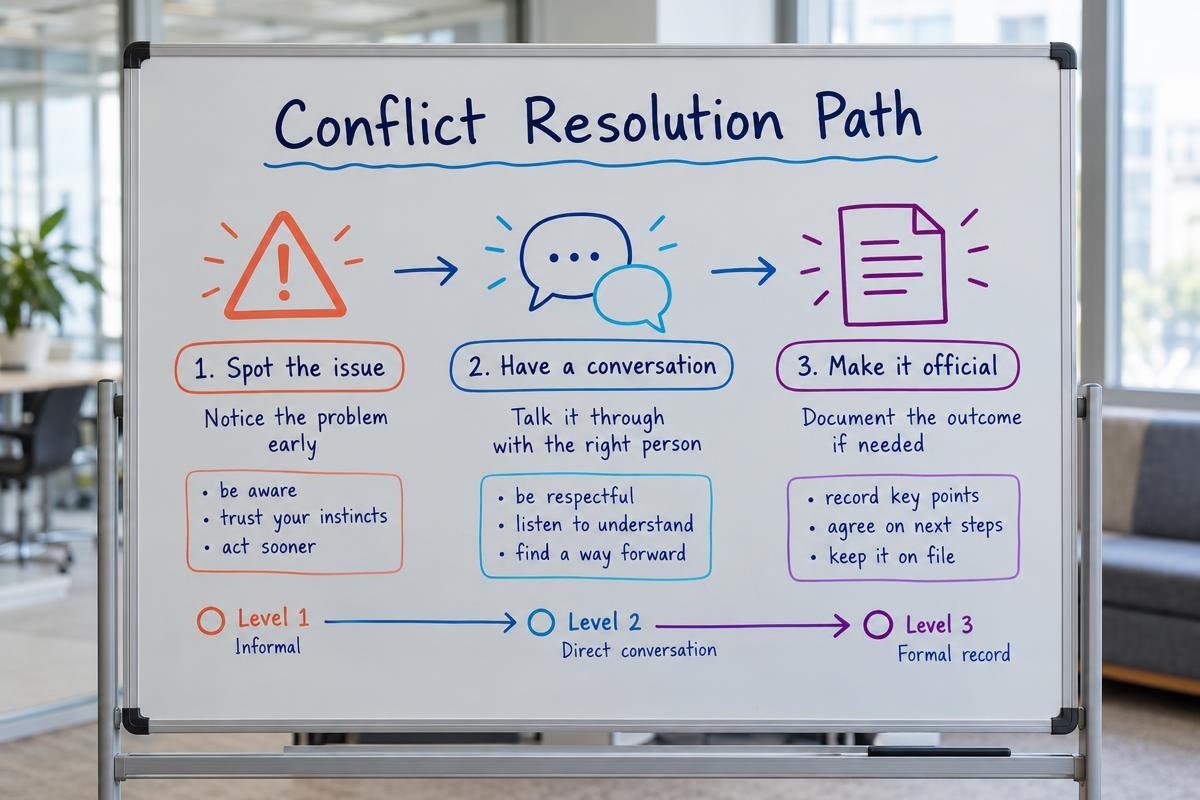
When you notice snide comments or deliberately missed deadlines, address the behaviour immediately. Do not ignore it and hope it goes away. Book a private meeting and focus entirely on the facts.
You could say: "I have noticed you have been quiet in our last few team meetings, and the weekly report was late on Thursday. I know this transition might be frustrating, but I need us to find a way to work together effectively. What is getting in the way right now?" This tackles the issue head on without accusing them of jealousy. If the situation escalates, understanding the rules for dealing with passive aggressive coworkers is a vital skill for protecting your own career.
Manage up
You also need to manage up during this period. Your own manager needs visibility into team changing, especially if a former peer is actively resisting your leadership. Keep your manager informed without sounding like you are complaining. Frame the conversation around the business impact: "I am experiencing some pushback from Sarah on the new reporting structure, which is delaying the Q3 rollout. Here is my plan to address it. Do you have any feedback on this approach?" This shows you are taking ownership while keeping leadership in the loop.
Giving constructive feedback to previous equals
Delivering a performance critique to someone who used to cover your shifts is uncomfortable. The trick is to separate the person from the standard. You are not judging them as a friend; you are holding them to the requirements of their role.
Focus on outcomes, not personalities
Tie all feedback back to team goals. Instead of saying "you are doing this wrong", frame it around the outcome. Try: "The current turnaround time on these client requests is pushing back the design team. What can we adjust in your workflow to hit the 24-hour target?" Practising these scenarios with Hey Compono can help you refine your delivery before the real meeting.
Tailor your approach
Understanding different personality styles makes this process much smoother. The Work Personality framework shows that an Auditor will want strict data to back up your feedback, while a Campaigner might need reassurance about the big picture. When you need to provide hard feedback for a coworker you now manage, tailoring your approach to their specific style removes a lot of the sting.
Manage the formal process
If informal feedback fails, you may have to place your former friend on a performance improvement plan. This is the ultimate test of your new boundary. A formal plan requires strict documentation, clear milestones, and HR involvement. When having this conversation, you must stick entirely to the script. Avoid phrases like "I really hate having to do this" or "HR is making me put this in place". You own the decision. Communicate the plan calmly, explain the support they will receive, and outline the exact metrics required for success.
How Hey Compono can help with your transition to manager
We know that moving from peer to boss is one of the steepest learning curves in business. If you are struggling to find the right words for a performance conversation or boundary setting, AI coaching gives you a safe space to practice before you face your team.
Related reading
Frequently asked questions
How do I stop feeling like an imposter when managing old friends?
Accept that feeling out of depth is completely normal. Focus on your new responsibilities rather than your old changing. You were promoted because leadership saw your capability to enable the team, so concentrate on removing roadblocks for your staff rather than proving you are the smartest person in the room.
Can I still hang out with my team outside of work?
You can attend social events, but your role has changed. Make a brief appearance to show support, buy a round of drinks if appropriate, and then head home early. Your team needs a space where they can relax without their manager watching.
What if a former peer refuses to listen to my instructions?
Document the specific instances where instructions were ignored. Have a direct conversation focused entirely on the business impact of their refusal. If the behaviour continues, you must follow your company's formal performance management process, treating them exactly as you would any other underperforming employee.
Should I apologise for getting the promotion over them?
Absolutely not. Apologising undermines your authority and the decision made by the business. You can acknowledge that the situation might be disappointing for them without apologising for your own career progression.