
 Mathan Allington

How to tell your manager you want to change teams in 2026
 Mathan Allington
How to tell your manager you want to change teams? Get practical scripts, timelines, and advice to make an internal move without burning bridges.
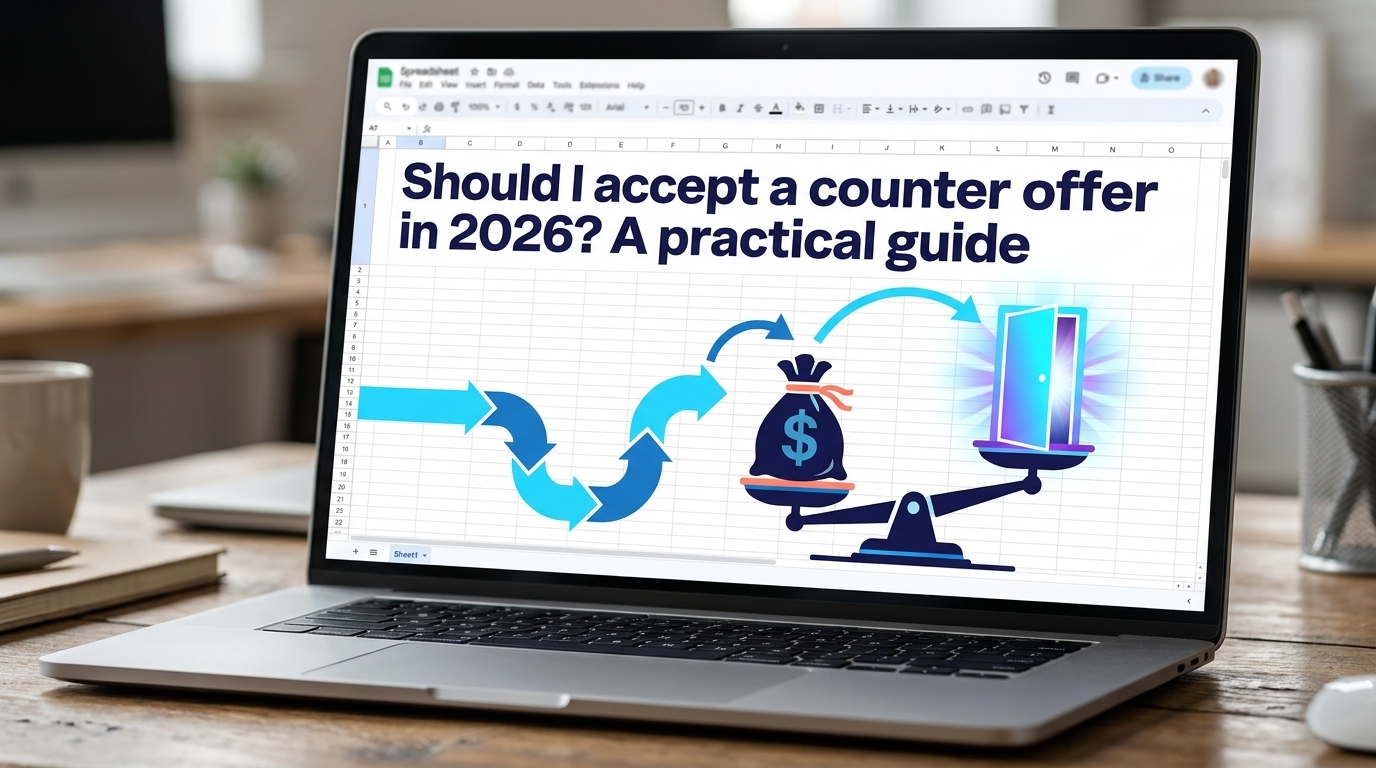
You should only accept a counter offer if it fundamentally fixes the original reason you wanted to leave, which rarely happens when the offer is just about money.
Last reviewed November 2026
Key takeaways
- Money alone rarely solves the deeper issues that pushed you to look for a new job in the first place.
- Trust is often permanently broken after you resign, making your long-term future at your current company uncertain.
- About half of employees who accept a counter offer end up leaving within 12 months anyway.
- Use a logical framework to evaluate the offer objectively before letting emotions or flattery sway your decision.
- You have a 24 to 48 hour window to make your choice and respond professionally to both employers.
You handed in your notice. You prepared for a tense conversation and awkward goodbyes. Instead, your manager panicked and slid a very generous new package across the desk. Now your head is spinning. It feels nice to be wanted, and the extra cash is certainly tempting. But a counter offer is complicated. It is flattering in the moment, but it forces you to question your entire career move.
Being offered more money or a shiny new title to stay put is a common scenario. Rough industry estimates suggest that 40–60% of employees who resign reportedly receive a counter-offer, although frequency varies by role, seniority, and industry (The Jonus Group, 2025). When a company is faced with the cost and downtime of replacing you, throwing cash at the problem is their fastest solution. But their quick fix does not mean it is the right move for your career.
When you resign, you create an immediate problem for your employer. They face the prospect of a vacant role, the cost of advertising, the time spent interviewing candidates, and the inevitable drop in team productivity while a new person learns the ropes. Offering you a salary bump is often much cheaper than replacing you.
This is why you have to look at the offer objectively. The sudden salary increase is rarely a delayed recognition of your worth. It is usually a retention tactic designed to solve a business problem. In fact, 42% of employees who voluntarily left said their manager or organisation could have done something to retain them (Gallup, cited by Perennial HR). If they had the budget and the ability to fix your role, you have to ask why it took your resignation to make it happen.
Financially, moving on is often the better bet for wealth building. By Q1 2026, job switchers’ pay was growing 8% annually versus 5% for workers who stayed in place (Bank of America Institute, reported by Fortune in 2026). A counter offer might match the new salary today, but your future earning potential usually stagnates if you stay.

Accepting a counter offer changes the changing between you and your employer. Even if your manager smiled and shook your hand when you accepted the new terms, the trust is often broken. They know you were out looking for other opportunities. They know you were prepared to leave.
When the next round of promotions or exciting projects comes up, your loyalty might be questioned. Management often wonders if you are just biding your time until a better external offer comes along. This loss of trust is a major reason why staying rarely works out in the long run. Gartner research cited by Harvard Business Review reportedly finds that about half of employees who accept a counter-offer leave within 12 months (The Agency Recruiting).
As career experts note, “Counter-offers almost always fix the money and rarely the reason you started looking” (Lechley). If you were frustrated by a toxic culture, a lack of progression, or poor leadership, those problems will still be waiting for you on Monday morning. The extra money simply acts as a temporary bandage.
When you are staring at two competing offers, the emotion of the moment can cloud your judgement. Different personalities handle this pressure in different ways. Some people get caught up in the loyalty they feel toward their current team. Others, like The Evaluator work personality, prefer to strip away the emotion entirely and rely on a logical scoring system.
To help you decide when it is time to move on, you need a way to compare the two options fairly. Use this decision matrix to evaluate the reality of both roles.
| Decision factor | Current job (Counter offer) | New job offer |
|---|---|---|
| Does it solve the core problem? | Money is better, but the daily frustrations remain. | Offers a fresh start and new challenges. |
| Long-term career growth | Future promotions may be limited due to broken trust. | Clear path outlined during the interview process. |
| Company culture | Known environment, but the underlying issues persist. | Unknown environment, but aligns with your values. |
| Financial package | Matches or slightly beats the new offer. | Reflects market rate without requiring an ultimatum. |
| Management relationship | Tension and doubt may linger after your resignation. | Clean slate with a manager who chose to hire you. |
Score each row based on what matters most to your daily happiness. If the current job only wins on the financial package, staying is highly likely to end in regret. When you are stuck in the messy middle of this choice, Hey Compono can help you talk through the options objectively and figure out what you actually want.
If you receive a counter offer, you usually have a tight window of 24 to 48 hours to make your decision. Do not let your manager pressure you into accepting on the spot. Take a breath, thank them for the offer, and ask for a day to consider it.
During this window, look closely at the non-monetary elements. If your primary reason for leaving was a lack of flexibility, does the counter offer include guaranteed remote work days? If you wanted career progression, does it come with a formal title change and a direct reporting line to leadership? If the offer is just cash, it is incomplete.
If you genuinely want to stay but need non-monetary changes, this is your brief window to negotiate. Ask for the remote work agreement or the title change to be put in writing as an addendum to your contract. Verbal promises made in a panic are easily forgotten three months later. If the company refuses to put the non-monetary terms in writing, you have your answer about their true intentions.
How you communicate your final decision dictates the health of your professional network from here. Whether you choose to leave or stay, you must handle the conversation with tact. If you need a safe space to practise these difficult conversations before you have them with your boss, the Hey Compono app offers adaptive voice coaching to prepare you.
If you are rejecting the counter offer and moving on, keep it brief and professional. Say something like: "I really appreciate the generous offer and the confidence you have shown in me. However, after careful consideration, I have decided to stick with my original plan to accept the new role. It is the right next step for my career goals, but I am committed to making this transition as smooth as possible for the team."
If you decide to accept the counter offer, you now have the difficult task of rejecting the new employer after you already said yes. Do this over the phone, never via email. You might say: "I am calling to share some difficult news.
When I resigned from my current role, my employer presented a counter offer that includes significant changes to my career path there. After a lot of thought, I have decided to stay. I sincerely apologise for the inconvenience this causes, as I have great respect for your company and the team I met."
The choice is entirely yours, but you must own the outcome. If you are still weighing up your next career move, remember that a new job offers a clean slate. A counter offer is just a more expensive version of the job you already decided to leave.
Choosing between two jobs is stressful, especially when relationships and loyalty are on the line. When you need guidance in your career, having an unbiased sounding board makes all the difference. Our AI coaching helps you untangle your thoughts, evaluate your options logically, and practise the hard conversations before they happen.
It can be a good idea if the counter offer directly fixes the specific issue that made you look for a new job, such as a rigid schedule or a lack of resources. If the offer includes written structural changes to your role alongside a salary bump, it might be worth considering. However, if the offer is purely financial, staying is rarely the best long-term choice.
You typically have 24 to 48 hours to make a decision. It is perfectly acceptable to ask your manager for a day to review the details. Do not accept verbally in the room just to relieve the awkward tension.
There is often a lingering shift in trust. Even if they are relieved you stayed, management knows you were prepared to leave. You will need to work hard to rebuild that trust and prove your commitment to the team, which can be exhausting.
It is generally best not to use a counter offer to start a bidding war. If you genuinely want the new job, simply decline the counter offer. If you try to play both sides, you risk frustrating the new employer and losing the new offer entirely.
Thank your manager for the offer and the recognition, but state clearly that you are sticking to your decision to leave. Focus on how the new role aligns with your long-term career goals, rather than listing the faults of your current job. Keep the conversation focused on a smooth handover.

How to tell your manager you want to change teams? Get practical scripts, timelines, and advice to make an internal move without burning bridges.
Learn exactly what to do if your boss doesn't like you. Get conversation scripts, documentation strategies, and steps to protect your career and...
To push back on a deadline with your manager using data, risk trade-offs, and proven scripts. Take control of your workload today.