
 Mathan Allington
How personality affects communication at work
 Compono
Discover how personality affects communication at work. Learn to identify different communication styles and reduce friction in your team today.
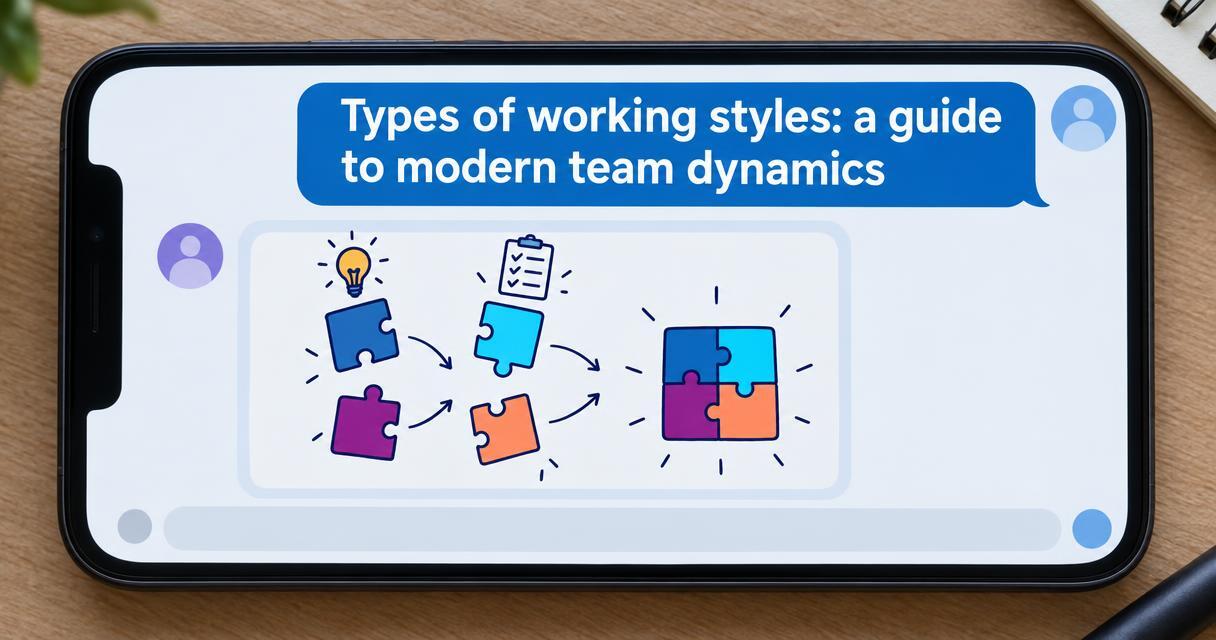
The core types of working styles describe how you naturally process information, make decisions, and interact with your team.
Last reviewed October 2026
They are not rigid categories that trap you in one way of doing things. They are default settings. When you understand the working styles present in your workplace, you stop taking friction personally and start seeing it as a predictable difference in approach.
Key takeaways
- Working styles reflect your natural preferences for communication, execution, and problem-solving.
- Teams experience less conflict when they map tasks to the strengths of different working styles.
- Remote and hybrid environments require intentional adjustments to support both highly collaborative and independent styles.
- Managers achieve better results when they adapt their leadership approach to fit how their employees naturally work.
Modern workplaces run on collaboration, but putting highly skilled people in a room together does not guarantee success. Without an understanding of how different individuals operate, productivity drops and interpersonal friction rises.
Gensler’s 2025 Global Workplace Survey found that employees with high choice over where and how they work are 2.5 times more likely to say their workplace supports individual and team productivity. Giving people autonomy is only effective when they know their own optimal working style. When a team operates in alignment with their natural preferences, they waste less energy on communication barriers and spend more time delivering high-quality outcomes.
This alignment also impacts retention. HP’s 2024 Work Relationship Index found that nearly 87% of knowledge workers would accept lower pay to work in an environment suited to how they operate. People want to feel understood at work. When forced to operate against their natural grain constantly, they burn out and eventually leave.
At Hey Compono, we understand working styles through the Work Personality framework. This model outlines eight distinct profiles based on decades of psychological research. There is no good or bad type. The framework simply explains why one person lives for strategy while another prefers to execute the details.
The Doer style focuses heavily on execution and reliability. They are the people who take a concept and push it across the finish line. They prefer clear instructions, defined outcomes, and minimal ambiguity. They find prolonged brainstorming sessions frustrating if they do not result in a clear action plan.
The Auditor is wired for precision. They spot the risks, check the compliance rules, and ensure the quality remains high. They need time to review information thoroughly before making a commitment. They do not appreciate being rushed into decisions without proper evidence.
The Helper operates with deep empathy. Their working style prioritises team cohesion and supporting others. They are highly attuned to how decisions impact the people around them. They thrive in environments where collaboration and mutual respect are valued above aggressive competition.
The Advisor brings wisdom and a calm presence. They listen well, synthesise complex information, and offer considered guidance. They do not rush decisions and prefer to act as a sounding board. Their style is excellent for mentoring but they can sometimes hesitate to take decisive, rapid action.
The Pioneer thrives on innovation. They are comfortable with risk and ambiguity. They are always looking for the next big idea. Their working style is highly energetic, but they can struggle with repetitive maintenance tasks or strict bureaucratic processes.
The Campaigner uses influence and vision to rally people. They are naturally persuasive, articulate, and focused on the big picture. They excel at pitching ideas and securing buy-in from stakeholders. They rely on other styles to manage the finer details of execution.
The Evaluator relies on analysis and logic. They detach emotion from their decisions, relying on data and evidence to choose the best path forward. They ask tough questions and expect rigorous answers. They can appear blunt to more sensitive styles, but their objective perspective is highly valuable.
The Coordinator excels at organisation and efficiency. They take chaotic situations and build structured processes around them. They ensure everyone knows their role and the timeline they need to meet. They prefer predictable routines and clear communication channels.
When you put different types of working styles in a room, you get friction. Friction is not always a negative force. When managed well, it prevents groupthink and ensures a balanced approach to problem-solving. If you want to know how this plays out in your own workplace, working with different personalities requires understanding the specific changing between any two people.
The table below outlines how contrasting styles interact, where they find overlap, and where communication often breaks down.
| Working style pair | How they collaborate best | Potential friction points |
|---|---|---|
| Pioneer and Auditor | The Pioneer generates big ideas while the Auditor ensures they are viable and safe to execute. | The Pioneer feels constrained by the Auditor's rules. The Auditor feels panicked by the Pioneer's lack of planning. |
| Doer and Campaigner | The Campaigner wins the necessary resources and buy-in, clearing the path for the Doer to execute the work efficiently. | The Doer gets frustrated by the Campaigner's focus on talk over action. The Campaigner feels the Doer lacks strategic vision. |
| Evaluator and Helper | The Evaluator brings objective data to complex problems while the Helper ensures the human impact of the decision is managed well. | The Helper perceives the Evaluator as cold or overly critical. The Evaluator views the Helper as too emotionally invested. |
| Coordinator and Advisor | The Coordinator builds the project structure while the Advisor provides deep subject matter expertise to guide the direction. | The Coordinator wants immediate commitment to a timeline. The Advisor wants more time to reflect on the nuances. |
Conflict between these pairs rarely stems from malice or incompetence. It stems from a clash in default operating models. You can try the Hey Compono app to explore how your own defaults might be interpreted by coworkers who approach work differently.
Remote and hybrid work setups increase the differences between working styles. In a physical office, casual proximity often smooths over communication gaps. In a digital environment, communication must be highly intentional to prevent misunderstandings.
Research shows work styles are not fixed personality types. People may prefer independent focus for deep work but shift toward collaboration for brainstorming or complex problem-solving, according to Lyra Health. A hybrid environment must support both modes.
Styles focused on execution and analysis often thrive in remote settings. They appreciate the uninterrupted time to focus deeply on complex tasks. To support them, teams must establish clear guidelines for asynchronous communication. This allows them to process information and respond thoughtfully without the pressure of constant interruptions.
Conversely, styles focused on influence, support, and rapid innovation can find remote work isolating. They draw their energy from real-time collaboration and spontaneous conversations. Leaders must design digital spaces that mimic this interaction, using virtual whiteboards, regular video check-ins, and dedicated channels for informal connection. The goal is to build an environment where team compatibility is maintained across different locations.
Neurodiversity also plays a major role in how working styles manifest in hybrid environments. Some employees may require specific sensory accommodations or highly structured routines to do their best work. Recognising neurodiversity as a key component of working styles ensures that hybrid policies remain flexible enough to support genuine inclusion.
The most effective leaders do not force their team to adopt a single way of working. Instead, they act as facilitators, adjusting their management approach to suit the individuals they lead. Organisations built around employees’ strengths can achieve up to 23% higher employee engagement, as reported by Gallup.
Assigning projects correctly is the first step. If a project requires rapid, high-volume output with strict deadlines, a manager should assign it to execution-focused styles. If a project requires careful risk assessment and complex data modelling, analytical styles should take the lead. By matching the task to the natural working style, managers reduce the need for micromanagement.
Feedback delivery must also adapt. Direct, analytical styles prefer immediate, unvarnished feedback focused purely on outcomes and data. Supportive and relationship-focused styles respond better when feedback is framed within the context of team goals and delivered with empathy. Understanding these nuances is critical when working through team conflict and performance conversations.
Ultimately, a high-performing team is a diverse team. You need the big thinkers to push the boundaries, the careful planners to mitigate the risks, and the reliable executors to deliver the final product. Understanding how these styles impact performance is the foundation of what we do at Hey Compono. By normalising the differences in how people work, you create an environment built on mutual respect and shared success.
Building a high-performing team is much easier when you understand the natural working styles of the people in it. Our coaching adapts to the individual, giving managers the insights they need to communicate clearly, reduce friction, and align tasks with natural strengths.
Related reading
Most frameworks divide working styles into categories of execution, strategy, analysis, and interpersonal support. The Work Personality framework explores this in greater detail across eight profiles, including Doers, Evaluators, Campaigners, and Helpers. Each represents a distinct approach to communication and problem-solving.
Your core preferences remain relatively stable throughout your career, but you can definitely learn to adapt your style to different environments. You might naturally default to analytical, independent work, but learn how to flex into a more collaborative style when managing a project team.
The most effective approach is to name the difference without judgment. Recognise that someone who needs high detail is not deliberately trying to slow down a fast-moving project. They simply require different inputs to feel confident in a decision. Structuring projects so both styles can contribute their strengths usually resolves the tension.
Forcing everyone to work in exactly the same way leads to burnout, disengagement, and high turnover. When you accommodate different styles, you allow people to work in the way that requires the least cognitive strain. This results in higher quality work, better team morale, and faster problem resolution.

Discover how personality affects communication at work. Learn to identify different communication styles and reduce friction in your team today.

Discover what personality types work well together. Learn how complementary traits build stronger teams and reduce friction in the workplace.

Discover how the Advisor in the workplace drives team collaboration, handles conflict, and builds harmony.