
 Mathan Allington

How to deal with a manager who doesn't manage
 Mathan Allington
To deal with a manager who doesn't manage. Discover practical scripts, remote work strategies, and steps to protect your career from an absent boss.
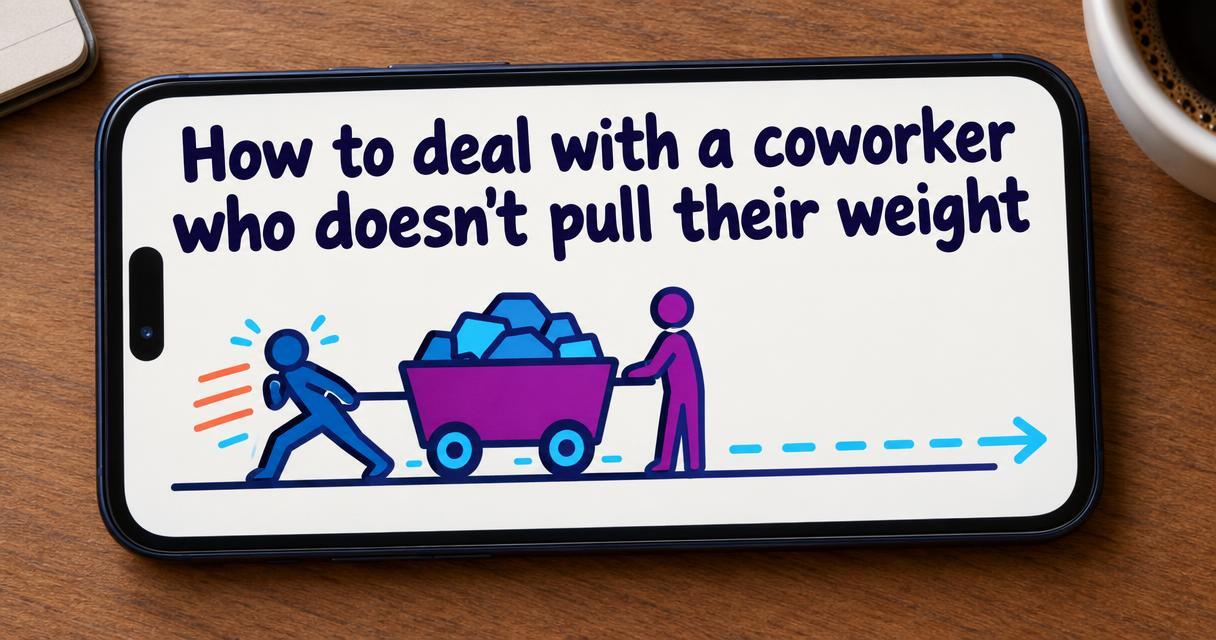
Knowing how to deal with a coworker who doesn't pull their weight starts with stopping the cycle of quietly doing their job for them. You have to address the behaviour directly, set firm boundaries around your own workload, and document the specific impact their missed deadlines have on the team before escalating the issue to management.
Last reviewed November 2026
Key takeaways
- Stop absorbing their unfinished tasks so they experience the natural consequences of their inaction.
- Document specific missed deliverables and project impacts rather than tracking their personal habits.
- Have a private conversation focused on team workflow instead of making personal accusations.
- Escalate to your manager only after you have factual evidence and a clear request for mediation.
You log off exhausted and resentful. You are carrying the mental load of two roles, while a colleague seems to glide through the week without breaking a sweat. Covering for someone else temporarily is part of being in a team. Doing it constantly is a fast track to burnout.
Many of us avoid addressing the imbalance because we do not want to cause drama. We fix the mistakes, quietly work late, and hope someone else notices the problem. But ignoring the issue only guarantees it will continue. At Hey Compono, we know that addressing poor performance requires a balance of clear communication and firm professional boundaries.
Before you confront your colleague, take a step back and look at the situation objectively. Frustration can cloud your judgment. You need to separate personal annoyance from actual professional impact. Someone taking long lunches might be irritating, but it only matters if their absence directly delays your work.
You should address the issue privately and focus on observable behaviour and team impact rather than labelling the coworker "lazy", according to guidance from Workalizer. Look at what is actually being dropped. Is this a new pattern caused by personal stress, or have they always worked this way? A sudden drop in output might point to an overloaded plate or confusion about their role. A chronic lack of effort usually points to a motivation problem.
You also have to admit your own role in the changing. If you always swoop in to save the project at the eleventh hour, your coworker has zero incentive to change. They know you will handle it.

The hardest step in dealing with a slacking colleague is changing your own behaviour. You have to let them drop the ball. If you keep catching it, management will never see the problem, and you will stay overwhelmed.
You should avoid routinely absorbing unfinished work, because solving the coworker's problems can reinforce their dependence on you, as discussed on Reddit. This is incredibly difficult if you take pride in the quality of your team's output. It feels unnatural to submit a project with a glaring hole in it.
When you are asked why a deadline was missed, you need to state the facts plainly. You can say that you completed your section on Tuesday and are waiting for your colleague's data. You do not need to complain or throw them under the bus. You simply report the status of the workflow. If you want to dive deeper into managing your own capacity, read our guide on how to help others without burning yourself out.
You cannot escalate the issue to management without speaking to the person first. They need a fair chance to correct their behaviour. The goal of this conversation is not to punish them. The goal is to figure out why the workflow is broken and agree on a fix.
If you are anxious about addressing the issue, Hey Compono lets you role-play the conversation in private first. Keep the discussion focused strictly on tasks and timelines. Avoid words like "always" or "never".
| What not to say | What to say instead |
|---|---|
| "You never finish your work on time and I have to do it." | "I noticed the client report was delayed because the initial data wasn't ready on Thursday. How can we prevent this next week?" |
| "You are being lazy and leaving me with everything." | "I am feeling overloaded right now. Can we review how we split these five accounts?" |
| "Why didn't you do the presentation slides?" | "I had to complete the slides yesterday to meet the deadline. Was there a roadblock on your end?" |
Listen carefully to their response. They might reveal that they lack training on a specific software, or that another manager is pulling them onto different projects. If you need more strategies for framing these talks, check out our guide on how to give hard feedback to a coworker.
A coworker who doesn't pull their weight can hide more easily in a remote or hybrid environment. Without office visibility, it is harder to see what people are actually doing all day. The solution is moving all task management into shared, visible platforms.
Stop taking requests or updates via private direct messages. Move the conversation into public project channels or tools like Asana, Jira or Monday. When tasks are assigned publicly with clear deadlines, a lack of contribution becomes obvious to everyone. You can quantify the imbalance when possible by noting that one person completed six of eight major tasks despite an agreed even split, a strategy recommended by Twin & Tine.
This visibility protects you. It removes the need for you to complain, because the project management tool tells the story on its own. Some work personalities find this level of transparency uncomfortable at first. If you naturally avoid confrontation, reading about Helper weaknesses and boundary setting can explain why you might struggle to leave tasks visibly incomplete.
You have set boundaries. You have had the direct conversation. You have moved tasks into public view. If the behaviour still has not changed after a few weeks, it is time to escalate.
Managers cannot act on vague complaints about someone having a bad attitude. They need hard evidence. You must document specific incidents with dates, assigned tasks, expected completion times, actual outcomes, and effects on project deadlines or colleagues' work, as advised by Workalizer. Keep a private log of these instances over a two-week period.
When you sit down with your manager, keep your emotions out of it. If the problem persists, bring objective documentation and a specific request to a manager or HR, such as clarified task ownership or mediation, as recommended by PathWise. Frame the issue entirely around team productivity and business outcomes. If the situation has escalated past poor performance and into active hostility, you will need a different approach to resolving conflict with a coworker.
Confronting a colleague about their lack of effort is uncomfortable, and it is easy to stumble over your words in the moment. Our AI coaching app gives you a safe space to practice setting boundaries and giving feedback before you have the real conversation. You can simulate the exact scenario, get real-time advice on your delivery, and walk into the meeting feeling prepared.
Related reading
If your manager ignores the issue, you have to strictly enforce your own boundaries. Focus entirely on completing only your assigned tasks. Communicate your progress clearly in writing, and let the coworker's missed deadlines become visible to wider leadership. Do not burn yourself out trying to cover the gap your manager refuses to manage.
It is petty to track their bathroom breaks or social chats. It is entirely professional to document missed deliverables, ignored emails, and broken deadlines that directly impact your workload. Focus your documentation strictly on business outcomes and workflow bottlenecks, never on personal habits.
Remind yourself that doing their job for them robs them of the opportunity to learn and grow. Accountability is a normal part of holding a job. Letting them face the consequences of their inaction is a professional boundary, not a personal attack on them.
You should almost always talk to your direct manager first. HR is there for policy violations, harassment, or serious workplace disputes. Poor performance and unequal task distribution are management issues. Only escalate to HR if your manager refuses to act and the situation violates company policy or your employment contract.
If they become defensive or angry, stay calm and do not match their energy. Restate your purpose clearly, noting that you want to find a better way to work together. If they refuse to calm down, politely end the conversation and let them know you will involve your manager to help mediate the workflow problem.
To deal with a manager who doesn't manage. Discover practical scripts, remote work strategies, and steps to protect your career from an absent boss.
Learn exactly what to do if your boss doesn't like you. Get conversation scripts, documentation strategies, and steps to protect your career and...
Exactly how to deal with a coworker who takes credit for your work. Get practical scripts, digital paper trail strategies, and expert escalation tips.