
 Mathan Allington

How to tell your boss you made a mistake and rebuild trust
 Mathan Allington
To tell your boss you made a mistake with practical scripts, a three-step framework, and tips to rebuild trust over the next 30 days.
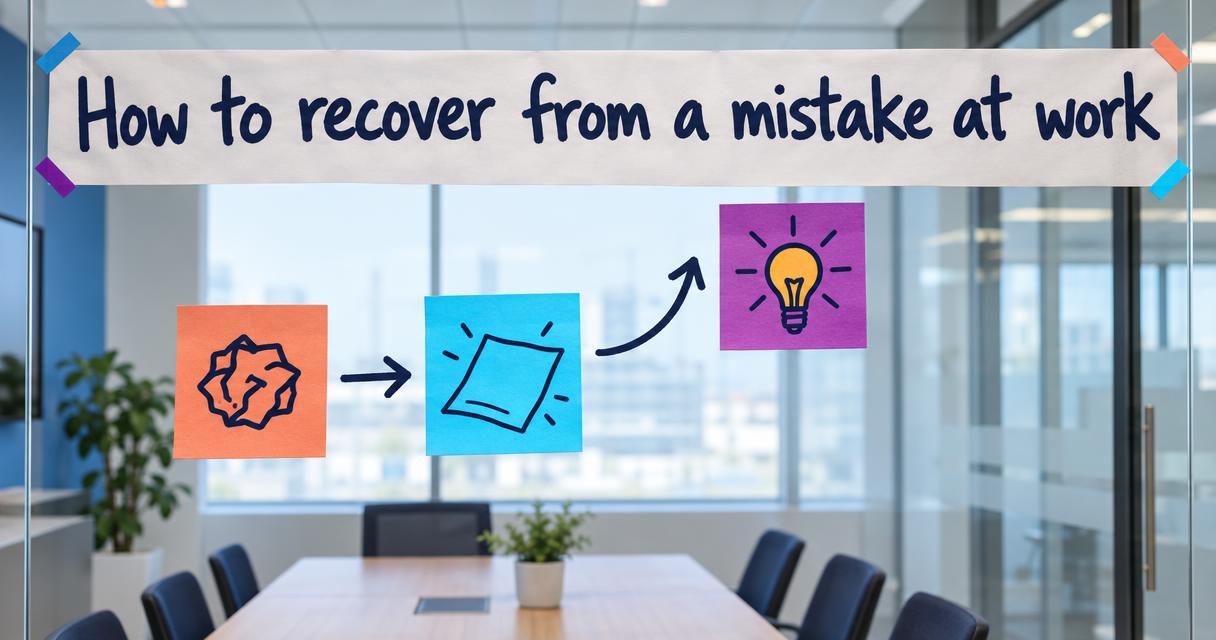
To learn how to recover from a mistake at work, you must own the error immediately, regulate your emotional response, communicate the failure clearly to affected stakeholders, and present a concrete remediation plan.
Last reviewed November 2026
Key takeaways
- Pause and regulate your nervous system before you react, so you can assess the actual damage instead of catastrophising.
- Communicate the error to your manager immediately with a clear, concise apology and a proposed solution.
- Use a root cause analysis framework to identify systemic workplace errors versus individual performance issues.
- Rebuild professional trust over thirty days through consistent follow-through and transparent progress updates.
That sinking feeling in your stomach is universal. You hit send on an email to the wrong client, accidentally delete a database row, or miss a non-negotiable compliance deadline. Panic sets in. Your brain catastrophises and tells you that you are about to be fired.
Psychological safety plays a massive role in how we process these moments. The American Psychological Association found that workers in low-psychological-safety environments were more than twice as likely to feel tense or stressed during a typical workday as those in high-safety environments: 61% versus 27%. When you fear punishment, a minor error feels like a career death sentence.
This same survey revealed that workers reporting low psychological safety were three times as likely to plan to look for a new job within a year. This fear is why people hide mistakes, and hiding mistakes always makes the fallout worse.
The reality is that everyone makes errors. What separates a true professional from an amateur is the recovery. You can fix this, and you can even use it to build stronger trust with your team. Here is exactly how to handle the situation from the first sixty minutes through to a thirty-day recovery plan.
Your immediate reaction to a mistake is usually physiological. Your heart races, your palms sweat, and your brain enters a fight or flight state. If you try to fix the problem in this state, you will likely make impulsive decisions that compound the error.
Step away from your desk for five minutes. Breathe. If you feel yourself spiralling into panic, use cognitive reframing to stop an anxiety spiral. Acknowledge the facts without the catastrophic narrative. The fact is that you missed a deadline. The narrative that you are incompetent and will lose your house is an invention. Your imposter syndrome will flare up, but you are not your mistake.
Our underlying work personalities dictate how we experience this panic. For example, an Auditor might obsess over the minor details they missed and struggle to move past the initial shock. A Campaigner might worry primarily about whether they have lost their manager's respect. Recognising your default reaction helps you bypass it.
Once you are calm, assess the blast radius. Is this a minor slip, a major critical fail, or a legal compliance issue? Distinguishing between a minor typo and a data breach determines your next move. Gather the raw facts quickly. You need to know exactly what happened before you speak to anyone.
The worst thing you can do is wait for someone else to discover your error. You must control the narrative. Transparency shows maturity and accountability. In fact, Boston Consulting Group found that in teams with high psychological safety, employees are encouraged to raise problems and admit mistakes without fear of blame or punishment.
When you approach your manager, leave the self-flagellation at the door. They do not want to manage your emotional breakdown. They want to know what broke and how you plan to fix it. Keep your communication brief, factual, and solution oriented. If you find these moments paralysing, the Hey Compono app helps you practise difficult workplace conversations with AI so you can find the right words before you face your boss.
Here are conversation templates to use based on the severity of the mistake.
| Severity level | Who to tell | Script template |
|---|---|---|
| Minor slip-up | Direct manager | "I noticed I made an error on X. I have already corrected it by doing Y, and it will not delay the final project." |
| Impact on a peer | Colleague and manager | "I messed up the data in the report I sent you. I apologise for creating extra work. I am pulling the correct numbers now and will have them to you by 2 PM." |
| Major critical fail | Manager and stakeholders | "I made a mistake with X, which has impacted Y. I take full responsibility. My proposed solution is Z. I need your approval to begin the fix immediately." |
| Legal or compliance breach | Manager, Legal, IT | "We have a compliance incident regarding X. The error occurred at this time. I have stopped the process and need immediate guidance on the mandatory reporting steps." |
Notice that none of these scripts include excuses. Never blame another department, a confusing brief, or your lack of sleep. Just state the facts and present the solution. If the mistake requires a formal apology to a client, draft it with your manager to ensure it meets company standards.
Once the immediate fire is out, you need to figure out why the mistake happened. This step transitions the situation from a failure into a process improvement. When you can explain the mechanics of the error, you prove to leadership that you are actively learning from it.
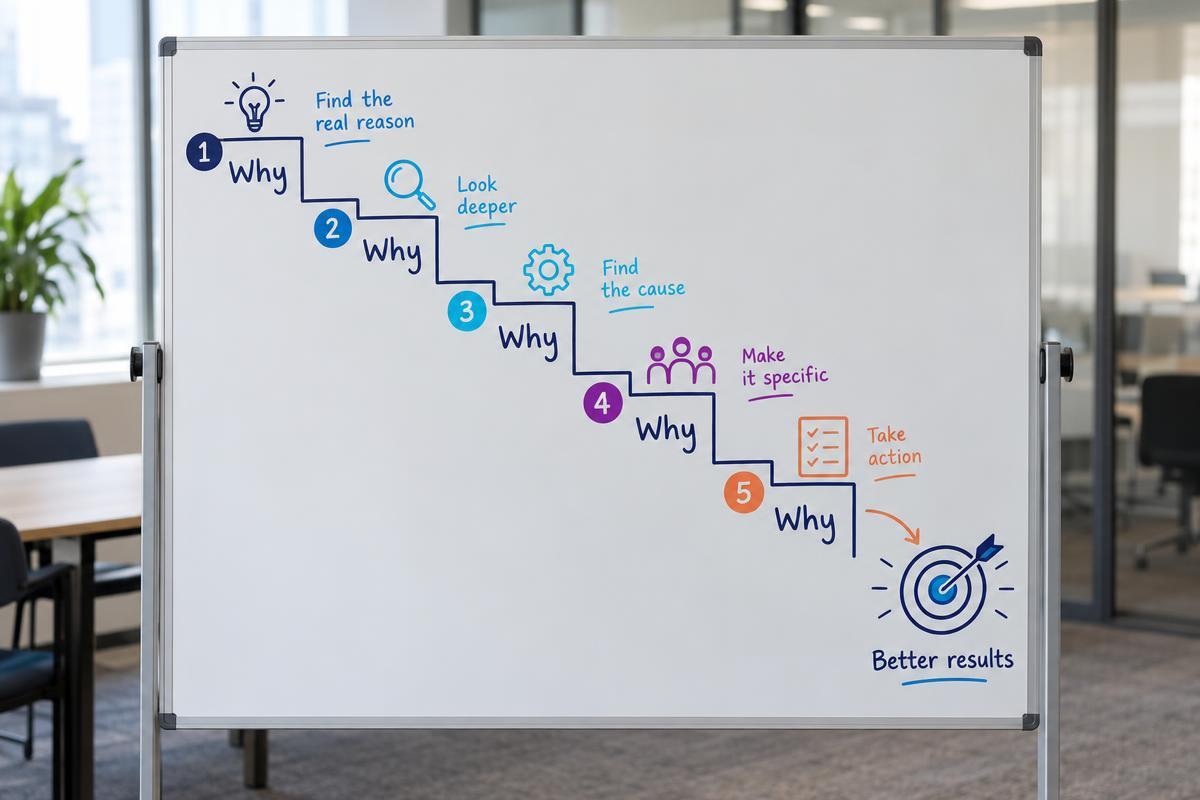
A proven method for this is the Five Whys framework. Instead of resting on a surface-level excuse, you ask "why" five times to drill down to the actual systemic issue. Here is how it looks in practice.
The problem is that the wrong report was sent to the client. Why? Because the files were named identically. Why were they named identically? Because we do not have a standard naming convention for final drafts. Why do we not have a standard convention? Because the team grew rapidly and we never formalised the onboarding document. Why was it not formalised? Because there is no central owner for our operations manual.
Suddenly, this is no longer just an individual performance issue. It is a systemic workplace gap. When you present this root cause analysis to your manager, you change the conversation. You are no longer the person who messed up the report. You are the person who identified a critical flaw in team operations and proposed a new naming convention.
As Ed Catmull from Pixar observed, “Failure in hindsight is a teacher, failure in prospect is a threat”. Choose to let it be a teacher.
A good apology stops the bleeding. Consistent action heals the wound. Trust is built through predictability, and when you make a mistake, you briefly become unpredictable. Your goal over the next thirty days is to prove your reliability.
In week one, focus purely on execution. Deliver your work flawlessly, even if it means checking your outputs three times. Over-communicate your progress on the remediation plan. Do not make your manager chase you for updates. Send a daily end-of-day summary until the issue is fully resolved.
By week two, you can begin to ease back into your normal rhythm, but keep your standards high. This is often when the fear of messing up at work kicks in again. You might find yourself second-guessing every decision. If you are struggling to regain your confidence, take time to understand how you naturally respond to stress so you can manage those triggers. Using Hey Compono for personal coaching can help you unpack these feelings safely.
In week three, repair any relationships that were strained by your error. If a colleague had to work late to help you fix a database issue, take them out for a coffee. Acknowledge their effort and thank them properly. People respect a colleague who remembers a favour.
At the end of week four, schedule a brief follow-up with your manager. Revisit the mistake objectively. Ask them if they are satisfied with the new processes you started and if there are any lingering concerns. This kind of consistent follow-through over time is exactly what helps restore your manager's belief in your competence. Bouncing back at work is a deliberate choice, not an accident.
Your career is decades long. A single mistake, even a highly visible one, is just a data point. When you reflect on the most capable leaders in your organisation, you will find people who have made massive errors. The difference is that they learned how to recover from a mistake at work without letting it destroy their professional identity.
It is easy to hold onto the shame. We often punish ourselves long after our manager has moved on. If you find yourself bringing up the error weeks later, stop. You have apologised. You have fixed the process. You have demonstrated reliability. Forgive yourself and get back to doing great work.
Admitting a mistake to your boss is intimidating, but practicing the conversation first takes the heat out of the moment. Hey Compono's AI coaching helps you role-play these tough discussions in private, so you can walk into the real meeting calm, prepared, and ready with a solution.
Related reading
A professional apology is brief, factual, and forward-looking. Acknowledge the error directly without making excuses, explain the immediate steps you have taken to fix it, and outline how you will prevent it from happening again. Avoid over-apologising or centreing your own feelings of guilt.
In most healthy workplaces, honest mistakes do not lead to termination, especially if you own up to them immediately and provide a solution. However, covering up an error, repeatedly making the exact same mistake, or violating major legal compliance regulations can put your job at risk.
Regaining confidence requires small, consistent wins. Focus on executing your daily tasks reliably and lean into your natural strengths. It also helps to conduct a root cause analysis so you understand exactly why the error occurred, which removes the fear that it might happen again randomly.
Yes. Controlling the narrative is always better than being caught out. When you bring an unnoticed mistake to your manager along with a concrete plan to fix it, you demonstrate integrity and problem-solving skills, which builds long-term trust.
An individual error occurs when a clear process exists but you fail to follow it. A systemic issue occurs when the process itself is flawed, undocumented, or sets employees up to fail. Using the Five Whys framework can help you determine if your mistake was caused by a deeper operational gap.
To tell your boss you made a mistake with practical scripts, a three-step framework, and tips to rebuild trust over the next 30 days.
Learn exactly how to deal with a passive aggressive coworker. Get practical scripts, learn when to involve HR, and find out how to protect your...

How AI platforms to upskill new leaders without live coaches can scale support, improve retention, and provide safe roleplay practice.